8th Pay Commission: Can Level 10 Pensioners See a Rs 56,000 Monthly Payout Increase?
Proposals submitted by central government employee federations suggest revising pension computation formulas under the 8th Central Pay Commission, potentially boosting monthly retirement payouts for Level 10 personnel by up to Rs 56,000.
In this piece
Central government staff associations have submitted demands urging the 8th Central Pay Commission to overhaul pension calculations, with some seeking payouts…
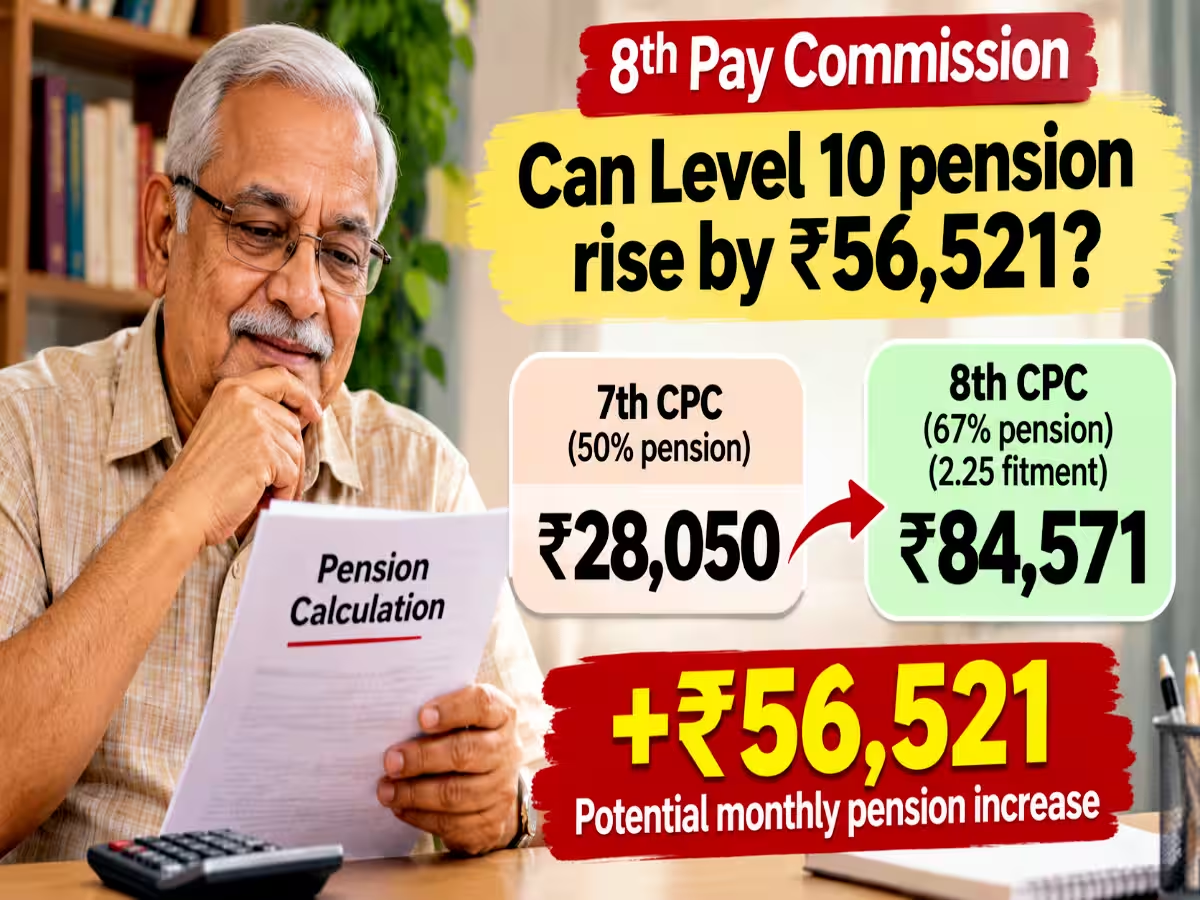
Central government employees and pensioner federations are pressing the newly constituted 8th Central Pay Commission to rethink the longstanding pension calculation framework. Analytical models and employee union submissions indicate that if proposed revisions and enhanced fitment factors are accepted, retired personnel in the Pay Level 10 bracket could see their monthly pension payouts rise by approximately Rs 56,000 compared to 7th Pay Commission baselines.
The potential windfall stems from formal representations submitted by prominent staff bodies, including the Bharatiya Pratiraksha Mazdoor Sangh and railway supervisors associations. These groups are advocating for an upward adjustment in the basic pension computation rate, urging the commission to consider benchmarks as high as 60 to 67 percent of the final basic pay drawn, rather than capping retirement payouts at the traditional 50 percent threshold.
Under the existing 7th Central Pay Commission matrix, Level 10 marks an important compensation threshold, typically representing entry-level Group A gazetted officers and senior administrative staff. The entry basic pay for Level 10 stands at Rs 56,100 per month, resulting in a standard minimum basic pension of Rs 28,050 prior to the addition of dearness relief allowances.
When projecting outcomes under the 8th Central Pay Commission, analysts evaluate the interaction between a revised fitment factor and the proposed increase in pension percentages. If a revised basic salary scale is established using an estimated fitment multiplier and combined with a higher calculation percentage, the monthly pension for Level 10 retirees would substantially eclipse current disbursements, yielding the projected Rs 56,000 incremental increase.
The fitment factor remains the central mathematical variable in revising central government pay and pension scales across successive commissions. During the implementation of the 7th Pay Commission, the government applied a common fitment factor of 2.57 to revise existing salaries, though employee federations have consistently demanded a higher multiplier to offset sustained inflationary pressures over the past decade.
The Union government constituted the 8th Central Pay Commission under the chairmanship of retired Supreme Court Justice Ranjana Prakash Desai to examine compensation structures for millions of central staff and pensioners. The panel faces the delicate task of balancing the financial welfare of public sector personnel against the broader fiscal obligations of the exchequer.
For retired civil servants and armed forces personnel, pension revisions represent a vital hedge against rising healthcare costs and living expenses. However, any structural shift away from the 50 percent formula would significantly amplify the government's recurring pension liabilities, prompting close scrutiny from the finance ministry before any formal policy changes are considered.
Financial analysts and administrative experts caution that the circulating figures remain strictly hypothetical calculations derived from union memorandums and digital estimation tools. The government has neither notified an official fitment factor nor signaled any formal intent to discard the existing 50 percent pension computation norm.
The commission is conducting consultations with stakeholder ministries, defense representatives, and employee federations as it compiles its exhaustive recommendations. A final report is expected to be submitted to the Union Cabinet around mid-2027, after which the government will deliberate on the formal implementation timelines, retrospective arrears, and revised pay matrices.
Primary source: Economic Times. Newzly rewrites and structures source reporting for clarity; verify critical details at the original.