Aging Gear Overload Triggered Longest US Flight Ground Stop Since 9/11
An overload of aging telecommunications hardware caused the longest nationwide U.S. flight ground stop since 2001, federal officials said, ruling out a cyberattack or external software outage after thousands of flights were grounded.
In this piece
Federal officials confirmed that outdated telecommunications equipment overloading under heavy data strain triggered the longest nationwide U.S. flight ground…
A catastrophic telecommunications failure caused by aging hardware overloading under data strain triggered the longest nationwide U.S. flight ground stop since September 11, 2001, federal transportation officials confirmed. The Federal Aviation Administration ordered domestic departures halted after critical radar and communication links began faltering across regional air traffic control centers. The sweeping stoppage disrupted travel for an estimated 1.5 million passengers before technical teams restored core operations.
Government officials swiftly addressed public safety concerns, explicitly ruling out a cyberattack, malicious intrusion, or widespread vendor software crash as the root cause. Transportation Secretary Sean Duffy and Homeland Security Secretary Markwayne Mullin emphasized that the outage was an internal technical malfunction. Authorities confirmed that the emergency order was enacted strictly as a precaution while engineers stabilized compromised data lines.
The crisis developed when regional air route traffic control facilities experienced sudden instability in the feeds that deliver flight data and radar tracking to controllers. Rather than risk tracking commercial airliners with corrupted or inconsistent information, air traffic supervisors chose to halt all departing aircraft nationwide. More than 3,500 planes that were already airborne when the order was issued continued under safe guidance and landed without incident.
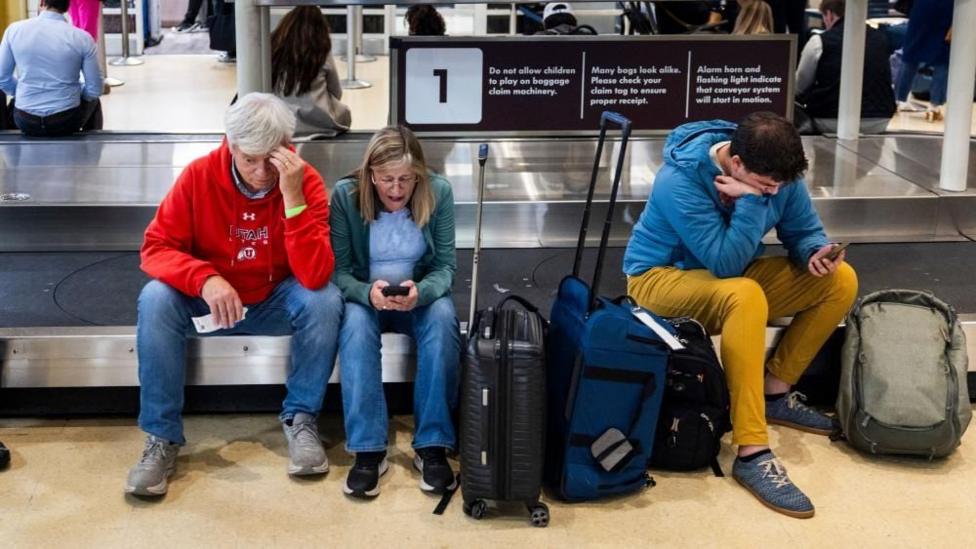
The ground stop remained in effect for roughly four hours before the agency lifted restrictions later that evening as systems regained stability. Despite the relatively rapid technical recovery, the halt triggered cascading operational snarls across every major domestic airport. Over 10,000 flights were delayed or cancelled, stranding travelers nationwide and leaving aircraft stranded far from their scheduled hubs.
Investigators traced the source of the breakdown to legacy telecommunications equipment, including vintage switches and routers connected by older copper lines dating back decades. Secretary Duffy noted that these older systems became heavily overloaded when forced to handle high volumes of modern digital data. Secretary Mullin added that ongoing efforts to integrate new digital technology into the national network placed unexpected strain on the older backbone.
The failure highlights the mounting fragility of the nation's core aviation infrastructure, which has long relied on patched-together legacy systems to manage modern air traffic volumes. Industry analysts noted that while air traffic volume has surged over recent decades, key components of the federal airspace network still depend on analog architecture. The dramatic shutdown served as an uncomfortably visible reminder of how vulnerable national mobility remains to isolated technical choke points.
Federal leaders pointed to the incident to renew calls for comprehensive federal funding to overhaul the air traffic management system. Duffy estimated that modernizing the entire national airspace infrastructure could require upwards of $50 billion in dedicated investment. Lawmakers and industry stakeholders have repeatedly debated modernisation packages, but transitioning away from decades of entrenched hardware has proven historically complex.
International air hubs also felt the ripple effects of the American ground stop, with global aviation authorities holding back U.S.-bound departures. European air traffic coordinator Eurocontrol and major transit hubs in the Asia-Pacific region slowed or paused flights until American airspace systems cleared the bottleneck. The coordinated response illustrated how localized infrastructure failures in the United States can disrupt global airline schedules within hours.
Airlines warned that the operational hangover from the four-hour ground stop would take several days to fully resolve. With aircraft displaced across dozens of terminals, carriers faced the logistical challenge of repositioning planes while complying with federal duty-hour limits for pilots and flight attendants. Passenger advocacy groups urged travellers to verify their flight statuses directly with carriers as airlines worked through deep rolling delays.
Federal aviation inspectors and telecommunications engineers are conducting a forensic review of the affected switches to prevent identical overloads during high-traffic periods. Regulators intend to evaluate fail-safes and communication redundancy across all regional control centers to ensure aging links can manage future traffic spikes. In the meantime, transportation officials maintain that the air traffic system remains safe, even as they press for long-term modernization.
Primary source: BBC US & Canada. Newzly rewrites and structures source reporting for clarity; verify critical details at the original.