Agweb Debuts as Background Browser Designed for Autonomous AI Agents
A developer has launched Agweb, an open-source macOS browser engineered to let autonomous AI agents navigate the web quietly in the background without stealing keyboard focus or draining system resources.
In this piece
Open-source developer paul-nameless has debuted Agweb, a WebKit-powered browser built specifically for autonomous coding agents on macOS. The application runs…
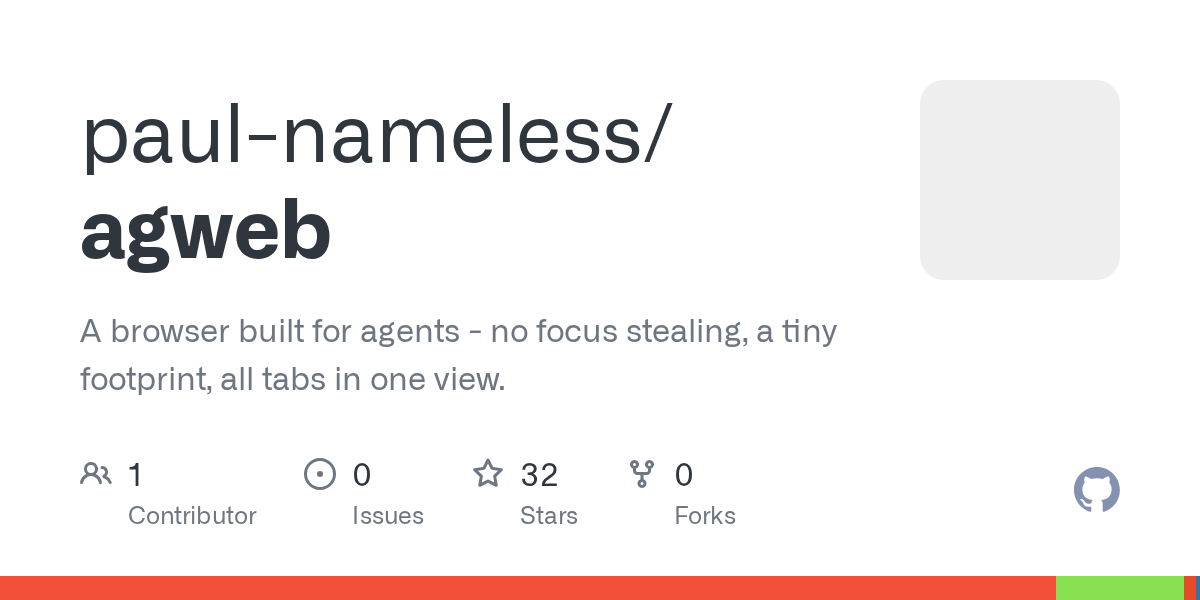
An open-source developer operating under the handle paul-nameless has introduced Agweb, a lightweight web browser engineered specifically to run autonomous software agents without disrupting human computer users. Released publicly on GitHub and showcased on Hacker News, the project seeks to eliminate common friction points encountered when artificial intelligence systems browse the web alongside everyday desktop activity.
Built around the native WebKit engine on macOS, Agweb operates as a dedicated agent environment rather than relying on standard desktop browser installations. Instead of launching intrusive visual windows that seize keyboard focus and disrupt ongoing work, the application runs discreetly in the background while executing automated browsing instructions.
Engineers interact with the browser directly from the terminal through a dedicated command-line interface modeled after familiar automation utilities such as Playwright CLI. Alongside terminal-driven controls, Agweb provides an overview dashboard that lets users monitor active sessions, observe real-time operational statuses, and inspect recent instructions executed across several agents simultaneously.
System resource management represents a core focus of the project's architecture. Conventional browser automation setups utilizing heavy Chromium processes frequently drain system memory and central processing units, especially when orchestrating multiple concurrent tasks. Agweb mitigates this strain by proactively throttling and suspending inactive agent tabs, preserving workstation performance over prolonged workflows.
Beyond resource efficiency, the browser incorporates input simulation capable of mimicking native macOS mouse and keyboard movements. These human-like interactions allow automated agents to traverse complex web interfaces smoothly, reducing failures triggered by conventional headless browser drivers and programmatic scraping tools.
Credential handling and user security are also built directly into the software's foundational design. Agweb supports authenticated browsing sessions through persistent named profiles and connects with standard password managers, including 1Password and Bitwarden. The integration ensures that sensitive login credentials remain shielded from model prompts and execution logs.
To streamline page rendering and insulate automated tasks from web clutter, the browser incorporates native filtering powered by uBlock Origin rule sets. By systematically blocking advertising networks and intrusive tracking scripts, the tool accelerates loading speeds while preventing irrelevant visual noise from confusing automated parsing routines.
The launch of Agweb reflects a broader transition across the software industry toward localized, autonomous development assistants capable of researching and executing online tasks. As developers integrate more background agents into their daily toolchains, dedicated tooling designed to coexist seamlessly with standard operating environments is emerging as an essential infrastructure requirement.
Although the current version of the browser remains tailored to macOS and its underlying WebKit framework, early interest across developer forums indicates strong community appetite for agent-native browser runtimes. The project's long-term utility will likely hinge on community contributions and potential support for cross-platform environments as autonomous developer workflows continue to mature.
Primary source: Hacker News. Newzly rewrites and structures source reporting for clarity; verify critical details at the original.