Akai Embraces Modding Community With MPC Sample 1.4 Firmware
Akai Professional has released the MPC Sample 1.4 firmware update, introducing beta support for custom community effects and an official plugin SDK to embrace independent hardware modders.
In this piece
Akai has released firmware update 1.4 for the MPC Sample, adding an official Plugin Builder SDK and support for custom community Knob FX. The update embraces…
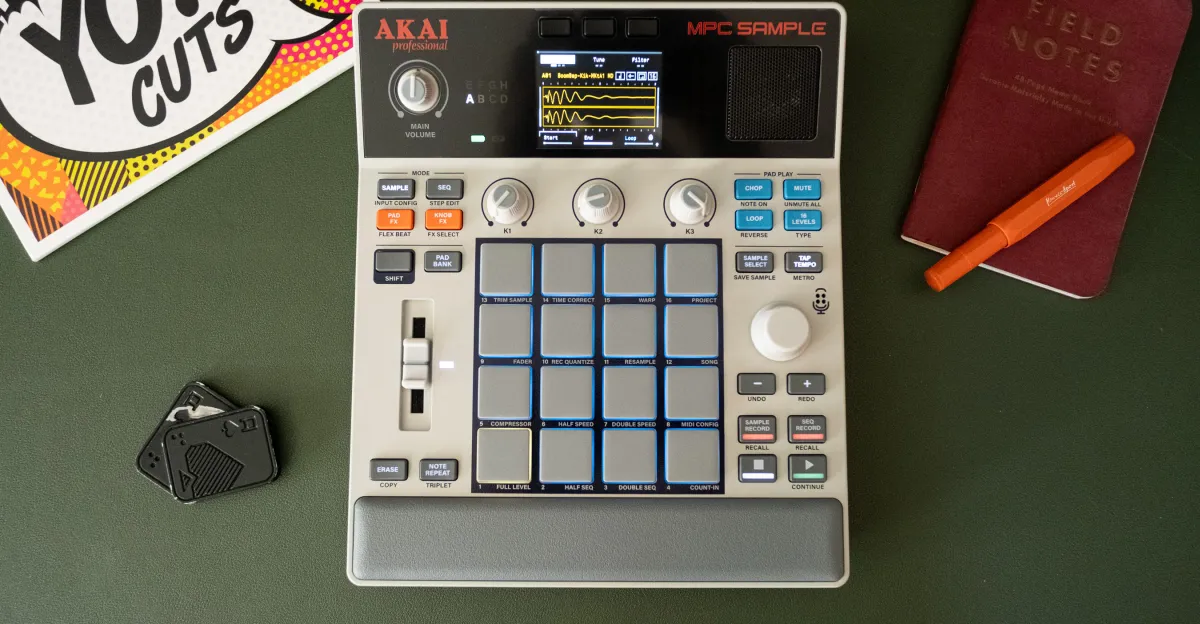
Akai Professional has released firmware version 1.4 for the MPC Sample, officially rolling out developer tools and beta support for custom community effects. The release marks a notable strategic pivot for the hardware manufacturer, which has chosen to openly embrace third-party modding rather than restrict unofficial modifications on its most accessible sampler.
Central to the 1.4 update is the beta debut of the MPC Plugin Builder software development kit alongside support for community-built Knob FX plugins. Through the device's MIDI configuration menu, beatmakers can now load and assign custom effects designed by independent programmers, significantly broadening the portable sampler's sound-design capabilities without requiring external computer processing.
The firmware also delivers specialized developer tools directly into the instrument's interface. Programmers and technical musicians can leverage USB remote access, diagnostic internal monitoring, screen capture functions, and remote audio and display sharing, giving creators the visibility required to test and refine bespoke audio software on physical hardware.
To complement the custom plugin architecture, Akai has integrated a resample and flatten pad capability. The workflow enhancement allows producers to render a pad and its active Knob FX processing directly into a fresh audio sample, bypassing single-effect limitations and enabling complex multi-effect layering directly inside the standalone environment.
The update extends beyond developer utilities to introduce several practical enhancements for everyday production workflows. A new sequence-length recording auto-play mode provides an intuitive looper-style workflow for spontaneous composition, while newly added 16-level tune scale modes offer expanded harmonic and melodic options across the hardware pads.
Operational transparency has also been improved to assist both developers and live performers in maintaining performance stability. A real-time hardware usage monitor now tracks processor, memory, and storage demands, complemented by dedicated preview volume controls during sample selection and audible event monitoring within the step editing menu.
The MPC Sample has steadily evolved into an unexpected favorite among software tinkerers and portable beatmakers seeking affordable standalone production gear. Earlier versions inspired enthusiasts to create unofficial operating systems and specialized SD-card modifications, establishing the budget-friendly instrument as a versatile testbed for independent music technology experiments.
Akai's decision to support user-generated software reflects a progressive approach within the electronic instrument industry. While manufacturers often restrict standalone hardware to safeguard proprietary ecosystems, releasing an official development kit invites long-term community innovation and extends the usable lifespan of portable electronic instruments.
The architectural transition nevertheless introduces practical adjustments for musicians who currently rely on informal community modifications. Technical documentation notes that several legacy mods and custom operating system builds crafted for firmware version 1.3 may need to be recompiled or adapted against the 1.4 binary base before functioning reliably.
Looking ahead, Akai is expected to continue refining the Plugin Builder SDK as feedback arrives from early developers and electronic music communities. By transforming an entry-level sampler into an adaptable, user-programmable platform, the company is bridging the gap between mainstream hardware production and grassroots music software culture.
Primary source: The Verge. Newzly rewrites and structures source reporting for clarity; verify critical details at the original.