world·Mississippi·Orleans Parish
Miracle on the Mississippi: All Accounted for After Tanker Hits Docked Cruise Ship
All passengers and crew are safe after an asphalt tanker collided with a docked river cruise ship in New Orleans, causing the paddlewheeler to capsize on the Mississippi River.
In this piece
All passengers and crew members survived without fatal injuries after an asphalt tanker struck a docked river cruise ship on the Mississippi River in New…
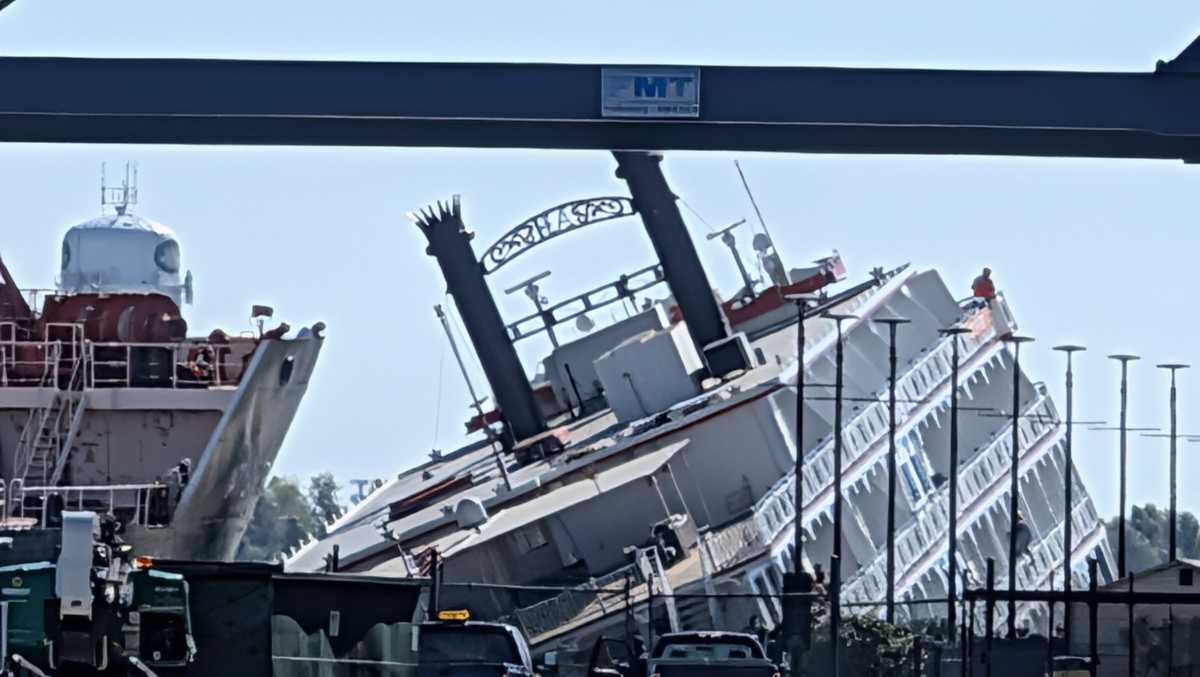
All passengers and crew members have been accounted for after an asphalt tanker collided with a docked river cruise ship on the Mississippi River in New Orleans, sending people into the water and causing the riverboat to capsize. Local officials confirmed that no fatalities occurred despite the violent impact, which caused the paddlewheeler to quickly roll onto its side. Authorities described the complete survival of everyone aboard as an astonishing outcome.
The incident occurred at approximately 12:30 p.m. local time just downriver from the Crescent City Connection bridge. The tanker ship Atlantic Asphalt reportedly suffered a loss of steering capabilities before drifting directly into the path of the American Heritage, an authentic paddlewheel vessel operated by American Cruise Lines. The cruise ship was moored alongside the riverbank, where passengers were in the process of disembarking at the conclusion of an eight-day cruise.
The force of the tanker's bow tore into the superstructure of the riverboat, breaching its hull and sending immediate shockwaves through the vessel. The riverboat began rapidly taking on river water, listing heavily within moments of the collision before settling on its side against the dock. The sudden shift threw several passengers, crew members, and dockside personnel directly into the river's swift, sixty-six-degree currents.
A chaotic yet swift rescue operation began immediately as local maritime workers and commercial crews sprang into action. Tugboat operators working along the waterfront rushed toward the scene, deploying life rings and pulling struggling individuals from the churning river before municipal responders reached the water. They were quickly joined by harbor police, the New Orleans Fire Department, and the United States Coast Guard in coordinating a unified triage and retrieval effort.
Emergency medical personnel transported thirty-two individuals to area hospitals for medical evaluation and treatment of non-life-threatening injuries. Officials stated that thirty passengers and two responding police officers were treated for minor cuts, contusions, and mild hypothermia resulting from immersion in the chilly river water. By late Friday, hospital officials confirmed that all admitted patients were in stable condition and expected to recover fully.
New Orleans Mayor Helena Moreno praised the coordinated heroism of first responders and nearby civilian mariners who prevented what could have been a catastrophic tragedy. Louisiana Governor Jeff Landry echoed the sentiment, officially dubbing the rescue the Miracle on the Mississippi and acknowledging the speed of emergency operations along the riverfront. Both officials emphasized that rapid interagency coordination averted significant loss of life in one of the country's busiest commercial waterways.
The Mississippi River through New Orleans represents one of the most heavily trafficked maritime corridors in the world, where commercial freight vessels constantly navigate alongside tourist ships. River cruises have expanded significantly in popularity over recent years, drawing thousands of travelers annually to multi-day regional voyages departing from the city's historic riverfront. Friday's collision highlights the complex operational hazards posed when heavy industrial shipping and passenger travel intersect in close quarters.
Harbor teams and environmental specialists deployed containment booms around the partially submerged American Heritage to manage potential fuel or oil spills along the shoreline. Officials reported that the Atlantic Asphalt sustained minor bow damage and was anchored under Coast Guard supervision while inspectors evaluated its hull integrity. Initial aerial and water assessments detected no catastrophic petroleum discharges into the river ecosystem.
The National Transportation Safety Board and the United States Coast Guard have launched a formal joint investigation into the mechanical and operational causes of the collision. Investigators plan to examine navigation logs, engine telemetry, and steering systems aboard the Atlantic Asphalt to determine why the tanker lost control. Salvage crews are also coordinating plans with federal authorities to safely stabilize, refloat, and remove the capsized cruise ship from the dock.
Primary source: Google News Mississippi. Newzly rewrites and structures source reporting for clarity; verify critical details at the original.