world·Arunachal Pradesh·Papum Pare District
Amit Shah Inaugurates NDRF 12th Battalion Campus in Arunachal Pradesh
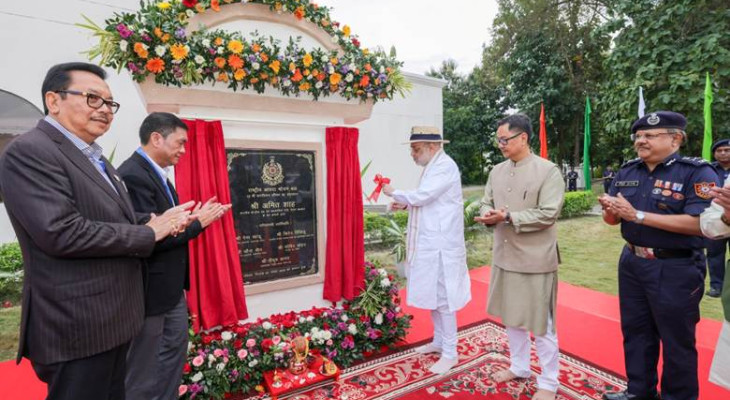
Union Home Minister Amit Shah inaugurated the permanent campus of the NDRF's 12th Battalion in Arunachal Pradesh, establishing a high-readiness disaster management and regional training hub in the Eastern Himalayas.
In this piece
Union Home Minister Amit Shah has inaugurated the permanent campus of the 12th Battalion of the National Disaster Response Force at Hollongi in Arunachal…
Union Home Minister Amit Shah inaugurated the newly constructed permanent campus of the 12th Battalion of the National Disaster Response Force in Hollongi, Arunachal Pradesh. The state-of-the-art facility is positioned to serve as a vital operational hub for disaster response and emergency relief across the northeastern frontier. Addressing senior officials, force personnel, and local dignitaries, Shah noted that the installation represents a critical step in safeguarding vulnerable highland communities against recurrent environmental hazards.
The battalion's new base is located near Itanagar in the Papum Pare district, strategically situated near Donyi Polo Airport to enable rapid deployment of personnel and life-saving equipment during regional emergencies. Built with earthquake-resistant engineering standards, the campus is designed to endure high seismic activity while maintaining uninterrupted emergency coordination centers. The infrastructure accommodates personnel barracks, tactical operations rooms, advanced medical stations, and dedicated equipment warehousing.
Beyond serving operational duties, the Hollongi facility has been designated as a central training institute for the State Disaster Response Forces of all eight northeastern states. Personnel from Assam, Meghalaya, Manipur, Mizoram, Nagaland, Tripura, Sikkim, and Arunachal Pradesh will receive specialized instruction in mountain rescue, flood evacuation, and landslide mitigation. Officials noted that standardized training protocols are intended to create seamless interoperability between federal and state teams during joint rescue operations.
Shah emphasized India's comprehensive transition in disaster management philosophy, moving away from historic post-calamity relief models toward proactive mitigation and risk reduction. He highlighted the central government's adoption of a targeted zero-casualty approach, which prioritizes early warning dissemination and pre-emptive evacuations ahead of catastrophic weather phenomena. The Home Minister affirmed that investments in space science, meteorological modeling, and telecommunication networks now form the backbone of national crisis preparedness.
The northeastern region remains exceptionally prone to severe natural adversities, including cloudbursts, massive landslides, flash flooding, and high-intensity earthquakes along fragile Himalayan fault zones. Establishing a permanent, fully equipped federal force base in Arunachal Pradesh addresses longstanding logistical bottlenecks caused by remote terrain and road blockages. Emergency responders stationed at the new base will be able to mobilize within minutes to reach cut-off mountain valleys.
During the ceremonial inspection, the Home Minister also commended the force for integrating civic welfare initiatives into its infrastructural layout. In particular, the facility includes an Olympic-size swimming pool and a deep-water diving tank that will be made accessible without charge to regional athletes and youth from nearby towns. Authorities noted that opening these aquatic training amenities to the public will foster local swimming talent while building community trust with the rescue personnel.
The inauguration was accompanied by the rollout of broader developmental projects across Arunachal Pradesh, highlighting the administration's strategic focus on border-area connectivity and community empowerment. Shah unveiled the Arunachal Pradesh Cooperative Vision Document 2027 and opened the Saras Mela during his regional itinerary, underscoring efforts to expand rural markets and cooperative societies. State leaders and administrative officials emphasized that regional resilience depends equally on physical infrastructure and economic stability.
Union and state authorities reiterated their commitment to strengthening border security and frontier community welfare under ongoing vibrant village frameworks. By improving roads, power supplies, digital connectivity, and disaster shelters, the administration aims to curb outmigration from remote mountain settlements. Officials emphasized that robust disaster response mechanisms provide frontier populations with greater security and reassurance during seasonal monsoons.
The operationalization of the 12th Battalion headquarters marks an important milestone in modernizing India's specialized disaster response architecture. As weather extremes become more unpredictable across the Eastern Himalayas, disaster management authorities anticipate that the Hollongi campus will significantly reduce turnaround times during future relief missions. The facility is set to commence regular field training modules and regional multi-agency coordination drills in the coming weeks.
Primary source: Google News Arunachal Pradesh. Newzly rewrites and structures source reporting for clarity; verify critical details at the original.