business·Delhi·New Delhi District
Asia’s diplomatic board draws India, the US, China and Russia at once
An Economic Times report frames a crowded stretch of Asian diplomacy, with India, the United States, China and Russia all active as ASEAN, the Quad and trade sit at the center of the maneuvering.
In this piece
Economic Times describes Asia as the stage for a four-sided power play involving India, the United States, China and Russia. The account points to Prime…
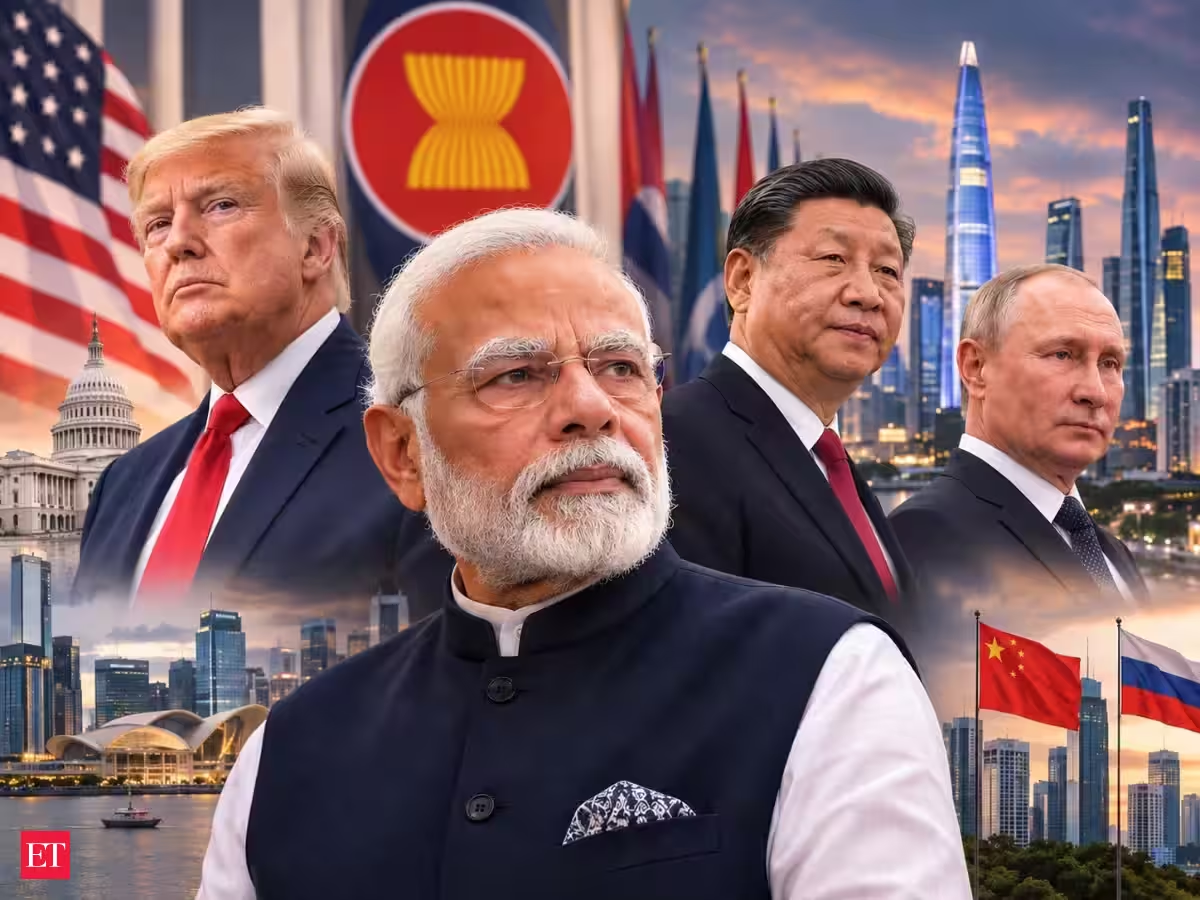
Asia is again the main board for great-power diplomacy, with India, the United States, China and Russia all in motion at the same time, according to an Economic Times report headlined around four big players on the region’s diplomatic chessboard.
The newspaper’s account, published in its India news section, ties Prime Minister Narendra Modi’s engagement with ASEAN to a wider contest that also names Donald Trump, Xi Jinping and Vladimir Putin. The framing places New Delhi, Washington, Beijing and Moscow on overlapping tracks rather than in a single negotiated setting.
The report’s own description points to ASEAN-India ties, the Quad, trade, and the Russia-China-US triangle as the issues pulling Asia to the center of a high-stakes global power play. It does not, in the material available for this article, set out a joint communique, a new treaty text or a timetable agreed by all four capitals.
That absence matters. Simultaneous activity is not the same as a four-way summit. Leaders can shape the same week’s headlines while pursuing separate bilateral agendas, and the Economic Times presentation treats the overlap itself as the story.
For India, an ASEAN-centered moment is a familiar way to stay present in Southeast Asia without reducing foreign policy to any one partnership. The Quad remains part of the same picture in the report’s keywords, which also keep trade, Russia, China and the United States in view. How those strands are being sequenced is not spelled out beyond that framing.
The United States appears in the account through Trump, and China and Russia through Xi and Putin, including a reference to Putin in a China context. The report does not supply quotes, concession lists or descriptions of what each capital offered or withheld.
Trade is listed alongside security and summitry, which fits a region where market access, supply chains and strategic alignment are negotiated in parallel. The Economic Times piece signals that commercial questions are inside the power play. It does not enumerate tariffs, deals or disputes in the text available here.
The stakes are structural. Southeast Asia and the wider Indo-Pacific are where India’s multi-alignment, US competition with China, and Russia’s effort to keep Asian partners all have to coexist. A crowded calendar raises the chance of mixed signals even when no single meeting is designed to settle the rivalry.
Readers should treat the “four big players” line as the newspaper’s organizing idea, not as confirmation that Modi, Trump, Xi and Putin have struck a common position. Nothing in the source material provided for this rewrite establishes such an agreement.
What happens next depends on the separate tracks the report flags: India’s ASEAN engagement, Quad-related diplomacy, and the trade and great-power contacts involving the United States, China and Russia. Economic Times presents Asia as the stage. The specific results of each encounter were not included in the material used for this article.
Primary source: Economic Times. Newzly rewrites and structures source reporting for clarity; verify critical details at the original.