world·Haryana·New Delhi District
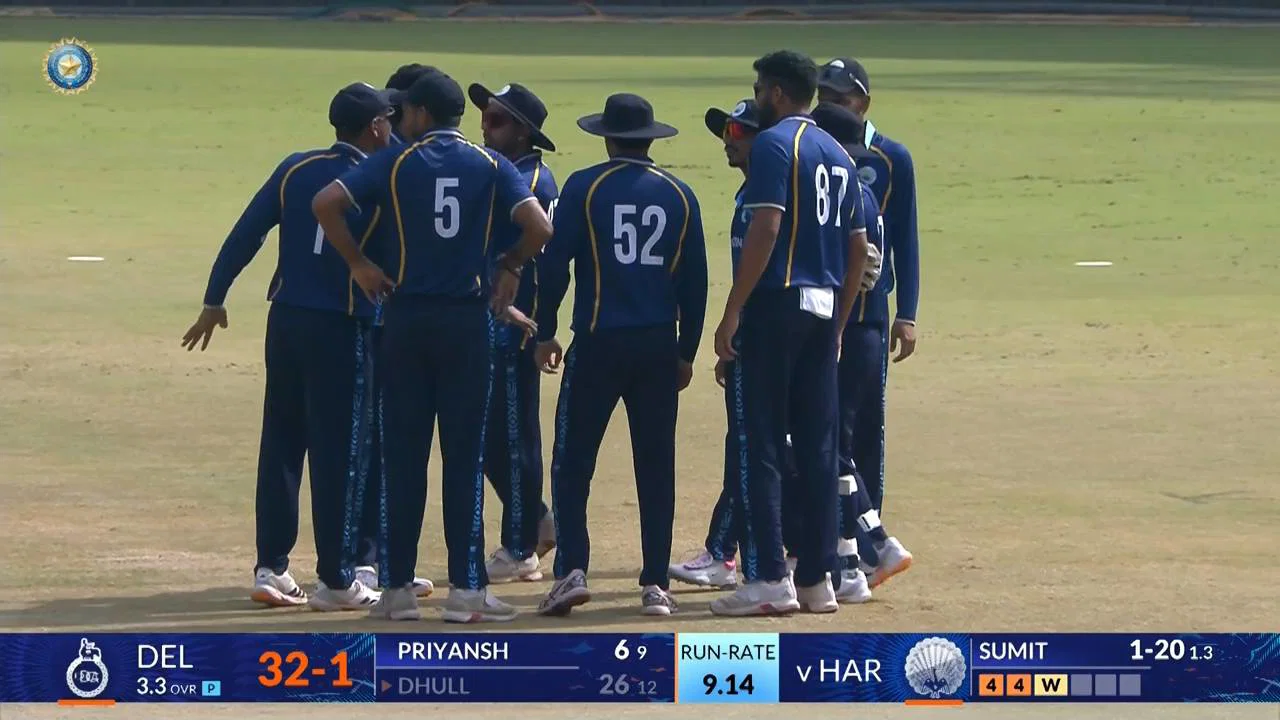
BCCI posts fall of wickets for Delhi vs Haryana in SMAT 2026
A BCCI item lists the fall of wickets for the Syed Mushtaq Ali Trophy meeting of Delhi and Haryana. The news feed names the fixture but does not carry the dismissal order or a result.
In this piece
BCCI material indexed under SMAT 2026 points to a fall-of-wickets card for Delhi against Haryana. The available headline does not include scores, batters, or…
The Board of Control for Cricket in India is the source named on a fall-of-wickets listing for a Syed Mushtaq Ali Trophy fixture between Delhi and Haryana in the 2026 edition. The item, carried in a Google News feed focused on Haryana, uses the headline “SMAT 2026, Delhi vs Haryana: Fall of Wickets.”
That headline is the substance available from the feed. It identifies the competition, the two state sides, and the type of scorecard detail being published. It does not reproduce the order of dismissals, the overs in which wickets fell, the batters involved, or a match result.
SMAT is the BCCI’s domestic Twenty20 tournament for state and association teams, named for Syed Mushtaq Ali. A fall-of-wickets card is a standard part of a limited-overs scorecard. It records the team total at each dismissal and, on a full card, usually the batter out and the over of the wicket.
Delhi and Haryana are established sides in Indian domestic cricket and regularly meet in BCCI state competitions. A fall-of-wickets page for their SMAT meeting is a live or post-innings reference for followers tracking how an innings broke down, rather than a match report in itself.
Because the feed text stops at the headline and the BCCI credit, this account does not assign a winner, a margin, or a venue. Those details, if published, sit on the underlying scorecard and were not present in the source material used here. Treating the headline as proof of a completed result would go beyond what the item actually states.
For readers, the fall of wickets is often the quickest way to see whether an innings collapsed in a cluster or was spread across the full allotment. In T20 cricket that pattern can matter as much as the final total, because middle-over wickets change the scoring rate sides can attempt later.
The listing is also a reminder of how domestic T20 coverage now travels. Short scorecard links move through news aggregators with little accompanying copy, while the authoritative numbers remain on the board’s own page. A Haryana-tagged feed picking up a Delhi–Haryana card fits that pattern: local interest, national competition, minimal text in the link preview.
Until the full card is opened, the only confirmed points are the tournament label SMAT 2026, the two teams, the fall-of-wickets framing, and BCCI as the named source. Any batter, bowler, score, or dismissal sequence circulating elsewhere should be checked against that card before it is treated as official.
What comes next is straightforward for anyone following the fixture. The BCCI fall-of-wickets page is the place to read the sequence as published. If the board later posts a match summary, points update, or further scorecard fields, those would supersede inferences drawn from a headline alone.
No quotes, player scores, or standings claims are attached to the feed item. Coverage here stays inside that limit: a BCCI fall-of-wickets reference for Delhi versus Haryana in SMAT 2026, with the detailed card still the document that settles how the wickets actually fell.
Primary source: Google News Haryana. Newzly rewrites and structures source reporting for clarity; verify critical details at the original.