Bihar Floats Tender to Solarise Agricultural Feeders Under RESCO Model
Bihar State Power Generation Company Limited has issued a tender to set up grid-connected solar plants for agricultural feeders statewide. The decentralized initiative aims to supply reliable daytime green power to farmers under the RESCO model.
In this piece
Bihar State Power Generation Company Limited has floated a competitive tender to deploy grid-connected solar plants for agricultural feeders statewide under the…
The Bihar State Power Generation Company Limited has invited bids for the establishment of grid-connected solar power plants aimed at solarising agricultural feeders across the state. The competitive initiative targets both segregated and mixed agricultural electricity lines to deliver decentralized clean power to rural irrigation networks. By converting conventional farm feeders to solar energy, the state seeks to modernize agricultural power distribution and enhance energy reliability.
According to the tender framework, the projects will be developed under the Renewable Energy Service Company model as part of the state's dedicated feeder-level solarisation scheme. Under this operational arrangement, selected solar power developers will finance, build, and operate the generation assets over an extended contractual term. The developers will earn revenue by supplying the entire electricity output directly to the state power grid.
All electricity generated from the distributed solar installations will be procured by Bihar's two state-owned distribution companies, North Bihar Power Distribution Company Limited and South Bihar Power Distribution Company Limited. The long-term power purchase agreements are intended to secure clean daytime power specifically for rural agricultural consumers. This direct procurement also helps regional utilities meet their renewable purchase obligations while stabilizing grid performance.
Prospective bidders must submit their formal technical and financial proposals through Bihar's e-tendering portal, with the bidding window closing on December 31, 2026. The tender conditions mandate an earnest money deposit of one lakh rupees per megawatt of proposed generation capacity to ensure financial commitment from developers. The transparent bidding process aims to attract established clean energy firms capable of timely project execution.
To streamline site selection and project deployment, the state utility has provided multiple avenues for securing necessary acreage across participating districts. Solar power developers are permitted to acquire or lease private land parcels independently to host their arrays. Alternatively, developers can utilize an online land bank portal established and managed directly by the state power generation enterprise.
Through this digital matchmaking portal, local farmers and landowners can register and list underutilized parcels for potential leasing to solar developers. This structured mechanism simplifies land aggregation bottlenecks that often delay infrastructure initiatives in densely populated agrarian regions. In turn, participating rural families gain access to steady, long-term rental income alongside their traditional livelihoods.
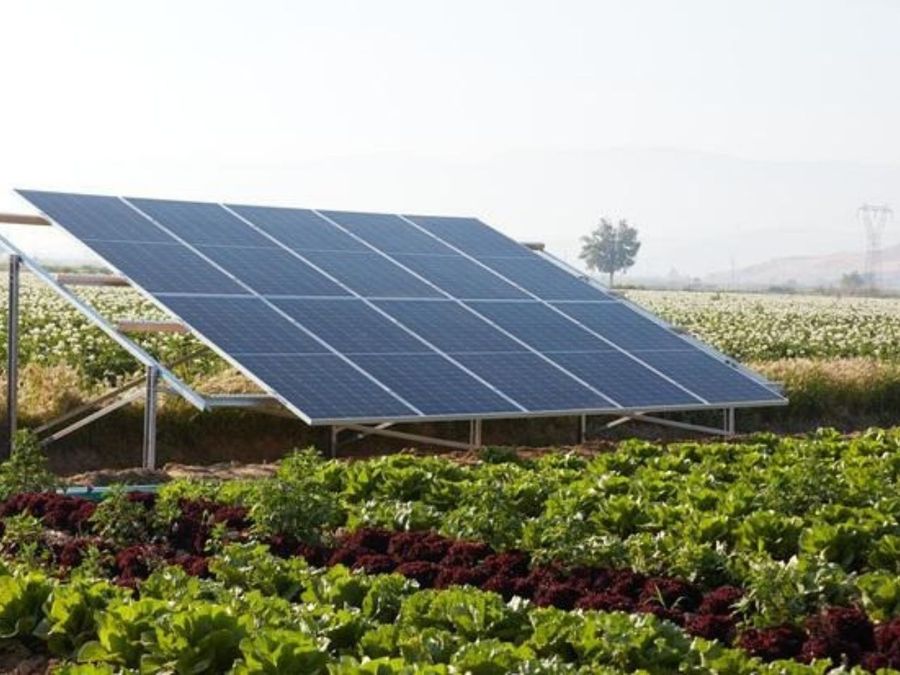
The tender also introduces specific technical guidelines encouraging Agri-photovoltaic installations that preserve the underlying ground for active crop cultivation. Projects adopting Agri-PV configurations are required to maintain a minimum structural ground clearance of three meters beneath the panels. This elevation ensures that standard agricultural equipment, tractors, and irrigation machinery can maneuver unimpeded across the fields.
Furthermore, the regulatory criteria dictate that agricultural yields on sites hosting dual-use installations must remain at least eighty percent of baseline open-field production. This benchmark ensures that fertile farm acres are not permanently diverted away from food production to make way for energy generation. State planners view this balanced model as a sustainable way to meet decarbonization goals without compromising regional agricultural output.
The solarisation drive addresses systemic distribution challenges that have historically troubled rural farming belts across eastern India. Supplying dependable solar electricity during sunlight hours allows cultivators to irrigate crops without having to work overnight or rely on erratic grid cycles. It also diminishes farmer dependence on costly diesel-powered pump sets, significantly lowering seasonal operating overheads for smallholders.
For the state power utilities, localized solar generation situated close to rural load centers substantially curbs technical transmission losses and reduces heavy agricultural subsidy burdens. As the procurement process moves toward the end of the year, industry observers will closely track developer participation and the resulting tariff discovery. The tender's outcome will serve as an important benchmark for future decentralized clean energy deployments across the state.
Primary source: Google News Bihar. Newzly rewrites and structures source reporting for clarity; verify critical details at the original.