Binance Hacker Dumps $158M in Altcoins for Ether as Researchers Question Key Security
The attacker behind Binance's multi-billion-dollar breach converted roughly $158 million in stolen altcoins into ether, as blockchain researchers questioned the exchange's official claim that private keys remained secure.
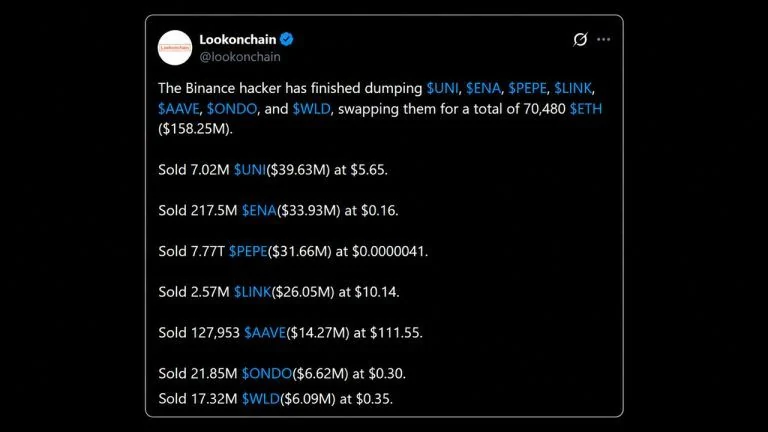
The exploiter behind the recent multi-billion-dollar breach of cryptocurrency exchange Binance has rapidly liquidated approximately $158 million in stolen altcoins, converting the proceeds into 70,480 ether. Blockchain analytics platform Lookonchain disclosed that the attacker offloaded holdings across seven major tokens within hours of the security compromise. The swift consolidation into Ethereum's native cryptocurrency reflects a calculated attempt to secure unfreezable digital assets.
The targeted sell-off encompassed prominent decentralized finance and utility tokens, including Uniswap, Ethena, Pepe, Chainlink, Aave, Ondo, and Worldcoin. Automated decentralized exchanges absorbed the heavy selling pressure as the perpetrator systematically routed batches of tokens through on-chain liquidity pools. Market observers noted that several of the affected altcoins experienced brief price turbulence during the concentrated liquidation wave.
The aggressive conversion drive occurred as centralized stablecoin issuers moved to mitigate broader fallout from the incident. Tether and Circle coordinated to blacklist and freeze billions of dollars in dollar-backed tokens held across addresses linked to the incident, sharply limiting the attacker's liquidation options. Sensing the closing window for asset recovery, the hacker prioritized dumping tokens lacking centralized blacklisting capabilities.
Binance leadership, including Chief Executive Officer Richard Teng, initially characterized the incident as unauthorized withdrawals stemming from a compromised DevOps workstation rather than an outright loss of wallet credentials. Teng maintained that no private keys were directly exposed or leaked during the intrusion, attempting to reassure market participants about the exchange's underlying core custody protocols.
Independent blockchain security researchers and forensic sleuths quickly questioned the exchange's explanation, noting that the unauthorized transactions bore hallmarks of legitimate hot-wallet cryptographic signatures. Analysts from prominent blockchain intelligence firms suggested the incident pointed toward key misuse or compromised transaction authorization workflows rather than an isolated external bug.
Security researchers pointed out that whether an adversary steals raw private keys or hijacks the automated environment tasked with signing transfers, the operational outcome remains practically indistinguishable. By executing authorized transfers through an internal service container, the intruder successfully prompted the exchange's hot wallets to release vast sums across multiple networks.
The security breach represents one of the largest single security incidents recorded in cryptocurrency history, with estimated preliminary exposures hovering between $5.8 billion and $6.3 billion before issuer intervention. Despite the immense scale of the unauthorized outflow, market disruptions remained relatively contained due to rapid liquidity freezes, stablecoin blacklists, and ongoing exchange monitoring.
Binance reiterated that user balances remain protected through corporate reserves and the platform's dedicated emergency fund, known as the Secure Asset Fund for Users. Management emphasized that any net shortfall arising from unrecovered assets would be fully absorbed by the platform's balance sheet without impairing customer deposits or halting core trading services.
The conversion into ether leaves the perpetrator holding substantial amounts of an asset that cannot be centrally frozen by a single corporate entity, posing ongoing monitoring challenges for investigators. Blockchain forensic teams continue to trace downstream transaction flows as the funds move through intermediate decentralized mixing routes and automated swap protocols.
Regulators and security auditors are expected to intensify scrutiny over centralized exchange operational security, particularly surrounding DevOps privileges and hot-wallet transaction signing controls. Industry observers note that the exploit underscores persistent vulnerabilities at the intersection of enterprise cloud infrastructure and decentralized asset custody.
Primary source: Bitcoin.com News. Newzly rewrites and structures source reporting for clarity; verify critical details at the original.