Bitcoin Correlation With Gold Hits All-Time High, Galaxy Research Finds
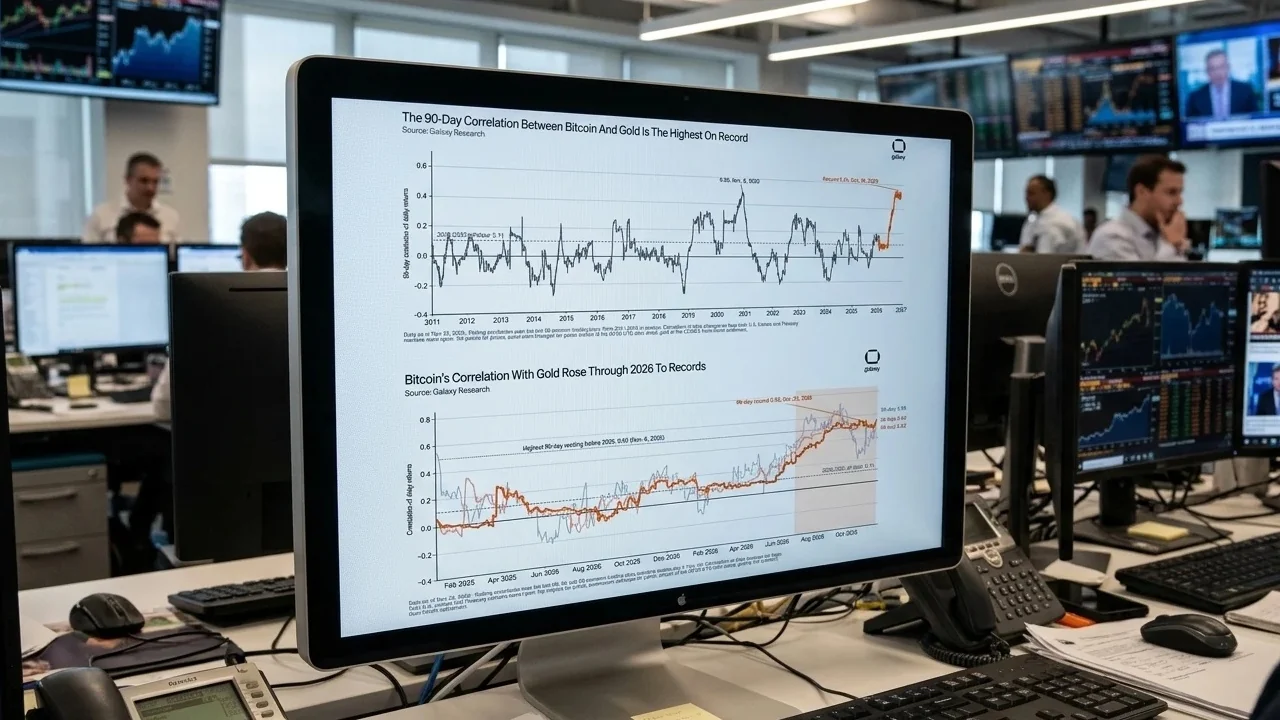
Bitcoin's 90-day rolling correlation with gold climbed to a record 0.56, surpassing a previous peak set in 2020 as institutional investors increasingly track both hard assets amid global macroeconomic shifts.
In this piece
Bitcoin's daily price moves tracked gold more closely over a 90-day window than at any point since 2011, according to new Galaxy Research findings. The…
Bitcoin's statistical correlation with gold has reached an all-time high, according to data compiled by Galaxy Research. The cryptocurrency's 90-day rolling correlation with the precious metal climbed to a record peak of 0.56 in late October, marking the tightest price alignment observed between the two hard assets since records began in 2011. The milestone reflects a significant shift in how the leading digital asset tracks traditional safe-haven commodities.
The findings, highlighted by Galaxy Research's head of firmwide research Alex Thorn, surpass the prior record of 0.50 established in November 2020. The metrics have largely sustained their elevated trajectory into November, with the 90-day correlation holding around 0.54 while the shorter-term 30-day metric pushed upward to 0.59. These figures confirm that the tighter alignment is not a brief statistical anomaly, but rather a sustained trend across multiple trading sessions.
The current readings represent a substantial departure from historical norms. Between 2020 and 2025, the baseline correlation between Bitcoin and gold hovered around just 0.11, indicating that daily movements in the two assets typically shared little direct statistical relationship over extended periods. For much of that span, crypto assets decoupled rapidly from physical commodities whenever broader financial markets experienced volatility.
The surge in directional alignment occurred during a phase of broader macroeconomic adjustments and shifting investor risk tolerance. Both Bitcoin and gold faced periods of downward price pressure alongside broader movements in U.S. equities, reflecting shared exposure to overarching monetary dynamics and shifts in global liquidity conditions. Traders increasingly responded to macroeconomic headlines by adjusting exposure across hard assets and risk-on holdings simultaneously.
For years, digital asset proponents have championed Bitcoin as a modern digital counterpart to gold, arguing that its fixed supply schedule makes it an effective hedge against currency debasement and macro uncertainty. However, market critics frequently pushed back on that comparison, pointing to long stretches where crypto behaved almost exclusively as a high-beta technology speculative play. The latest data provides fresh empirical evidence to reignite that longstanding structural debate.
Historically, cryptocurrency prices tended to track growth-oriented equity benchmarks like the Nasdaq 100 far more reliably than precious metals. When broader equities sold off or rallied on shifts in interest rate forecasts, Bitcoin often amplified those swings, distancing itself from the traditional stability associated with gold reserves. That tendency led institutional allocators to categorize crypto primarily alongside venture tech rather than established commodity baskets.
The recent record alignment suggests that institutional capital and market participants may increasingly be viewing Bitcoin through the lens of monetary alternative assets. When investors navigate heightened geopolitical tensions and macroeconomic shifts, capital allocations appear to be treating both assets with comparable sensitivity to dollar strength and debt trajectories. This convergence highlights an evolving perception among macro fund managers searching for non-sovereign stores of value.
Research analysts observe that while correlation does not indicate identical fundamental drivers, a persistent positive reading above 0.50 demonstrates a measurable co-movement. The synchronized price patterns underscore how macroeconomic narratives can temporarily override sector-specific fundamentals in determining asset performance. Market participants are paying closer attention to these statistical bridges as cross-asset trading strategies expand.
Market observers emphasize that asset correlations in volatile sectors remain fluid and subject to swift decoupling. Whether Bitcoin maintains its near-record correlation with gold will likely depend on forthcoming central bank policies, sovereign liquidity shifts, and whether independent crypto-specific market cycles reassert themselves. For now, the historic correlation metric offers institutional investors a notable reference point in evaluating digital asset maturity.
Primary source: Bitcoin.com News. Newzly rewrites and structures source reporting for clarity; verify critical details at the original.