Bitcoin Draws Attention as Cryptographers Organize Amid AI Breakthrough Rumors
A Bitcoin.com News report says cryptographers have formed a group called CIRG as rumors of an AI breakthrough circulate, while Coinbase addresses Bitcoin security and debate over P versus NP grows.
In this piece
Bitcoin.com News reports that cryptographers have formed CIRG as talk of an artificial-intelligence breakthrough spreads. The item also says Coinbase has…
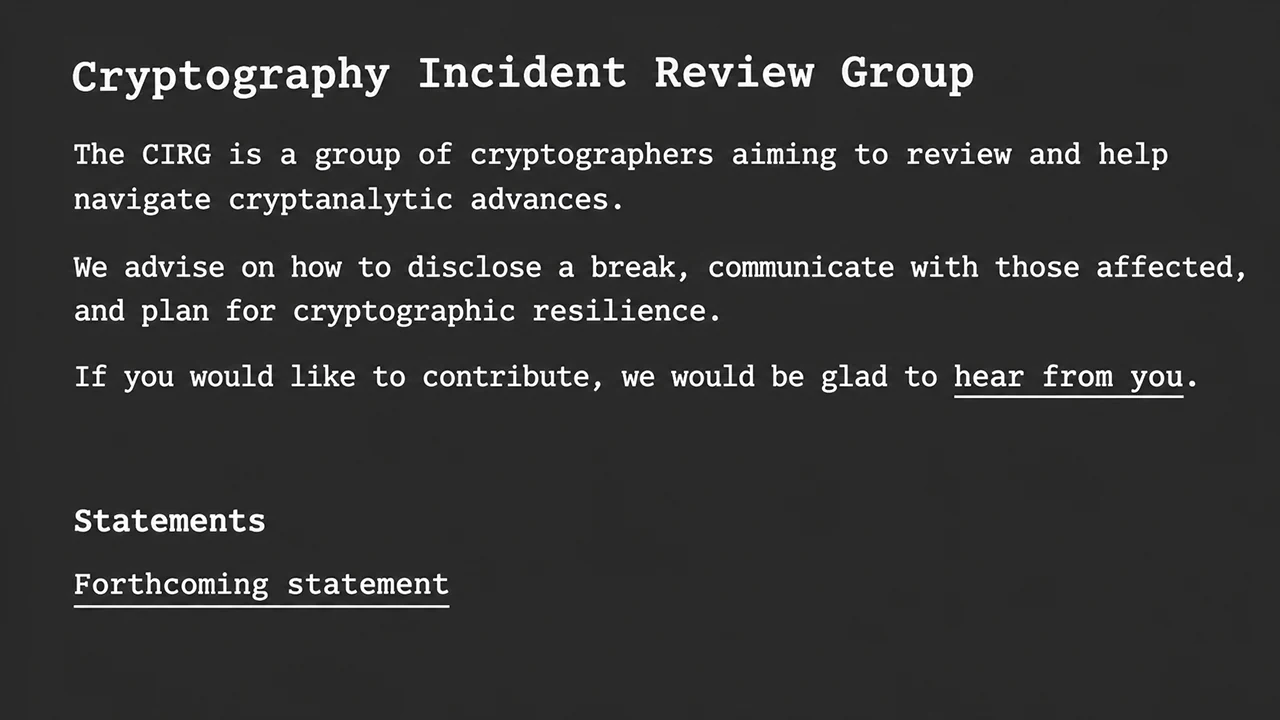
Bitcoin is back in a security conversation that mixes cryptography, artificial intelligence rumors, and a long-running question in computer science. Bitcoin.com News reports that cryptographers have formed a group referred to as CIRG as rumors of an AI breakthrough circulate, that Coinbase has addressed Bitcoin security, and that debate over the P versus NP problem is intensifying.
The report, as provided, is brief. It does not spell out what CIRG stands for, who leads it, how large the group is, or what formal steps it has taken. It also does not quote Coinbase, describe any product change, or identify a specific AI system said to have achieved a breakthrough. Those omissions matter: the item frames a cluster of concerns rather than a confirmed technical event.
What the outlet does state is that cryptographers are organizing in response to the rumors. In the account given, the formation of CIRG is presented alongside heightened attention to whether advances in AI could alter assumptions that protect digital money. The report treats the AI development as rumor, not as a verified result.
Bitcoin’s day-to-day operation depends on cryptographic tools, including hashing and digital signatures, that are designed to be easy to use in one direction and hard to undo without the right key or an infeasible amount of computation. A rumor that a new method could shortcut that hardness is enough, on its own, to pull Bitcoin into the discussion even when no public proof has been set out.
The same report says Coinbase has addressed Bitcoin security. Without the exchange’s wording, timing, or technical detail in the source material, it is not possible to say what Coinbase claimed, whether it changed any control, or how it weighed the rumors. The mention signals that a major crypto platform is part of the public conversation, and nothing more specific than that.
P versus NP sits at the center of the debate the report says is intensifying. The problem asks whether every question whose answer can be checked quickly can also be solved quickly. It remains unsolved. A proof that P equals NP would reshape large parts of theoretical computer science. It would not, by itself, hand anyone a ready-made way to break Bitcoin, because practical cryptography also depends on particular algorithms, parameter choices, and engineering, not only on that abstract question.
Researchers have long separated “hard in theory” from “broken in practice.” Many cryptographic designs rest on problems believed to be difficult for known algorithms, with safety margins chosen so that even large improvements in computing would not immediately collapse them. An AI system that suggested a new attack, or that solved a narrow puzzle, would still need independent review, reproducible methods, and evidence that the result scales beyond a demonstration.
That standard of evidence is the gap in the current item. Bitcoin.com News ties CIRG, Coinbase’s comments, and the P versus NP debate to AI breakthrough rumors, but the supplied account does not include a paper, a benchmark, a vulnerability identifier, or a statement that a cipher, hash, or signature scheme has failed. Until those materials appear, the story is about concern and coordination, not about a demonstrated break.
The stakes are still easy to see. Bitcoin holdings, exchange operations, and payment software all assume that private keys stay private and that transaction history cannot be quietly rewritten. A credible challenge to those assumptions would force wallet makers, miners, exchanges, and protocol developers to assess whether any concrete attack exists and whether users need new guidance. A rumor, even a widely repeated one, does not meet that bar.
For now, the reported next step is scrutiny rather than a settled outcome. Cryptographers organizing under the CIRG name, as the outlet describes it, would be a place to test claims if technical details are released. Coinbase’s reported comments keep a large trading venue in the frame. Readers still lack the underlying statements, membership, and any AI result that could be checked.
What happens next depends on whether the rumors produce public evidence. If researchers or companies publish methods that others can reproduce, the cryptography community can judge whether Bitcoin’s current designs are affected. If the claims stay unnamed and unreviewed, the episode remains a warning about how quickly AI speculation can collide with an open problem like P versus NP and with the security story around Bitcoin.
Primary source: Bitcoin.com News. Newzly rewrites and structures source reporting for clarity; verify critical details at the original.