Crypto Leaders Blast Misleading WSJ Ad on Tokenization Risks
A full-page Wall Street Journal ad by a conservative non-profit urged S&P 500 CEOs to reject stock tokenization — but industry executives say it misrepresents how regulated U.S. tokenization actually works.
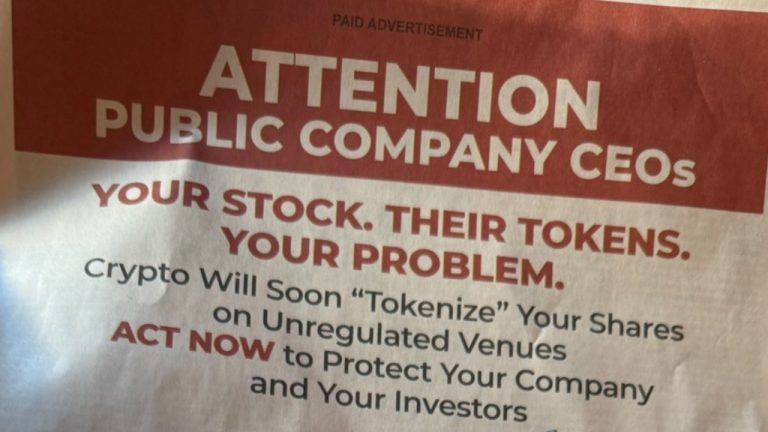
A full-page advertisement in the Wall Street Journal is stoking a sharp debate over the future of stock tokenization, after a conservative non-profit urged S&P 500 executives to reject efforts to replicate their company shares as crypto tokens on blockchain networks.
The ad, headlined "Your Stocks, Their Tokens, Your Trouble," ran in the weekend business section of the Journal on October 24 and 25, 2026. It was placed by the Common Sense Leadership Fund, a 501(c)(4) civic organization founded in 2021 and based in Arlington, Virginia, that describes its mission as advancing individual freedom and reducing regulation.
The organization called on S&P 500 chief executives to exercise a 30-day withdrawal right, effectively opting their companies out of programs that would see their shares tokenized and traded on blockchain-based venues. It listed eight specific risks: pricing divergence across token venues, ownership ambiguity, impaired capital raising, cybersecurity vulnerabilities, market manipulation potential, anti-money laundering and know-your-customer compliance gaps, reduced investor protections, and potential personal legal liability for corporate officers.
The ad landed at a moment of heightened scrutiny over a partnership between crypto exchange OKX and Intercontinental Exchange, the parent company of the New York Stock Exchange, to offer tokenized equity products. At least 22 major U.S. companies — including Microsoft, Alphabet, Goldman Sachs, Qualcomm, Caterpillar, McDonald's, and Western Digital — have already voiced opposition to being included in the OKX-ICE initiative, underscoring that resistance to tokenized equities extends well beyond the crypto debate.
But prominent figures in the digital-asset industry pushed back hard on the ad itself, arguing it blurs critical distinctions between legitimate, regulated tokenization and the speculative or unregulated practices it appears to describe. Carlos Domingo, CEO of Securitize — one of the leading platforms for tokenizing real-world assets under U.S. regulatory oversight — called the depiction of tokenization processes misleading. He said the ad conflates tokenization methods with trading venues and argued that none of the cited concerns apply to properly structured tokenization conducted under SEC supervision on regulated platforms.
Gabriel Shapiro, co-founder of MetaleX, offered a more nuanced critique. While agreeing that some concerns raised in the ad are worth examining, Shapiro flagged the risk of intermediary ownership concentration, noting that platforms such as Robinhood and Coinbase holding significant stakes in tokenized shares could create complications during contested corporate voting scenarios.
The dispute arrives as the tokenized real-world asset market is experiencing rapid institutional growth. Total distributed tokenized assets reached approximately $39 billion in October 2026, with represented asset value exceeding $350 billion across millions of holding addresses. The asset classes involved now span U.S. Treasuries, money-market funds, private credit, equities, real estate, and exchange-traded funds.
Regulatory frameworks are also evolving to keep pace. The U.S. Securities and Exchange Commission issued a conditional regulatory exemption in September 2026 permitting certain onchain securities markets to operate, a move that proponents argue gives tokenization a credible legal foundation in the United States. The SEC has also been clear that digital securities remain securities regardless of format, meaning existing investor-protection rules apply.
Critics of the WSJ ad argue that by conflating regulated domestic platforms with offshore or unregulated token venues, the Common Sense Leadership Fund risks misleading corporate decision-makers at precisely the moment the industry is trying to establish legitimacy under federal oversight. Supporters of the ad counter that the risks are real and that not enough executives understand them.
What happens next may hinge largely on the SEC's ongoing rule-making and the decisions of individual S&P 500 companies about whether to permit tokenized versions of their shares to trade. With the 30-day opt-out window the fund cited now in play, the coming weeks are likely to bring further corporate statements — and further debate about who actually benefits from putting Wall Street on the blockchain.
Primary source: Bitcoin.com News. Newzly rewrites and structures source reporting for clarity; verify critical details at the original.