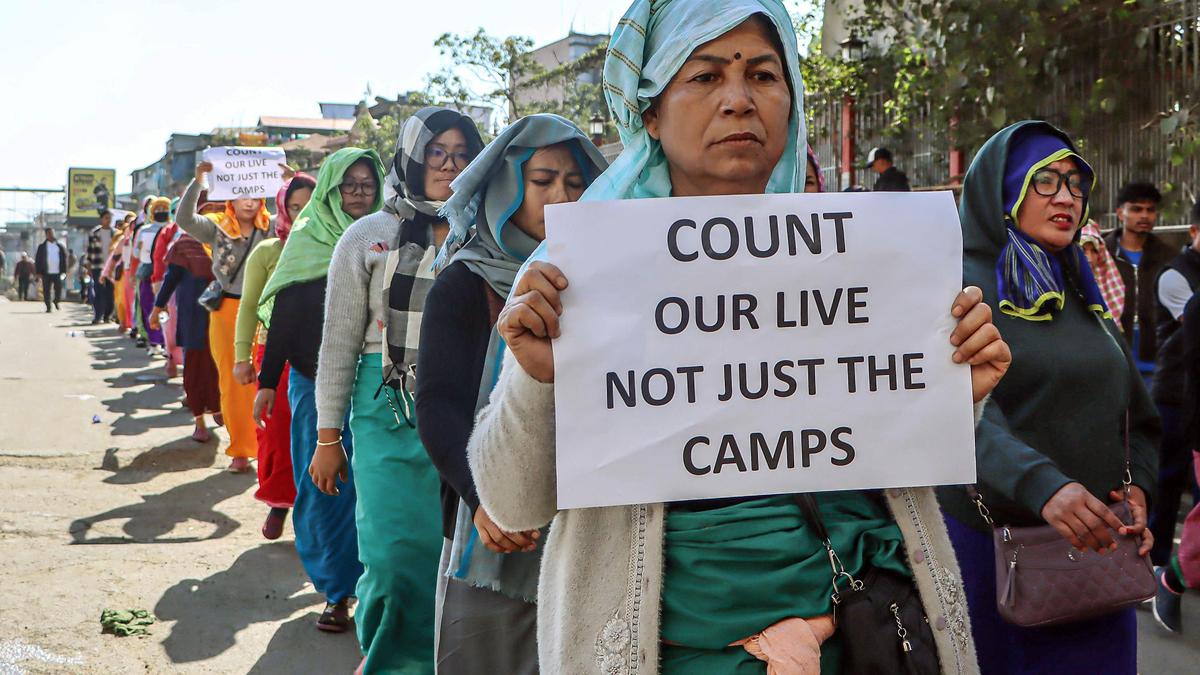
Displaced people march in Manipur, seek dignified resettlement after ethnic clashes
Thousands of people uprooted by ethnic clashes in Manipur marched to demand dignified resettlement, The Hindu reported, keeping return and housing at the center of the state’s unresolved crisis.
In this piece
Thousands of people displaced by ethnic clashes in Manipur held a march demanding dignified resettlement, according to The Hindu. The protest highlights how…
Thousands of people displaced by ethnic clashes in Manipur held a march demanding dignified resettlement, The Hindu reported. The demonstration put public pressure on the question of how people forced from their homes can return or be housed with security and basic dignity.
The report, carried through a Google News listing of The Hindu’s account, describes the marchers as people already displaced by the clashes. It does not identify the route, the organizing groups, or any statement read out at the gathering.
Manipur, in India’s Northeast, has lived with the consequences of ethnic violence that tore through communities and emptied neighborhoods. Displacement has remained one of the most visible results: families in relief camps and temporary shelters, separated from land, work, and schools.
“Dignified resettlement,” the demand named in the report, is broader than a promise of shelter. In conflicts of this kind it usually means a return or relocation that includes safety, a livable house, and a way to resume ordinary life. The Hindu’s account does not spell out a detailed charter of demands beyond that call.
The scale described — thousands of marchers — indicates that the protest drew people beyond a small delegation. No official crowd estimate, police comment, or government response is included in the material available here, so the precise size of the march and any official reaction cannot be stated.
Ethnic clashes in Manipur have, over an extended period, displaced large numbers of residents and hardened divisions over land, identity, and local administration. Which communities were represented in this particular march is not stated in the source and is not assumed here.
For people still living away from their homes, resettlement is the difference between an open-ended stay in temporary conditions and a recognized place to live. Delays affect livelihoods, children’s education, and access to health care, even when emergency rations and camp services continue.
Public marches are one of the few ways displaced residents can make that stakes visible to the state government and to a national audience. The Hindu’s report frames the event as a demand rather than as a clash, and nothing in the available account describes violence at the march itself.
What happens next is not set out in the report. Whether the protest produces talks, a timetable for return, or new relief measures will depend on responses from the Manipur government and other authorities — responses that are not quoted in the source.
Until those responses are on record, the march stands as a public reminder that displacement from the ethnic clashes is unresolved. The immediate facts are limited to what The Hindu reported: thousands of displaced people marched in Manipur and asked for dignified resettlement.
Primary source: Google News Manipur. Newzly rewrites and structures source reporting for clarity; verify critical details at the original.