European Spacecraft Finds Chaotic Scene at Asteroid Deflection Site
The European Space Agency’s Hera probe has reached the Didymos system, uncovering a heavily deformed moonlet and sprawling debris field left by NASA’s historic planetary defense test in 2022.
In this piece
The European Space Agency's Hera mission has rendezvoused with asteroid Dimorphos, returning its first close-up views since NASA intentionally crashed the DART…
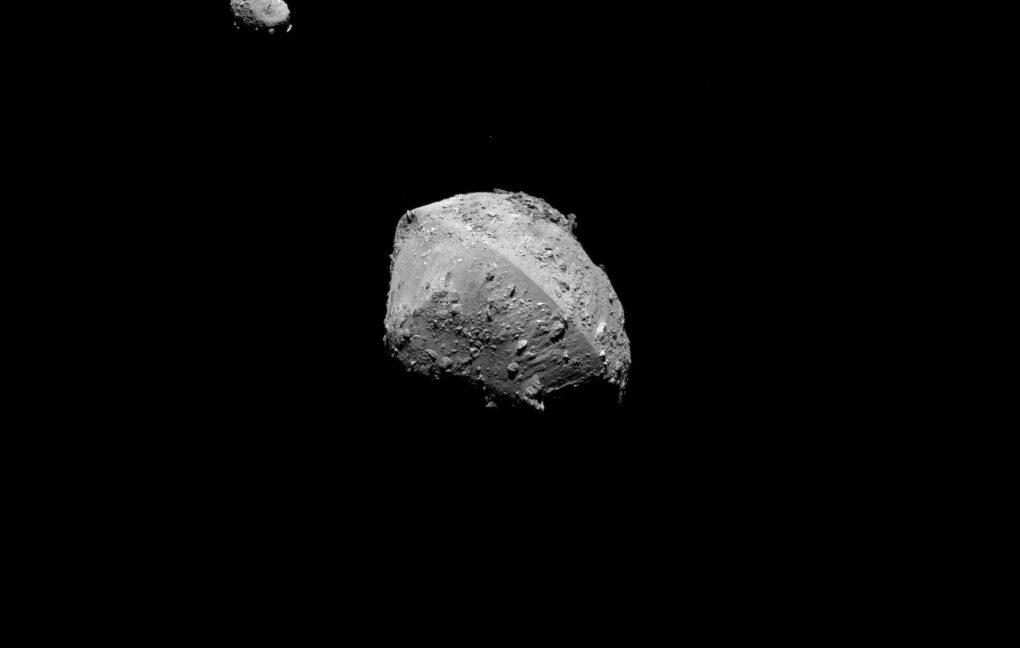
The European Space Agency's Hera spacecraft has arrived at the binary asteroid system Didymos and Dimorphos, sending back its first close-range images of the cosmic wreckage left by NASA's planetary defense experiment. The initial observations reveal a dramatically altered landscape on Dimorphos, the small moonlet intentionally struck by NASA's Double Asteroid Redirection Test spacecraft in September 2022.
Rather than finding a neat, localized crater, Hera's imaging systems captured a chaotic and heavily restructured celestial body. The violent collision flattened one entire face of the roughly 150-meter-wide moonlet and excavated a massive depression comparable in scale to a sports stadium. Hundreds of loose boulders and fragmented rock slabs remain scattered across the surface, marking the violent dynamics of the impact.
Early navigational tracking and optical data also indicate that the impact altered more than just the physical profile of Dimorphos. The kinetic blast transferred substantial angular momentum to the moonlet, prompting it to tumble erratically along its orbital trajectory around the larger asteroid Didymos. Instead of maintaining a predictable, tidally locked rotation, the moonlet appears to be wobbling through space as it navigates the shared gravitational field.
The rendezvous represents the culmination of a joint international effort to evaluate whether kinetic impactors can successfully protect Earth from hazardous near-Earth objects. When NASA guided DART into Dimorphos at a speed exceeding six kilometers per second in 2022, ground-based observatories confirmed that the crash trimmed roughly 33 minutes off the moonlet's orbital period. While that orbital shift validated the core concept of deflection, scientists lacked close-up imagery to analyze the internal mechanics of the strike.
Launched by the European Space Agency in October 2024, Hera traveled for two years through interplanetary space to perform the forensic investigation NASA's probe could not complete. Equipped with high-resolution Asteroid Framing Cameras, thermal infrared sensors, and laser altimeters, the European spacecraft was engineered to conduct autonomous close-proximity navigation around the twin asteroids. Its arrival provides the missing half of humanity's first full-scale planetary defense exercise.
Understanding how Dimorphos responded to the impact is essential for refining future deflection models. Asteroids of this size are often loose rubble piles held together by weak gravitational forces rather than solid monolithic rocks. By assessing how deeply the impactor penetrated and how shockwaves propagated through the interior rubble, planetary scientists can calibrate how much force would be necessary to deflect asteroids of varied compositions.
The mission is scheduled to enter an even more intensive observation phase in the coming weeks. Hera plans to maneuver closer to Dimorphos before deploying two specialized CubeSats, named Juventas and Milani. These miniaturized probes will perform low-altitude flybys and carry out low-frequency radar sounding to map the asteroid's internal density, mineral distribution, and precise mass.
European mission controllers and international science teams will spend months analyzing the streams of telemetry and high-resolution spatial maps beamed back to Earth. The resulting dataset will help researchers determine the exact momentum transfer efficiency of kinetic deflection. The findings are expected to serve as the definitive benchmark for asteroid mitigation strategies if an incoming space rock ever threatens Earth.
For planetary scientists, the chaotic terrain uncovered by Hera confirms both the immense destructive force of kinetic redirection and the complexity of predicting post-collision outcomes. As Hera draws nearer and its secondary probes begin their deep structural surveys, the observations will transform an experimental cosmic strike into an actionable blueprint for safeguarding the planet.
Primary source: Ars Technica. Newzly rewrites and structures source reporting for clarity; verify critical details at the original.