Federal Appeals Court Halts Army's Lead Azide Detonation Permit at Iowa Plant
A federal appeals court has temporarily halted an emergency EPA permit allowing the U.S. Army to detonate tons of degraded lead azide at the Iowa Army Ammunition Plant following legal challenges from environmental groups.
In this piece
The 8th U.S. Circuit Court of Appeals issued an administrative stay blocking the U.S. Army from carrying out open detonations of unstable explosive chemicals in…
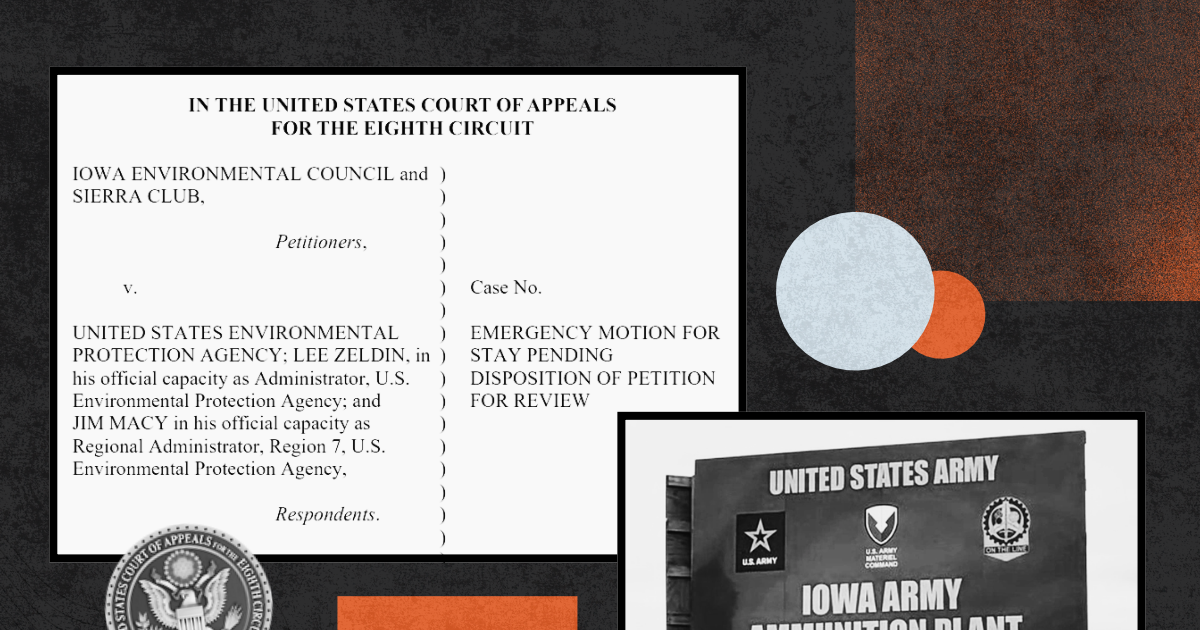
A federal appeals court has temporarily blocked the U.S. Army from detonating thousands of pounds of degraded explosive material at a military facility in southeastern Iowa. The 8th U.S. Circuit Court of Appeals granted an administrative stay halting an emergency disposal permit granted by the Environmental Protection Agency. The intervention freezes the military's plans while judges consider an emergency petition filed by environmental organizations.
The legal battle centers on the Iowa Army Ammunition Plant, located in Middletown within Des Moines County. Military officials identified roughly 9,500 pounds of deteriorating lead azide, a primary explosive compound commonly used in detonators and artillery primers. Over time, the stored chemicals began to crystalize and destabilize, creating severe handling hazards that prompted the Army to seek rapid disposal authorization.
In response to the mounting danger, the EPA issued an emergency permit granting the military permission to destroy the volatile munitions through open-air controlled detonations. Army personnel argued that attempting to move or treat the sensitive materials inside closed containment units posed unacceptable detonation risks to personnel on site. The federal approval cleared the way for detonations across multiple days at the complex's designated demolition grounds.
Environmental organizations, represented by Earthjustice alongside the Iowa Environmental Council and the Sierra Club, swiftly moved to halt the planned operation. The coalition filed an emergency challenge arguing that the regulatory agency bypassed critical safety reviews and failed to evaluate safer available disposal technologies. Attorneys maintained that open burning and open detonation release airborne heavy metals directly into nearby atmospheres without filtration.
Advocates and public health experts warned that open-air blasting could disperse fine particulate lead dust across surrounding communities and agricultural land. Lead is a potent neurotoxin that presents lifelong cognitive and developmental dangers, particularly for young children, even at minimal exposure thresholds. Petitioners emphasized that prevailing wind patterns could carry toxic plumes beyond the military perimeter and across the Mississippi River into western Illinois.
The disposal operation triggered widespread pushback from local residents and elected leaders who cited short notice and inadequate public disclosure. Iowa Governor Kim Reynolds and regional officials questioned the transparency of the federal review process and urged the military to prioritize civilian safety. Community members voiced frustration that neighborhood alerts and air monitoring details arrived only days before blasting was scheduled to begin.
Prior to the court's formal injunction, the Army had already postponed the initial blast timeline from its planned Friday commencement to the following week. Defense officials cited changing local weather forecasts, noting that sudden drops in ambient temperature can heighten chemical instability and alter atmospheric dispersal modeling. Despite that temporary operational delay, opponents pursued formal legal remedies to ensure the operation could not proceed without judicial scrutiny.
The dispute highlights ongoing national friction surrounding the military's continued reliance on open burning and open detonation to dispose of conventional munitions waste. While federal environmental rules have increasingly restricted thermal treatment of hazardous chemical wastes in commercial industries, defense installations frequently utilize regulatory exemptions. Clean air advocates have repeatedly pressed Congress and federal regulators to mandate enclosed thermal oxidation and advanced containment units.
The administrative stay will remain active while the 8th Circuit evaluates full legal briefings from Earthjustice, the EPA, and the Department of Defense. Judges must decide whether to extend the injunction into a broader preliminary stay or allow the military to resume disposal protocols under enhanced monitoring. For now, the volatile chemical stockpile remains under specialized surveillance at the Middletown facility while courts weigh environmental safety against military urgency.
Primary source: Google News Iowa. Newzly rewrites and structures source reporting for clarity; verify critical details at the original.