Gnosis Pay Data Breach Exposes Sensitive Customer Records and Linked Crypto Wallets
Gnosis Pay has confirmed a data breach affecting its legacy consumer card platform, exposing sensitive customer records including card numbers, addresses, and crypto wallets while user balances remain intact.
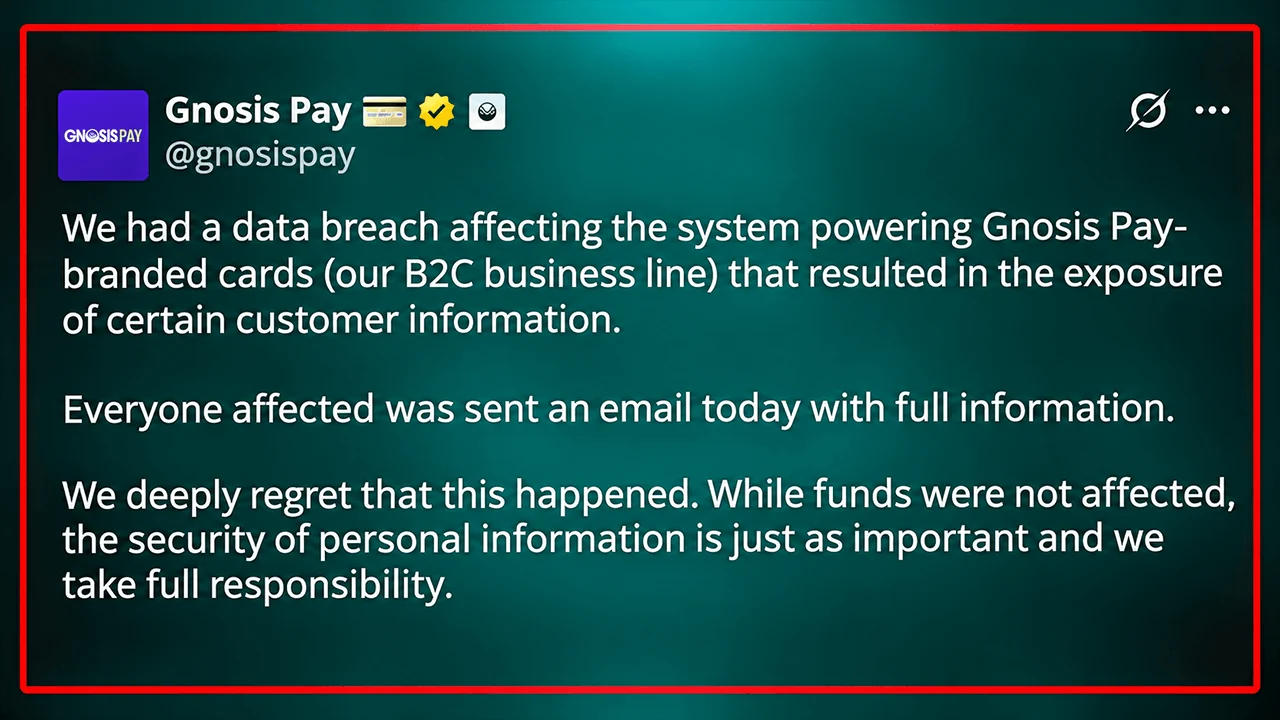
Gnosis Pay has confirmed a security breach involving its legacy consumer card system, resulting in the unauthorized exposure of sensitive customer records. The incident was acknowledged following reports that unauthorized third parties had gained access to internal systems housing cardholder data.
According to disclosures following the incident, at least one affected customer reported that detailed personal identifying information had been compromised. The exposed data reportedly included the individual's full name, residential home address, card number, and linked cryptocurrency wallet addresses.
Despite the unauthorized intrusion into customer records, Gnosis Pay stated that customer funds remain secure. The company emphasized that the breach did not compromise underlying account balances or allow the direct unauthorized withdrawal of deposited assets.
The unauthorized access specifically affected the platform's legacy consumer card infrastructure rather than its newer core systems. Legacy environments frequently present distinct operational security challenges for expanding financial technology services as platforms update and migrate customer data across evolving architectures.
Gnosis Pay operates as a bridge connecting digital assets with traditional payment rails, allowing users to spend cryptocurrency balances through payment cards. Because these financial services interact directly with conventional banking networks and merchant systems, they require collecting personal identification details alongside public blockchain addresses.
The exposure of combined home addresses, payment card details, and crypto wallet addresses presents elevated risks for impacted users. Cybersecurity analysts have consistently warned that linking physical identity markers with on-chain wallet addresses can leave cryptocurrency holders vulnerable to targeted phishing schemes and social engineering attempts.
The breach highlights persistent data protection challenges across the broader cryptocurrency payments sector. While decentralized protocols rely on mathematical encryption for direct on-chain transfers, off-chain infrastructure and corporate databases remain vulnerable to conventional network compromises.
Specific details regarding the total number of affected users and the exact duration of the intrusion have not yet been fully detailed. The company has not released an exhaustive public accounting of the breach perimeter or indicated whether additional customer cohorts were affected beyond the legacy system.
Security analysts generally recommend that cardholders affected by financial data compromises monitor linked accounts for unauthorized transactions and exercise heightened caution with unsolicited communications. Impacted customers whose card numbers were exposed may also need replacement payment cards to mitigate the risk of fraudulent charges.
As the company continues to respond to the incident, users and market observers are awaiting further updates on the full scope of remediation. The breach underscores the delicate security balance required when merging traditional payment card issuance with digital asset ecosystems.
Primary source: Bitcoin.com News. Newzly rewrites and structures source reporting for clarity; verify critical details at the original.