Goa Bets on Defence, Pharma and Green Tech to Build Specialized Manufacturing Hub
Goa is charting a path toward specialized manufacturing, leveraging its pharmaceutical base, defence shipbuilding, and green technology to build a sustainable, high-value industrial economy beyond tourism.
In this piece
Goa is pushing to diversify its economy beyond tourism and mining by developing niche manufacturing capabilities in pharmaceuticals, defence, and green…
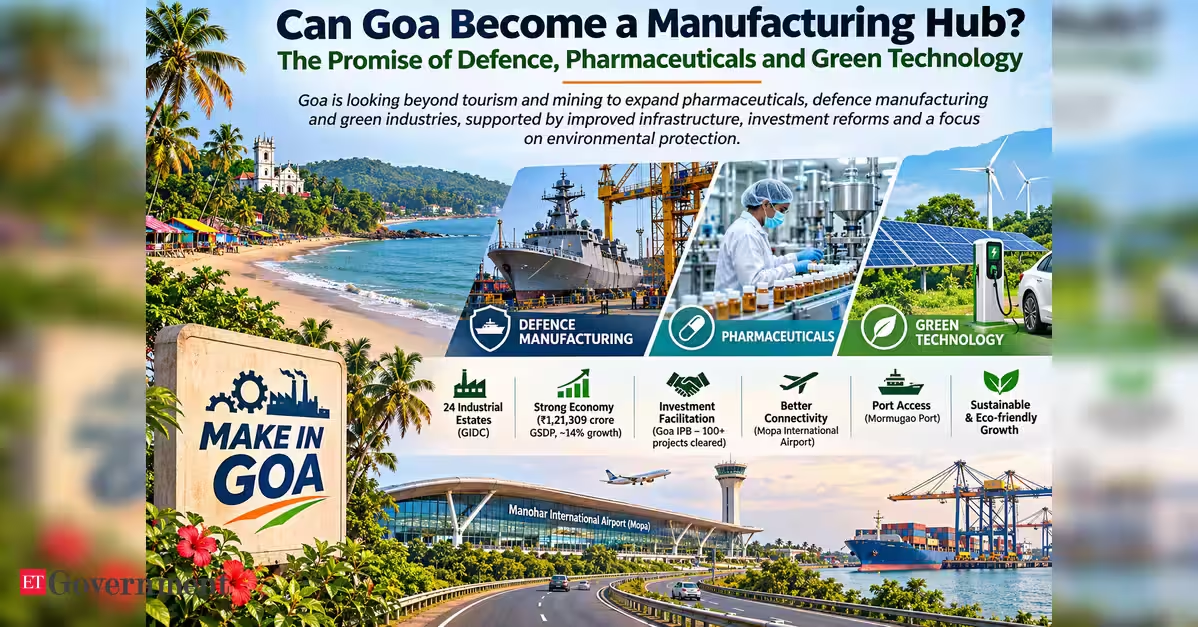
Goa is stepping up strategic efforts to establish itself as a specialized manufacturing and innovation center, seeking to broaden an economy historically dominated by tourism and mining. Policymakers and industrial leaders are focusing on high-value, non-polluting sectors to drive sustainable economic growth. Defence production, pharmaceuticals, and green technology have emerged as the primary sectors expected to anchor the state's industrial future.
The coastal state already possesses a formidable industrial foundation in the healthcare sector, generating roughly 12 percent of India's overall pharmaceutical output. Established industrial areas, such as the Verna Industrial Estate managed by the Goa Industrial Development Corporation, house numerous leading domestic and multinational drug manufacturers. These manufacturing facilities have long supplied international markets while creating a skilled regional technical workforce.
State authorities and industry analysts now envision advancing beyond standard generic medicine production toward high-value research, advanced medical technology, and biotechnology. To facilitate this shift, logistics networks and cold-chain facilities are being modernized across the region. These improvements aim to ensure temperature-sensitive pharmaceutical shipments reach global markets without transport delays or quality degradation.
Defence manufacturing represents another cornerstone of Goa's long-term industrial ambition, drawing on the proven maritime shipbuilding capabilities of Goa Shipyard. As India emphasizes domestic self-reliance through the Make in India and Atmanirbhar Bharat defence initiatives, the state is targeting expanded manufacturing contracts for naval vessels, patrol craft, and sophisticated marine engineering systems.
To complement large-scale defence shipbuilding, local planners are fostering an ecosystem of specialized ancillary suppliers and precision engineering workshops. Facilities such as maritime clusters are intended to encourage small and medium enterprises to supply vital components, marine electronics, and structural assemblies. Officials believe integrating local suppliers into national defence supply chains will create skilled employment and retain technical talent within the state.
Given Goa's compact land area and delicate coastal ecology, policymakers have ruled out water-intensive and heavily polluting heavy industries. Instead, the industrial framework places strong emphasis on green technology, clean energy systems, and electronic manufacturing clusters. Initiatives targeting net-zero carbon pathways and circular economy practices are designed to foster commercial growth without threatening the state's natural environment.
Physical and digital connectivity improvements have played a critical role in facilitating this industrial transition. The commissioning of Manohar International Airport at Mopa, alongside major highway upgrades and port connectivity enhancements, has alleviated transport bottlenecks that historically hampered freight movement. These multi-modal transport links enable advanced manufacturing facilities to import critical inputs and dispatch finished products more efficiently.
Administrative reforms have accompanied physical development, with the state government updating regulations to improve the ease of doing business. Measures such as single-window clearance mechanisms, simplified land allotment rules, and digital compliance platforms aim to lower bureaucratic barriers. Industrial authorities hope these procedural enhancements will attract high-tech companies seeking transparent and predictable regulatory conditions.
Despite these positive indicators, significant structural challenges remain, particularly severe constraints on available industrial land and persistent environmental concerns. Given the state's rich biodiversity and tourism-dependent coastline, industrial expansion frequently faces scrutiny from environmental groups and local communities. Balancing ambitious economic targets with strict conservation standards continues to represent a central policy challenge for state leadership.
Moving forward, Goa's emergence as a viable manufacturing destination will depend on how effectively it executes its targeted, niche industrial strategy. If state planners can maintain policy consistency, nurture skilled technical personnel, and preserve ecological safeguards, Goa could establish a durable model for clean, knowledge-driven manufacturing. Success will ultimately hinge on transforming potential into sustained investment across its chosen priority sectors.
Primary source: Google News Goa. Newzly rewrites and structures source reporting for clarity; verify critical details at the original.