Goa Expands Higher Education Footprint to Build Knowledge Economy Beyond Tourism
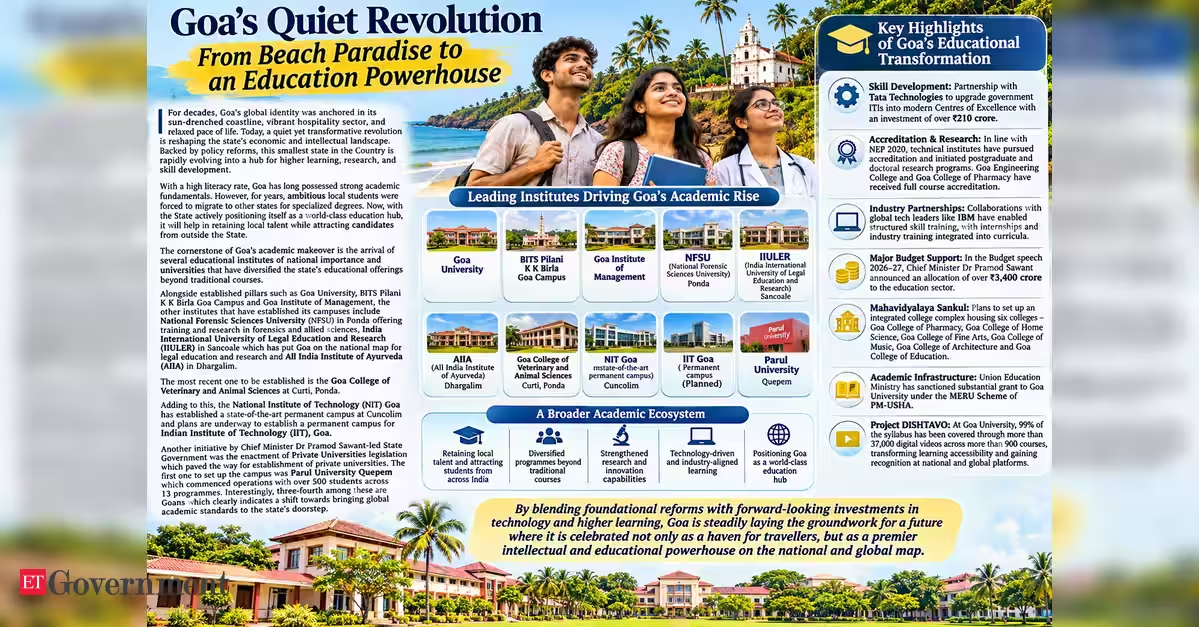
Backed by a state budget exceeding ₹3,400 crore and major central grants, Goa is expanding its network of premier institutes and digital learning initiatives to establish itself as a national hub for higher education.
In this piece
Goa is actively transitioning beyond its traditional reputation as a leisure destination by investing heavily in higher education and technical research. With…
Goa is stepping up its push to emerge as a national destination for higher education and advanced research, pairing substantial budgetary funding with institutional expansions. The state government under Chief Minister Dr. Pramod Sawant has allocated more than ₹3,400 crore to the education sector in its budget, signaling a concerted effort to build long-term intellectual capital. The capital outlay aims to modernize academic infrastructure, expand degree offerings, and upgrade polytechnic and collegiate facilities across the coastal state.
The transformation is anchored by the presence of several premier institutes of national importance that have established roots in the state. Campuses including the Indian Institute of Technology Goa, the National Institute of Technology Goa, BITS Pilani K K Birla Goa Campus, and the Goa Institute of Management have positioned the state as an academic center. These institutions have expanded access to elite engineering and management curricula, drawing faculty and students from across India.
A primary objective of this educational expansion is curbing the regional brain drain that historically saw local scholars leave for neighboring states. For decades, students from Goa routinely moved to metropolitan centers in Maharashtra and Karnataka to pursue specialized degrees in engineering, medicine, and business. State authorities believe that anchoring prestigious academic programs locally will retain top-performing youth while attracting competitive talent from other regions.
At the state university level, Goa University has secured critical support through central funding programs, notably under the Multidisciplinary Education and Research Universities scheme of the Pradhan Mantri Uchchatar Shiksha Abhiyan. These funds are designed to bolster research infrastructure, expand postgraduate faculties, and foster interdisciplinary innovation. Upgrades at the university are paired with institutional accreditation drives at state-run colleges to ensure compliance with national academic standards.
Digital integration forms another core pillar of the state's educational blueprint through Project DISHTAVO, shorthand for the Digital Integrated System of Holistic Teaching and Virtual Orientations. Under this initiative, Goa University and affiliated colleges have digitized roughly 99 percent of their course syllabi. The initiative has generated more than 37,000 digital instructional videos covering upwards of 900 courses, expanding remote and hybrid learning opportunities for undergraduate and graduate students.
State technical institutions are also hitting benchmarks in quality certification and programmatic accreditation. Flagship institutes such as the Goa Engineering College and the Goa College of Pharmacy have attained course accreditations from national evaluation bodies while expanding doctoral research pathways. These academic enhancements are designed to elevate teaching rigor and ensure degrees hold parity with older technical universities across the country.
The institutional overhaul aligns closely with the objectives of the National Education Policy 2020, focusing on experiential learning and industry relevance. Curricula are incorporating mandatory internships, dissertation projects, and hands-on laboratory requirements to bridge the gap between classroom theory and real-world application. The state has also entered partnerships with global technology leaders like IBM to introduce structured technical skill certifications in modern software disciplines.
The academic push comes as Goa seeks to establish stable, sustainable pillars for its regional economy. Traditional revenue drivers such as leisure tourism remain subject to seasonal fluctuations, while iron ore mining has faced prolonged legal and regulatory uncertainties. Establishing a knowledge-based economy driven by technical talent, research institutes, and emerging technology ecosystems offers the state a cleaner, more resilient economic foundation.
State planners are also capitalizing on Goa's high standard of living, environmental appeal, and improved transit connectivity to attract top researchers and academic talent. The convergence of quality healthcare, civic infrastructure, and a peaceful coastal environment serves as a competitive advantage over congested urban educational hubs. Academic administrators note that these lifestyle factors make the state uniquely appealing for researchers, startup founders, and visiting scholars.
Moving forward, state officials plan to continue integrating higher education with emerging industries in biotechnology, digital technologies, and marine sciences. Sustained success will depend on resolving long-standing logistical needs, including the finalization of permanent campuses for national institutes and the continued expansion of industry research tie-ups. If current momentum holds, Goa appears set to solidify an identity where intellectual enterprise and academic achievement stand alongside its storied coastline.
Primary source: Google News Goa. Newzly rewrites and structures source reporting for clarity; verify critical details at the original.