Google Alternative Kagi Launches Privacy-Focused Email Service in Challenge to Gmail
Privacy-centric tech company Kagi has launched a public beta of Kagi Mail, offering an ad-free, subscription-based alternative to Gmail built on open standards and user-funded infrastructure.
In this piece
Kagi announced the public beta rollout of Kagi Mail, expanding its privacy-first product suite beyond search and browsing to challenge Google's Gmail. The…
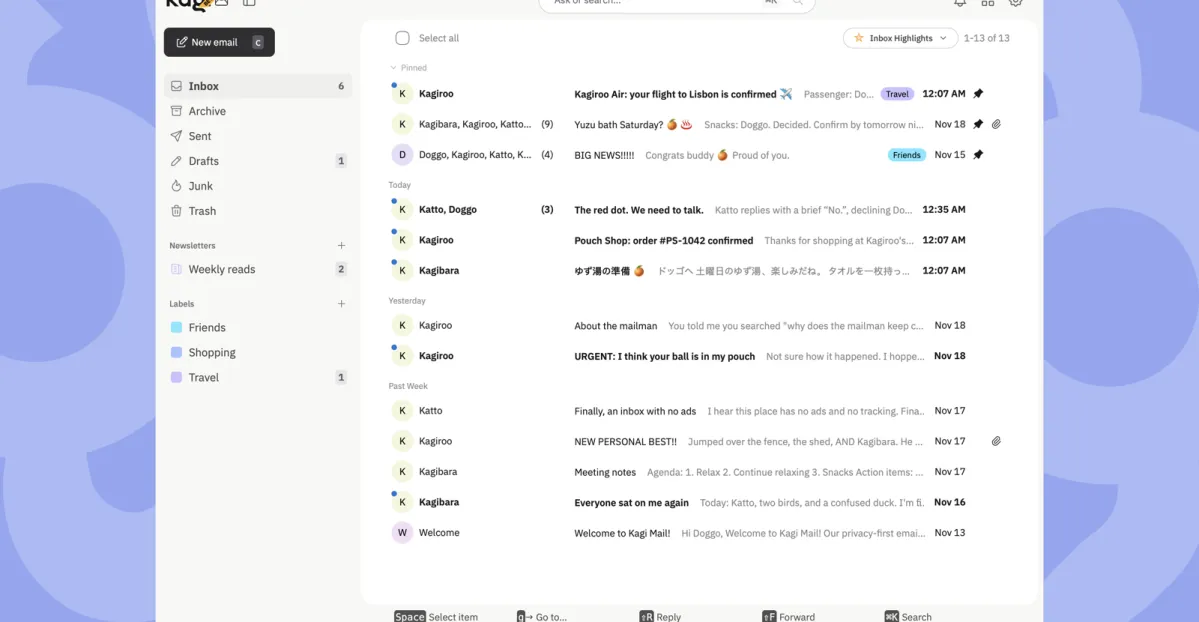
Kagi has officially launched the public beta of Kagi Mail, expanding its privacy-first subscription ecosystem into direct competition with Google's Gmail. The company announced that the new email platform operates on a user-funded model designed without advertising, data surveillance, or algorithmic tracking. The debut marks Kagi's most ambitious push yet to construct an independent suite of web services that rival incumbent tech conglomerates.
The service is explicitly marketed around four core principles: zero surveillance, no ads, adherence to open standards, and zero vendor lock-in. Unlike mainstream free email providers that monetize communications through ad targeting and data harvesting, Kagi Mail relies entirely on direct customer subscriptions. Subscribers receive access to a modern web client, an integrated calendar, and 50 gigabytes of dedicated storage.
Kagi built the system around open-source architecture and standardized communication protocols, including IMAP, JMAP, and CalDAV. This architectural foundation ensures users are not tethered to proprietary applications and can manage their accounts through any compatible third-party desktop or mobile email client. The company emphasized that interoperability remains a primary defense against traditional platform lock-in.
Users signing up for the platform can operate with custom domain names or choose native @kagimail.com addresses. To help safeguard personal privacy across the web, Kagi Mail also incorporates unlimited email aliases that allow subscribers to generate disposable addresses for newsletters and online registrations. These forwarding tools help prevent personal inboxes from exposure to data brokers and spam operations.
Alongside basic messaging tools, the service introduces several opt-in productivity features powered by artificial intelligence. These include thread mapping to clarify complex multi-party exchanges, automated inbox summaries, and sender screening designed to catch phishing attempts before they land in an active inbox. Kagi notes that all artificial intelligence features can be completely deactivated with a single toggle for users who prefer strict manual control.
The expansion into electronic mail follows Kagi's successful entry into paid web search and browser development. Founded to offer a direct commercial counterweight to Google Search, Kagi's flagship search engine gained a loyal following by delivering ad-free, customizable search results funded by monthly subscriptions. The company also develops Orion, a lightweight, privacy-oriented web browser designed as an alternative to Chrome and Safari.
Taking on established email giants represents a formidable challenge in modern software, as switching email providers is notoriously difficult for mainstream consumers. Legacy providers like Gmail, Microsoft Outlook, and Yahoo dominate global communications and serve as default identity anchors for millions of digital accounts. Even so, rising concerns over privacy compromises, invasive ad profiles, and automated inbox scanning have opened a viable market for independent alternatives such as Proton Mail and Fastmail.
Kagi Mail is currently open to prospective users through a 60-day free trial period. Following the trial, ongoing access costs ninety-nine dollars annually, though the service is bundled without extra charge for members subscribed to Kagi's top-tier Ultimate plan. The pricing structure reinforces Kagi's broader philosophy that digital privacy can only be sustainably preserved when software is funded directly by its end users.
As the public beta progresses, Kagi plans to refine the platform based on feedback from early adopters while completing native application support across major operating systems. Industry observers will be watching closely to see whether consumer demand for privacy-focused tools can drive meaningful adoption in an email market long dominated by free, ad-supported incumbents. For privacy advocates, the release represents another meaningful step toward building a decentralized and accountable web experience.
Primary source: The Verge. Newzly rewrites and structures source reporting for clarity; verify critical details at the original.