Gujarat CMO Reviews Saurashtra and Kutch Grievance Cases via SWAGAT
The Gujarat Chief Minister's Office has reviewed citizen grievance cases from the Saurashtra and Kutch regions under the state's SWAGAT online grievance redressal initiative, urging administrative departments to ensure timely resolutions.
In this piece
Officials from the Gujarat Chief Minister's Office have reviewed pending public grievances originating from the Saurashtra and Kutch regions through the state's…
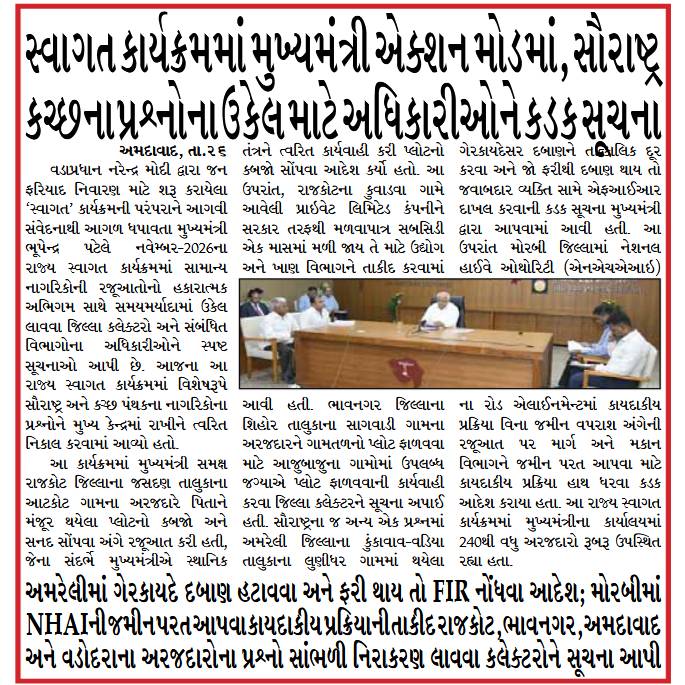
The Gujarat Chief Minister's Office conducted a comprehensive review of citizen grievance cases from the Saurashtra and Kutch regions under the state's SWAGAT online initiative. The administrative session focused on scrutinizing long-pending civic matters and direct representations submitted by residents from across the state's western districts. Administrative leadership instructed regional authorities to accelerate the disposal of registered complaints and avoid procedural delays.
The review evaluated administrative responses across municipal bodies and district departments handling public petitions in both Saurashtra and Kutch. Officials examined the status of individual representations logged through the grievance portal, seeking updates on pending clearances and field verifications. The proceedings highlighted the state leadership's emphasis on direct oversight to ensure that citizen grievances receive structured, accountable consideration.
SWAGAT, which stands for State-Wide Attention on Grievances by Application of Technology, is Gujarat's flagship digital public grievance redressal mechanism. Established to create a transparent conduit between citizens and governance bodies, the initiative uses digital applications and periodic executive reviews to monitor administrative responsiveness. The system operates hierarchically, covering taluka, district, and state levels to address citizen petitions that encounter bottlenecks in routine administrative channels.
The focus on Saurashtra and Kutch highlights key geographic regions characterized by expansive rural areas, industrial coastal belts, and evolving urban centers. Citizens in these districts frequently file petitions related to land administration, local infrastructure maintenance, agricultural concerns, and civic amenities. Managing grievances from these diverse topographies requires close coordination between local administrative offices and centralized state departments.
Under the SWAGAT framework, high-level online review sessions allow senior executives to question district authorities directly regarding unresolved citizen submissions. Grievance applications submitted to the portal undergo preliminary documentation before being flagged for regional or state-level appraisal. The digital mechanism aims to eliminate bureaucratic inertia by requiring departmental heads to explain why specific grievances have lingered without administrative closure.
Direct reviews by the Chief Minister's Office serve as an essential enforcement tool within Gujarat's administrative architecture. When senior leadership intervenes in regional grievances, it establishes administrative accountability across municipal corporations, district collectorates, and panchayat bodies. Observers note that such high-level interventions prevent lower-tier administrative tiers from issuing superficial paperwork closures without solving the underlying issues on the ground.
The continued reliance on digital grievance platforms reflects an institutional shift toward technology-enabled public administration in India. By centralizing petition tracking online, governance systems create searchable audit trails that document every stage of a citizen's complaint. This technological visibility helps protect applicants from bureaucratic runarounds while offering policymakers measurable data on which public departments generate the highest volumes of citizen complaints.
Despite the systematic design of digital grievance portals, civil society monitors and administrative reviews frequently encounter persistent implementation bottlenecks. Many grievances escalated to the state level involve intricate interdepartmental jurisdictions, boundary verifications, or ongoing revenue assessments that resist swift clerical resolution. Ensuring that field officers execute orders faithfully on the ground remains an ongoing challenge for administrative overseers.
Following the Saurashtra and Kutch case review, district collectors and department heads across the concerned regions are expected to submit compliance reports on the instructions issued. Field teams will likely be tasked with completing pending verifications, processing stalled paperwork, and communicating final resolutions directly to the applicants. State monitors are positioned to track these directives through subsequent digital follow-ups until the flagged complaints reach formal closure.
As Gujarat continues to utilize the SWAGAT online platform, periodic regional evaluations are expected to extend across other administrative zones in the state. The ultimate success of these high-level reviews rests on whether administrative directives translate into durable, equitable outcomes for ordinary citizens. The Chief Minister's Office is expected to maintain regular monitoring schedules to assess whether the directives issued for Saurashtra and Kutch produce tangible improvements in local governance.
Primary source: Google News Gujarat. Newzly rewrites and structures source reporting for clarity; verify critical details at the original.