Haryana cane protests threaten mill supplies and raise sugar price risk
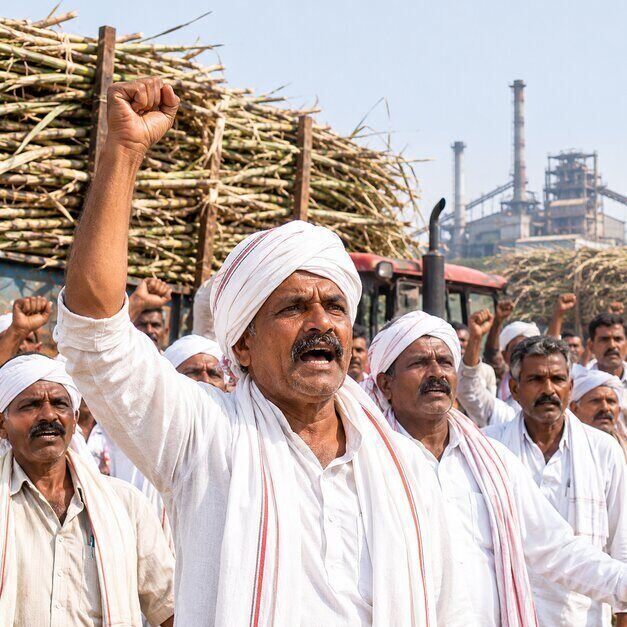
Farmer protests in Haryana are reported to be disrupting cane deliveries to sugar mills, creating a supply squeeze that could add upward pressure on sugar prices.
In this piece
ChiniMandi reports that cane farmers’ protests in Haryana are threatening mill supplies and adding upside risk to sugar prices. Details of the demonstrations…
Cane farmers’ protests in Haryana are threatening supplies to sugar mills and adding upside risk to sugar prices, according to a report carried by ChiniMandi and circulated through Google News. The available account is brief and does not spell out the scale, duration, or precise locations of the demonstrations.
The headline framing is nonetheless clear: grower action is being treated as a risk to the flow of cane into mills rather than as a settled disruption with measured losses. In a state where sugarcane is a major cash crop and mills depend on timely arrivals through the crushing season, even a partial slowdown in deliveries can tighten raw-material availability.
Haryana sits in India’s northern cane belt, alongside larger producing states. Mills in the region typically schedule crushing around the harvest window, when farmers cut and deliver cane under state-advised pricing and payment arrangements. When those arrangements become a flashpoint, roadside protests and withheld deliveries have historically been the tools growers use to press mills and the state government.
The ChiniMandi item does not identify which mills are affected, how much cane has been delayed, or whether crushing has already slowed. It also does not quote farmer groups, mill operators, or officials. Those gaps mean the report should be read as an early warning of supply risk, not as a full accounting of lost tonnage or closed factories.
Why the story matters is the link it draws between farm-gate protest and sugar prices. Mills cannot produce sugar without a steady cane intake. If arrivals fall for more than a short interval, factories may run below capacity, defer crushing days, or face higher costs to secure cane from farther afield. Traders watching wholesale and futures markets often treat that kind of uncertainty as a reason to price in a firmer tone, even before official production numbers change.
“Upside risk” in this context means the chance that prices move higher if the supply threat persists. It does not, on the evidence available, confirm that domestic or export prices have already risen by any particular amount. Broader factors — national cane output, monsoon performance, government export and stock policy, and international sugar balances — still set the larger price backdrop. A localized protest is one input among those, and its weight depends on how long it lasts.
For farmers, the underlying grievances in such episodes commonly involve cane price, arrears, weighing practices, or the timing of mill payments. None of those specifics are stated in the source item, so they should not be assumed for this protest. What can be said is that any action serious enough to threaten mill supplies is likely tied to the commercial relationship between growers and factories during the season.
For mills, interrupted cane supply is an operational problem as well as a commercial one. Crushing campaigns are planned around a finite window. Cane left standing too long loses recoverable sugar, and a stop-start season raises recovery and logistics costs. Buyers of sugar, molasses, and related products watch those conditions because they feed into availability later in the year.
Consumers and bulk users — from household retail to confectionery and beverage makers — would feel a sustained squeeze only if reduced crushing in Haryana were large enough, or long enough, to tighten regional stocks. The current report does not establish that threshold. It does flag that market participants are already treating the protests as a price risk rather than a purely local labor dispute.
What happens next depends on whether deliveries resume quickly or the standoff widens. Confirmation would normally come from mill associations, state cane officials, or follow-up reporting that names affected units and describes whether crushing is continuing. Until those details appear, the prudent reading is the one in the ChiniMandi headline: Haryana’s cane protests are a live threat to mill supplies and a source of upward risk for sugar prices, with the size of that risk still unquantified.
Primary source: Google News Haryana. Newzly rewrites and structures source reporting for clarity; verify critical details at the original.