world·Uttar Pradesh·Lucknow District
India Advancing to Become World Skill Capital, PM Modi Tells Lucknow Convocation
Prime Minister Narendra Modi declared in Lucknow that India is rapidly advancing toward becoming the skill capital of the world, calling for equal respect for vocational graduates and touting nationwide technical training overhauls.
In this piece
Prime Minister Narendra Modi addressed the 5th Kaushal Deekshant Samaroh in Lucknow, emphasizing India's push to become a global hub for skilled labor. Modi…
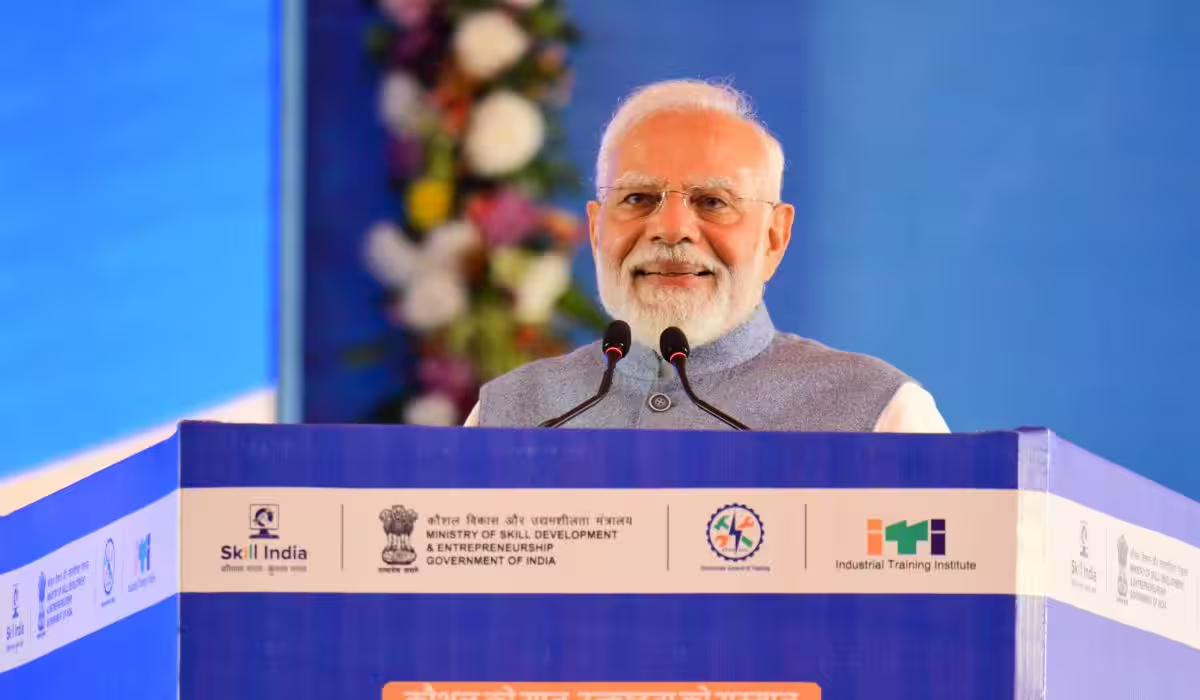
Prime Minister Narendra Modi announced that India is rapidly advancing toward becoming the skill capital of the world, positioning its youth to meet expanding global demand for technical talent. Speaking at the 5th Kaushal Deekshant Samaroh held at the Indira Gandhi Pratishthan in Lucknow, Modi praised vocational graduates as essential architects of modern national development.
The national convocation brought together educators, industry leaders, and trainees, with Modi felicitating 52 national-level toppers from Industrial Training Institutes, National Skill Training Institutes, and Institutes for Training of Trainers. Uttar Pradesh Chief Minister Yogi Adityanath and Union Minister of State for Skill Development and Entrepreneurship Jayant Chaudhary joined the Prime Minister on stage to celebrate the academic and practical accomplishments of the honorees.
During his address, Modi urged society to shed traditional biases that prioritize conventional degrees over hands-on trades, insisting that Industrial Training Institutes and Indian Institutes of Technology are both vital pillars of the nation. He emphasized that the dignity of technical labor must be recognized, arguing that an ITI certificate carries immense practical weight in building national infrastructure and driving manufacturing.
Rooting the modern skilling drive in India's historical heritage, Modi invoked the principle of Shrameva Jayate, or victory through labor, as a guiding economic philosophy. He pointed to indigenous traditions including Lucknow’s Chikankari embroidery, Banarasi silk, Kashmiri Pashmina, and regional metallurgy as historic proofs that skilled artisans have long shaped the country's cultural and commercial identity.
The Prime Minister reviewed a decade of expansion across India’s vocational training landscape, noting that nearly 5,000 new ITIs have been established nationwide since 2014. He highlighted that total enrollment has surged substantially over that period, pointing to a marked rise in young women pursuing technical trades and entering formerly male-dominated industrial fields.
To prepare institutes for modern industrial needs, the government has embarked on upgrading technical curricula and physical facilities through substantial funding initiatives, including the 60,000 crore rupee PM-SETU program. The scheme aims to revamp roughly 1,000 ITIs into advanced hub-and-spoke centers equipped with contemporary machinery, digital classrooms, and industry-aligned testing facilities.
Modi noted that more than 30 new-age disciplines have been incorporated into vocational syllabi to keep pace with global technological shifts. These specialized fields include artificial intelligence, robotics, electric vehicles, semiconductor fabrication, drone operation, cybersecurity, and green hydrogen systems, ensuring domestic workers remain competitive across automated supply chains.
Directly addressing widespread concerns about artificial intelligence displacing human workers, Modi reassured the audience that automation will not eliminate jobs for those who hold verified, hands-on technical skills. He asserted that while digital algorithms can process information, physical execution, precision craftsmanship, and maintenance still require trained human judgment and practical proficiency.
In a major announcement aimed at bolstering India's global vocational standing, Modi revealed that the country will host the WorldSkills Asia competition in Greater Noida in 2027. He described the upcoming international event as an unprecedented opportunity for Indian apprentices to display their capabilities on a global stage while drawing international investment into domestic technical programs.
Looking ahead, policymakers are focusing on deepening partnerships between vocational training centers and multinational manufacturers looking to diversify their global supply chains. With international mobility agreements expanding and high-tech manufacturing gaining momentum under national industrial policies, Indian authorities aim to translate domestic skilling certifications into globally recognized credentials for the next generation of industrial workers.
Primary source: Google News Uttar Pradesh. Newzly rewrites and structures source reporting for clarity; verify critical details at the original.