Indian Railways Completes Breakthrough in Longest Tunnel of Sivok-Rangpo Project
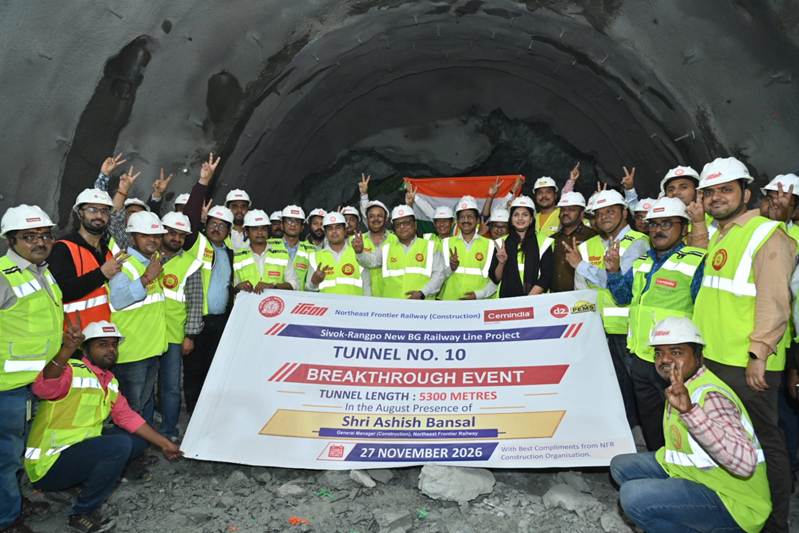
Indian Railways has achieved breakthrough excavation in the 5.3-kilometer Tunnel No. 10, completing underground digging across all 14 tunnels of the strategic Sivok-Rangpo rail line connecting Sikkim.
In this piece
Indian Railways has achieved breakthrough excavation in the 5.3-kilometer Tunnel No. 10 of the Sivok-Rangpo New Line Project, completing tunneling work across…
Indian Railways has completed underground excavation on the 5.3-kilometer Tunnel No. 10 of the Sivok-Rangpo New Line Project, achieving a decisive milestone in the mountain corridor. The successful breakthrough marks the completion of excavation across all 14 tunnels along the route, according to an announcement released by the Ministry of Railways. The achievement clears the most demanding subsurface obstacle on the long-awaited rail corridor.
Tunnel No. 10 stands as the longest tunnel constructed along the 45-kilometer broad-gauge project. Railway engineers and construction crews tackled the difficult Himalayan geological formations by working simultaneously from both portal ends as well as two additional adit access tunnels. This multi-front approach expedited subterranean digging and allowed continuous geological monitoring throughout the alignment.
The Sivok-Rangpo line originates in West Bengal, passing through the Darjeeling and Kalimpong districts before crossing into the Pakyong district of Sikkim. Because the route traverses exceptionally rugged and unstable Himalayan slopes, approximately 86 percent of the entire 45-kilometer alignment is built underground within tunnels. The subsurface design reduces exposure to surface landslides while minimizing disruption to fragile mountain ecosystems.
Alongside the 14 tunnels, the engineering plan features 23 bridges engineered to span deep gorges and cross the Teesta River and its tributaries. The project incorporates passenger stations at Sivok, Riyang, Melli, and Rangpo, providing critical transit hubs across both states. The alignment also features a rare underground passenger halt at Teesta Bazaar, designed to serve communities situated deep inside the mountain valley.
The completion of the rail corridor will connect Sikkim directly to the national broad-gauge railway network for the first time in the state's history. Sikkim has long remained one of the few Indian states without an operational railway link, relying exclusively on road travel and air services. Integrating the state into the broader railway map is expected to transform travel patterns for local residents and tourists alike.
The railway line addresses chronic vulnerabilities associated with National Highway 10, the sole primary highway connecting Sikkim to the plains of West Bengal and the rest of India. The highway frequently faces extended closures during heavy monsoon rains due to landslides, mudslides, and swelling of the Teesta River. Having an underground railway route running parallel will provide a dependable, all-weather lifeline for freight and passenger transport.
Beyond public mobility, the project carries major economic and strategic importance for the northeastern frontier. Reliable rail transport is anticipated to significantly reduce the cost of moving food, construction supplies, and consumer goods into Sikkim. It will also offer stronger logistics support for regional development, local agriculture, and national security infrastructure along the border region.
With underground boring and excavation officially completed across all 14 tunnels, project authorities are turning their attention to secondary engineering and finishing stages. Work is actively progressing on permanent concrete tunnel lining, ballast preparation, and track laying. Teams will also carry out the installation of ventilation systems, power supply lines, signaling infrastructure, and comprehensive railway safety controls.
The successful breakthrough of Tunnel No. 10 paves the way for the project's final phases, bringing commercial operations one step closer to reality. Railway officials indicated that testing and inspection procedures will follow as track and safety installations reach completion. When formally opened, the line will fulfill a longstanding connectivity goal for the Himalayan state and set a new benchmark for mountain rail engineering in India.
Primary source: Google News Sikkim. Newzly rewrites and structures source reporting for clarity; verify critical details at the original.