Investor-Owned Utilities Charge 23% More for Electricity Than Public Providers
A new analysis of U.S. electricity pricing finds that investor-owned utilities now charge an average of 17.8 cents per kilowatt-hour — 23% above public utilities and co-ops — with the gap widening sharply since 2020.
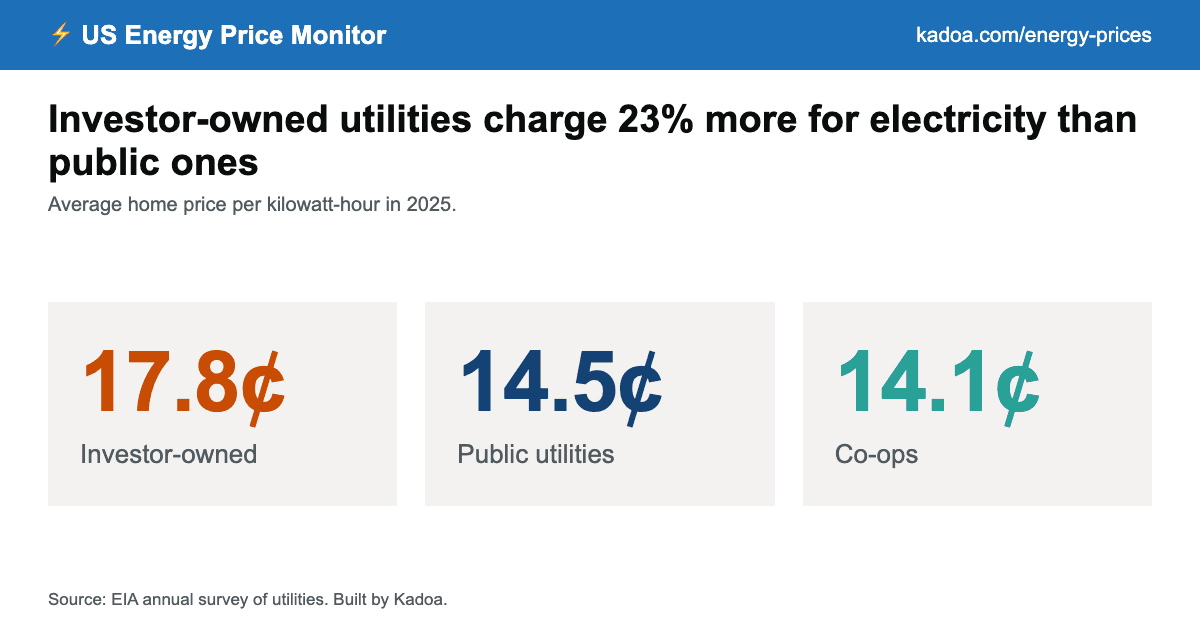
American households served by investor-owned electric utilities are paying significantly more for power than those served by public utilities or rural cooperatives, according to a new pricing analysis by data firm Kadoa. Investor-owned utilities now charge an average of 17.8 cents per kilowatt-hour, compared with 14.5 cents at public utilities and 14.1 cents at cooperatives — a gap of roughly 23%.
The divergence has accelerated sharply over the past five years. Since 2020, investor-owned utility rates have risen 34%, compared with 19% for both public utilities and cooperatives. That spread also outpaced general inflation: consumer prices rose roughly 24% over the same period, meaning investor-owned electricity costs climbed about 7.9% in real terms, while nonprofit provider rates actually fell approximately 4.3% in inflation-adjusted terms.
Much of the divergence was concentrated in a single period. Between 2020 and 2023, during a prolonged global energy crisis driven by post-pandemic demand surges and supply disruptions, investor-owned utilities raised rates by 25%. Public utilities and cooperatives held their increases to around 11% over the same stretch.
The geographic reach of the gap is broad. In 38 of the 48 states where both utility types operate, investor-owned prices rose faster than those of nonprofit alternatives. The largest spreads were recorded in Maine, Washington, and California, states that have each seen significant debates over utility regulation and rate-setting in recent years.
The structural explanation offered by the analysis centers on the shareholder model. Investor-owned utilities are required to earn a financial return for shareholders on the capital they invest in infrastructure. Public utilities and cooperatives, by contrast, have no shareholders and are designed to recover costs rather than generate profit, which tends to put downward pressure on rates.
Despite the higher per-kilowatt-hour cost, investor-owned utility customers do not always face the highest monthly bills. Average monthly household electricity costs are $146 for investor-owned utility customers, $130 for public utility customers, and $159 for cooperative members. The cooperative figure reflects the fact that rural co-op service territories often have lower population density, requiring more infrastructure per customer and higher average consumption.
The findings arrive at a moment of heightened scrutiny for the electricity sector. Grid modernization programs, electric vehicle adoption, and data center buildouts are prompting large capital investment cycles across all utility types, and regulators in multiple states are weighing how to allocate those costs between shareholders and ratepayers.
For investor-owned utilities, large infrastructure projects feed directly into rate base — the asset pool on which regulators allow them to earn a return — giving them an inherent incentive to build that nonprofit providers do not share in the same way. Critics argue this model can lead to gold-plating of infrastructure; proponents contend it attracts private capital that would otherwise require public financing.
The analysis does not account for differences in service reliability, renewable energy mix, or infrastructure age across utility types, factors that can meaningfully affect both costs and the value customers receive. Nor does it assess differences in service territory demographics or regional wholesale power market conditions, which can heavily influence retail rates.
Still, the consistent nationwide pattern — investor-owned prices outpacing nonprofit alternatives in nearly four of five states over a five-year span — is likely to add momentum to ongoing policy conversations about utility ownership structures, rate-setting transparency, and the long-term affordability of electricity as the U.S. grid undergoes its most significant transformation in decades.
Primary source: Hacker News. Newzly rewrites and structures source reporting for clarity; verify critical details at the original.