Kansas-UCLA NCAA soccer match turns on late comeback and full penalty shootout
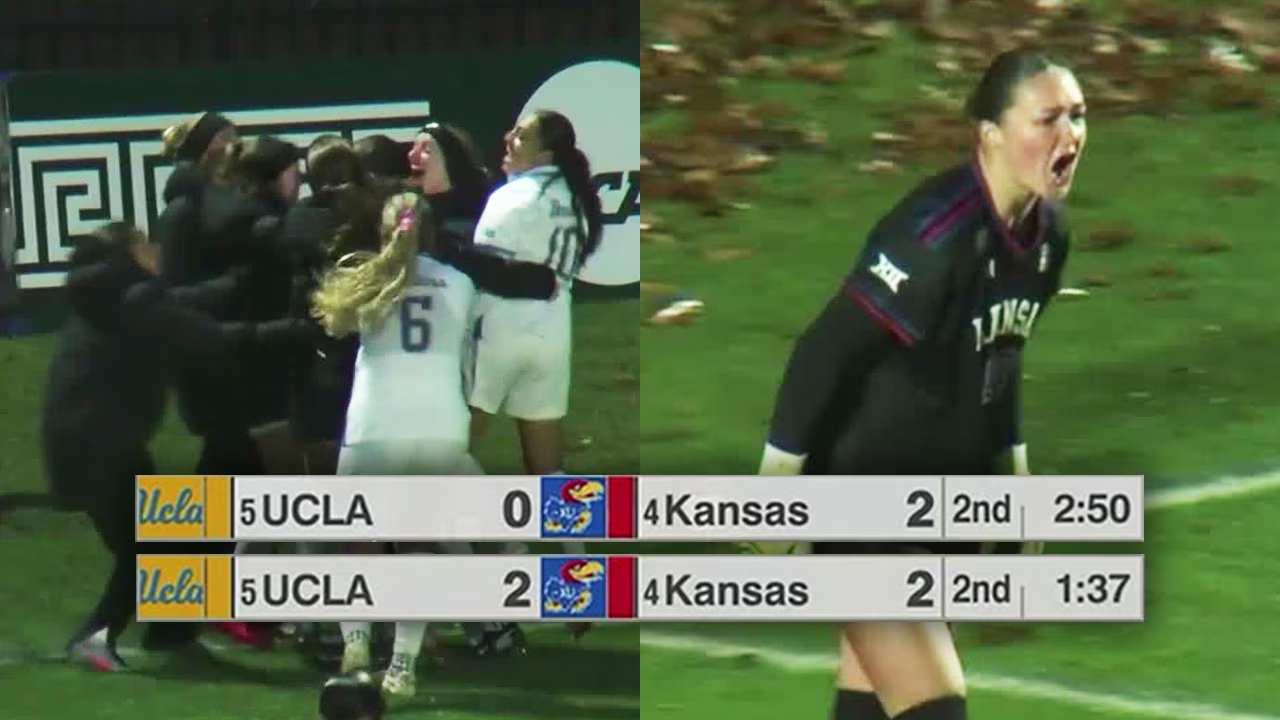
NCAA.com framed a Kansas-UCLA NCAA soccer meeting as a thriller settled only after a late comeback and a complete penalty-kick shootout. The wire item did not include a final score or winner.
In this piece
A Kansas-UCLA NCAA soccer game reached a full penalty-kick shootout after a late comeback, according to an NCAA.com headline carried on a Google News Kansas…
A Kansas-UCLA NCAA soccer match was described as a thriller built on a late comeback and a full penalty-kick shootout, according to a headline from NCAA.com distributed through a Google News Kansas feed. That is the extent of the competitive detail in the item as received. No final score, goal scorers, or winning side appears in the source text.
The pairing places the University of Kansas against UCLA in the NCAA soccer championship structure. The headline does not say whether the match was in the men’s or women’s tournament, which round it occupied, or where it was played. Those facts would normally sit in an official recap or box score, which was not included with this wire summary.
In NCAA tournament soccer, a game that is level after regulation continues into overtime. If the teams are still tied when extra time ends, the winner is decided by penalty kicks. The phrase “full PK shootout” indicates the match reached that tiebreaker rather than being settled in open play. It does not, by itself, establish how many kicks each side took or how the sequence unfolded.
A late comeback means one team erased a deficit late enough to keep the match alive. The headline does not identify which program trailed, when the equalizer arrived, or whether the comeback forced overtime, the shootout, or both. Any reconstruction of the minute-by-minute sequence would go beyond what the source states.
Single-elimination NCAA soccer gives that kind of finish unusual weight. The winner stays in the championship bracket. The loser sees its season end on the same night. A shootout compresses that outcome into a short series of set kicks after a full match has already failed to separate the teams.
Kansas readers have a direct stake because one of the two named programs is theirs, which explains why the item surfaced on a Kansas news feed. UCLA’s presence makes the same result a national college-soccer story as well. Nothing in the headline establishes home-field advantage, attendance, or a campus site in Kansas or California.
No players, coaches, or officials are named in the material. There are no quotations, no card or injury notes, and no mention of a next opponent. The description “thriller” is the source’s characterization of the contest, not a statistical measure.
Until an NCAA.com recap or another primary account supplies the box score, the confirmed frame stays narrow. Kansas and UCLA played an NCAA soccer match. One side mounted a late comeback. The game still required a full penalty-kick shootout. The winner and the score were not part of the item used for this report.
Readers looking for advancement implications should treat the headline as a result alert, not a complete match report. Official championship notes would be the place to confirm the round, the scoring, and which program moved on. Those details should not be inferred from a title line alone.
The next public step is the fuller NCAA account of the same game. That record is what can assign a winner, list the kicks, and place the match in the bracket. Based only on the wire item in hand, the story is the manner of the finish: a late comeback that still left Kansas and UCLA to settle the night from the penalty spot.
Primary source: Google News Kansas. Newzly rewrites and structures source reporting for clarity; verify critical details at the original.