Kimi K3.1 Pro Scores 55 on Artificial Analysis, Hitting the Pareto Frontier
Moonshot AI's Kimi K3.1 Pro has scored 55 on the Artificial Analysis Intelligence Index, securing a spot on the Pareto frontier by balancing frontier reasoning performance with practical operational efficiency.
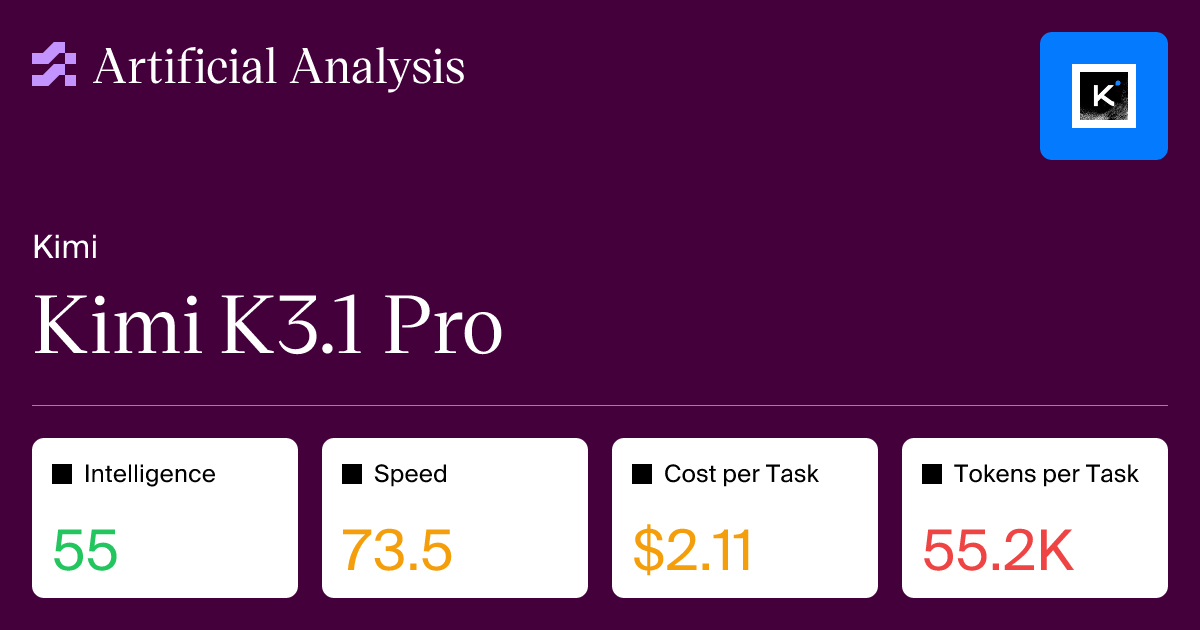
Moonshot AI has reached a significant technical milestone with its latest flagship model, Kimi K3.1 Pro, achieving a score of 55 on the independent Artificial Analysis Intelligence Index. The benchmark result positions the model directly on the industry-watched Pareto line, reflecting an optimal frontier between intelligence and operational efficiency. The placement follows a surge of developer interest across technical communities tracking the next generation of reasoning architectures.
Evaluations conducted by Artificial Analysis place Kimi K3.1 Pro among the top tier of artificial intelligence models tested worldwide. With an index rating of 55, the model moves into fourth place overall on the independent leaderboard, outpacing prominent systems including GPT-6 Astra, Claude Fable 5.1, and Gemini 4 Argon. The ranking positions the release as one of the most capable models currently accessible to developers for technical workloads.
Under the hood, Kimi K3.1 Pro represents an aggressively post-trained evolution of Moonshot AI's prior Kimi K3 foundation. The system is built upon a 2.8-trillion parameter mixture-of-experts foundation that activates an estimated 104 billion parameters during active inference. This selective activation mechanism allows the model to deliver deep reasoning capacity while avoiding the crippling compute latency associated with dense multi-trillion parameter networks.
Moonshot attributed the notable leap in capability to extensive joint reinforcement learning deployed across hundreds of technical domains. The training methodology integrated automated sandbox execution loops, iterative rollout scheduling, and an expansive 1-million-token context window. These architectural choices specifically target complex reasoning, technical problem solving, and long-horizon autonomous agent tasks.
The model's position on the Pareto line serves as a key indicator of practical deployment viability for enterprise engineering teams. On Artificial Analysis, the Pareto frontier maps the trade-off curve between intelligence benchmarks, operating cost, and execution speed. Securing a spot on this boundary demonstrates that the model does not merely achieve high test scores, but does so within practical resource constraints.
The achievement highlights how rapid iterative post-training can narrow the competitive divide between proprietary frontier labs and accessible architectures. Kimi K3.1 gained 11 points over its direct predecessor, illustrating that algorithmic refinement and improved synthetic training environments can drive outsized performance gains. For organizations evaluating frontier deployments, the result offers another viable alternative to existing Western proprietary giants.
In preparation for wider developer distribution, Moonshot implemented targeted safety safeguards into the training pipeline. The development team filtered out offensive cyber-vulnerability research and exploit data from the mid-training and reinforcement learning cycles. This defensive filtering aims to mitigate risks associated with dual-use autonomous tools before broader deployment models are finalized.
The system is currently accessible via Moonshot AI's cloud application interface and developer API using the model identifier kimi-k3.1-pro. Moonshot also introduced a companion endpoint, kimi-k3.1-pro-highspeed, which is designed to process identical reasoning prompts up to three times faster for latency-sensitive applications. Developers are already leveraging both endpoints to assess long-context retrieval and code generation stability.
The next critical test for the architecture will arrive in early November 2026, when Moonshot AI is scheduled to release the model weights publicly. Releasing the weights will allow the broader open-source community to inspect the model's internal representations, verify its benchmark claims on independent hardware, and explore customized fine-tuning for specialized industry use cases.
Primary source: Hacker News. Newzly rewrites and structures source reporting for clarity; verify critical details at the original.