Linux Kernel Security Reports Posted Publicly in Apparent Disclosure Error
Several vulnerability reports reached a public Linux kernel mailing list before mainline fixes were available, Phoronix reported. The apparent disclosure error involved flaws with reported severity scores as high as 9.0.
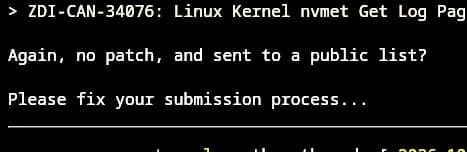
Several Linux kernel vulnerability reports were posted to a public mailing list rather than handled privately, according to Phoronix. The publication described the disclosure as apparently accidental, although that explanation has not been independently confirmed.
Phoronix attributed the submissions to Trend Micro’s Zero Day Initiative and reported that kernel maintainer Greg Kroah-Hartman questioned their public posting. At the time of its report, fixes had not reached mainline, although some patches were undergoing testing or waiting in development branches.
The reported issues included SMB Direct and KSMBD flaws described as potentially allowing remote code execution, both carrying reported CVSS scores of 9.0. Other submissions concerned possible local privilege escalation in networking code and the VMware graphics driver, alongside information disclosure in NVMET code.
Those descriptions identify different potential consequences, not a single vulnerability affecting every Linux installation in the same way. The Phoronix account does not establish the full range of affected releases, deployment-specific exposure or whether attackers have exploited the reported flaws.
The distinction between public and private reporting is central to the incident. Public disclosure before a repair is available can create a period in which defenders know about a potential weakness but cannot yet obtain the corresponding fix through their normal update channels.
The Linux kernel’s security documentation describes security@kernel.org as a private contact for officers who help verify reports and assist with fixes. It generally directs researchers to the relevant subsystem maintainers, with the security team included where appropriate, rather than immediately posting confidential findings publicly.
However, the guidance does not treat every public bug submission as improper. It makes exceptions for issues already public or readily discoverable, including through widely available automated tools, and says AI-assisted discoveries should be treated as public while reproduction material is withheld from public posts.
That qualification matters when assessing what happened here: a public submission alone does not conclusively establish a reporting mistake. The available reporting does not confirm the submitter’s reasoning or whether those exceptions applied to these particular findings, so the apparent error remains an attributed assessment.
The documentation also separates developing an upstream fix from coordinating distribution updates and disclosure. Its stated policy is to release robust fixes for publicly known bugs immediately; limited delays for undisclosed issues are intended to accommodate testing and coordinated rollouts, rather than indefinite secrecy.
The next development to watch is confirmation that the relevant fixes have been accepted and released, followed by information establishing which supported kernels require updates. Phoronix’s account indicates that some repair work was already underway, but it does not provide a confirmed release timetable covering all the reported issues.
Primary source: Phoronix. Newzly rewrites and structures source reporting for clarity; verify critical details at the original.