world·Madhya Pradesh·Bhopal District
Madhya Pradesh Sugarcane Farmers Continue Bhopal Protest as Police Restrict Movement
Sugarcane growers from Madhya Pradesh staged sit-ins across Bhopal for a second day as police erected barricades, stalling marches over demanded cane rate hikes following a collapse in negotiations with private mill owners.
In this piece
Sugarcane farmers in Madhya Pradesh continued protesting in Bhopal for a second day after police blocked routes toward the Chief Minister's residence. Growers…
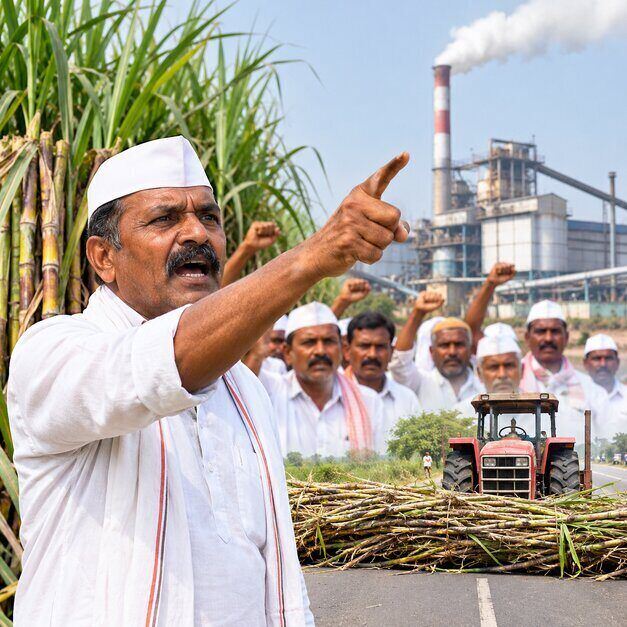
Sugarcane growers from across Madhya Pradesh extended their demonstration in the state capital into a second consecutive day on Tuesday, maintaining sit-ins after law enforcement personnel restricted vehicular and pedestrian movement near critical transport corridors. Police erected barricades around the Veer Savarkar Bridge and the Regional Research Laboratory area to intercept convoys advancing toward government administrative complexes and the Chief Minister's residence.
The ongoing demonstration is spearheaded by the Rashtrawadi Kisan Army, with farmer representatives and rural demonstrators arriving in substantial numbers from Narsinghpur district, the primary sugarcane-growing belt of central Madhya Pradesh. Demonstrators assembled after regional talks mediated by local authorities failed to reconcile deep divides between agricultural producers and private processing facilities.
At the center of the dispute is a demand for a guaranteed sugarcane purchase rate of 600 rupees per quintal for the current crushing season. Agitating farmers are also seeking an additional state-funded bonus of 100 rupees per quintal to help alleviate the financial strain caused by volatile agricultural markets.
Beyond base pricing, farmer representatives are pressing the state administration to enforce a strict statutory mandate ensuring that all cane deliveries are fully settled within fourteen days of arrival at mills. They have also requested mandatory interest charges on delayed payments to prevent processors from holding unpaid dues for months at a time.
Growers argue that the existing compensation structure is insufficient to match the rapidly climbing cost of cultivation across central India. The price of essential agricultural inputs, including synthetic fertilizers, certified seed varieties, electricity tariffs, and tractor diesel, has increased steadily over recent seasons alongside steep hikes in daily labor and field-to-mill transport expenses.
Tensions reached a tipping point earlier this month when administrative conciliation convened by the district collector in Narsinghpur ended without an agreement. While farmer delegations firmly maintained their requirement of 600 rupees per quintal, private sugar mill owners refused to exceed 450 rupees per quintal, claiming higher procurement figures would threaten their operational viability.
Faced with the standoff in the home district, hundreds of growers traveled toward Bhopal to press their case directly before senior state officials. However, local police forces intervened along designated arterial corridors, sealing off thoroughfares and deploying personnel in riot gear to prevent the crowd from approaching official government offices.
Unable to proceed further into the city, the protesting farmers have begun converting transit points and road shoulders into semi-permanent camps. Agitation organizers have marshaled consignments of dry food rations, drinking water, and basic cooking amenities, demonstrating their intent to sustain an extended roadside vigil until ministerial talks are formally scheduled.
The agitation reflects growing friction across regional agrarian economies where fixed processor offers collide with escalating operational overheads for cash crops. Madhya Pradesh's sugar sector serves as a vital economic engine for the central districts, leaving district administrators anxious to resolve the conflict before the peak winter harvest schedule is completely disrupted.
For now, both farmer leaders and administrative representatives remain in a watchful stalemate as traffic diversions remain active across Bhopal. Observers note that any breakthrough will depend on whether state authorities decide to intervene directly to bridge the financial gap between mill operators and growers before broader protests spread to neighboring agricultural hubs.
Primary source: Google News Madhya Pradesh. Newzly rewrites and structures source reporting for clarity; verify critical details at the original.