world·Madhya Pradesh·Bhopal District
Madhya Pradesh Unveils Five Initiatives to Boost MSME Exports Under Free Trade Agreements
Madhya Pradesh has unveiled a five-point trade initiative, including an action plan and dedicated helpdesk, to help local MSME exporters leverage India's free trade agreements and target one lakh crore rupees in exports.
In this piece
The Madhya Pradesh government launched five export-promotion initiatives at a trade conclave in Bhopal to support MSMEs. The package includes a 2026–27 action…
The Madhya Pradesh government has launched a suite of export-promotion initiatives aimed at helping micro, small, and medium-sized enterprises tap into global trade networks. Unveiled during the Madhya Pradesh Export and Free Trade Agreement Conclave in Bhopal, the measures are designed to help regional businesses utilize India's existing and upcoming foreign trade pacts.
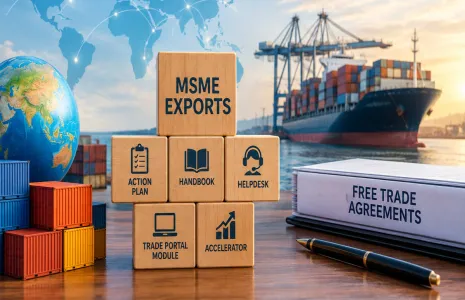
The administration introduced five targeted interventions to simplify international commerce for small manufacturers across the state. These include the Madhya Pradesh FTA Action Plan for 2026–27, a dedicated FTA Handbook, an online trade portal module, an enterprise accelerator, and a direct inquiry helpdesk. State officials emphasized that the combined framework addresses long-standing institutional bottlenecks that previously discouraged regional firms from pursuing cross-border transactions.
At the center of the strategy is the 2026–27 FTA Action Plan, which outlines 31 specific action points arranged across seven strategic objectives to systematically expand state outbound shipments. Complementing the roadmap, the state released an FTA Handbook designed as a practical guide for entrepreneurs. The publication details preferential tariff benefits across diverse commodity categories, clarifies rules of origin, and provides directory information for trade authorities.
To assist business owners navigating complicated regulatory clearances, the state established a dedicated single-window FTA Helpdesk. Operating through designated telephone and email channels, the unit is mandated to answer queries regarding export certification, international standards, and tariff classifications within two business days. Alongside the desk, authorities launched an FTA module within the Madhya Pradesh Trade Portal to provide digitized market intelligence.
The government also unveiled an FTA Accelerator mechanism intended to identify high-potential small enterprises and fast-track their readiness for overseas markets. Small and medium enterprises form the backbone of the state's industrial employment and manufacturing output, yet many struggle with non-tariff barriers and compliance overheads. The accelerator seeks to bridge that gap by preparing local suppliers to meet global supply chain benchmarks.
Senior leadership at the conclave, including state MSME Minister Chaitanya Kumar Kashyap and senior administrative officials, outlined a broader economic ambition behind the program. The state is pursuing a long-term goal of reaching one lakh crore rupees in total export volume. Officials noted that maximizing the benefits of bilateral trade agreements is vital to sustaining that growth trajectory amid evolving global commerce patterns.
The state initiatives align with broader national trade developments, as India continues to negotiate and implement free trade agreements with key trade partners across Europe, the Middle East, and Asia. Despite reduced tariffs under these treaties, domestic utilization rates among smaller firms have historically remained subdued due to limited awareness and complex documentation procedures. Madhya Pradesh is seeking to reverse this trend by localizing institutional support.
Trade analysts and regional industry representatives note that decentralized state assistance is essential for integrating inland industrial corridors with seaports and international cargo routes. By reducing informational barriers, small-scale producers in textiles, agriculture, engineering, and manufacturing can better compete against foreign rivals in preferential export destinations. Expanding overseas sales is also expected to attract ancillary investments and generate high-skilled manufacturing employment.
Moving forward, commerce departments and district industry centers are expected to hold regional awareness workshops across commercial clusters to drive adoption of the new digital tools. Authorities will monitor query response times at the helpdesk and evaluate how effectively local exporters claim duty preferences under active agreements. As global trade dynamics continue to shift, the state aims to establish a repeatable framework for small-firm internationalization.
Primary source: Google News Madhya Pradesh. Newzly rewrites and structures source reporting for clarity; verify critical details at the original.