MSTR’s Bitcoin Outperformance Depends on the Entry Date
A Bitcoin.com News analysis questions Saylor’s amplified-exposure pitch for MSTR, arguing that comparisons with bitcoin depend on when investors bought and that the two investments are not interchangeable.
In this piece
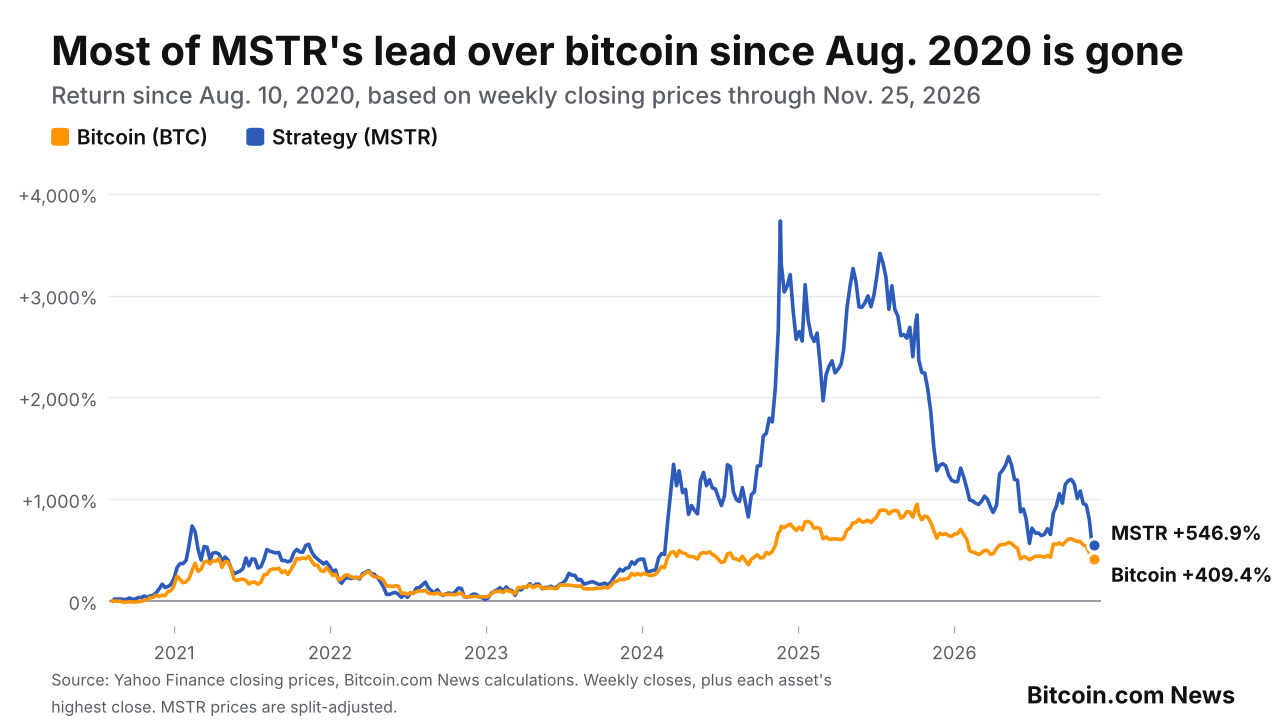
MSTR’s performance advantage over bitcoin varies with the investment’s starting date, according to a Bitcoin.com News opinion and analysis article. The piece…
MSTR’s claimed performance advantage over bitcoin depends on the entry date, according to a Bitcoin.com News opinion and analysis article that questions Saylor’s amplified-exposure pitch. Its central argument is that bitcoin can also outperform MSTR, making the starting point essential to any comparison of the two investments.
The article challenges the idea that MSTR offers a consistently superior way to gain bitcoin exposure. Rather than establishing a universal winner, the supplied account describes a relationship in which the relative result changes according to when an investor entered the market. That qualification limits what a broad outperformance claim can demonstrate.
Entry dates matter because investment returns measure changes from a particular starting value, not performance in isolation. Two investors comparing the same assets over different periods can therefore reach different conclusions without either calculation necessarily being wrong. A favorable comparison for one holding period does not establish an advantage across every other period.
That distinction is central to evaluating the amplified-exposure argument attributed to Saylor. Greater exposure to an asset’s price movements and better realized investment returns are different propositions. Even if an investment is presented as a way to magnify exposure, that description alone does not establish that every buyer will finish ahead of someone holding the underlying asset.
The source also flags differences between MSTR and bitcoin, cautioning against treating them as interchangeable investments. At the most basic level, a stock and bitcoin are different assets, so a comparison should identify what is being measured rather than rely solely on their shared association. Similar investment narratives do not make their returns identical.
For investors, the practical issue is whether a performance claim matches the period relevant to their own decision. A comparison beginning on a particularly favorable date may accurately describe that interval while offering a limited picture of other entry points. Examining alternative starting dates can help distinguish a period-specific result from a broader claim of superiority.
The supplied material does not include return figures, comparison dates or a detailed account of the differences discussed in the full article. It therefore does not support a numerical judgment about the size or duration of either asset’s lead. Nor does it establish which investment would outperform over a future holding period.
The analysis leaves the amplified-exposure pitch subject to a narrower test: whether its supporting comparisons remain persuasive when the entry date changes. Going forward, the relevant question is not simply whether MSTR has beaten bitcoin over a selected interval, but how clearly any performance claim states its timeframe and limitations.
Primary source: Bitcoin.com News. Newzly rewrites and structures source reporting for clarity; verify critical details at the original.