Myanmar Military Air Strikes Kill Dozens at Wedding Venue and School
Recent air strikes launched by Myanmar's military government have struck a wedding venue and a school, killing dozens of civilians as the junta increasingly relies on aerial firepower to quell nationwide resistance.
In this piece
Air strikes conducted by Myanmar's military government have killed dozens of civilians across the country, hitting a wedding venue and an educational facility…
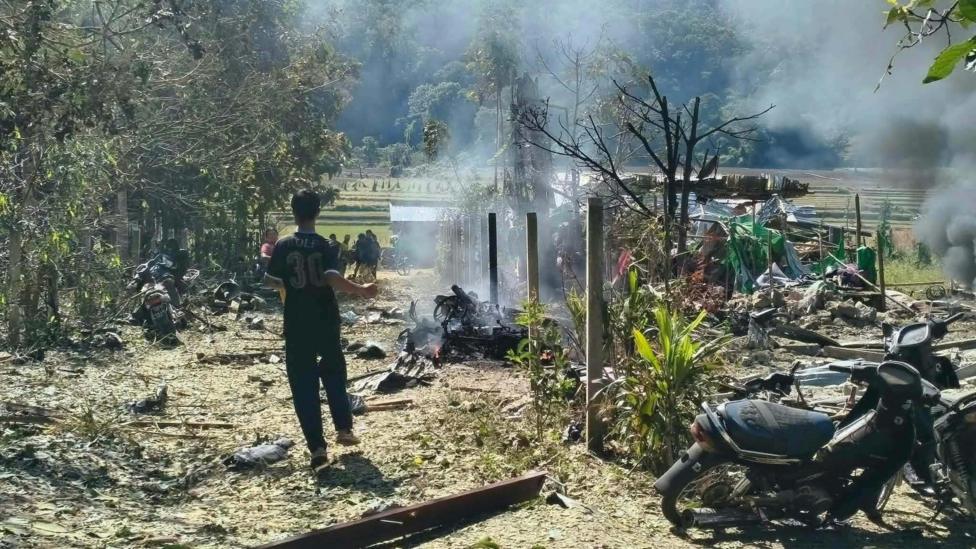
Air strikes conducted by Myanmar's military government have killed dozens of civilians over recent days, striking community locations that included a wedding venue and a school. The deadly bombardments underscore an intensifying reliance on aerial warfare by the ruling military junta as armed conflict persists across the Southeast Asian nation. The incident represents one of the deadliest series of reported aerial bombardments in recent weeks.
According to reports documented by international media outlets, the munitions struck civilian gatherings where local residents had assembled for everyday social and educational activities. First responders and local community groups faced severe hazards while attempting to rescue survivors from the rubble of damaged structures. Although precise casualty breakdowns remain subject to ongoing assessment, initial reports confirm significant fatalities and serious injuries among attendees.
The strikes fit into an established military strategy that leans heavily on combat aircraft and heavy artillery to challenge opposition forces. Over the past year, the military has experienced substantial territorial reversals and lost control of numerous strategic outposts to armed resistance alliances. In response to these ground-level vulnerabilities, commanders have increasingly authorized stand-off air raids against areas perceived as unsympathetic to central military rule.
Bombardments targeting schools and festive celebrations highlight the mounting dangers confronting ordinary citizens who have nowhere safe to shelter. Humanitarian organizations have repeatedly emphasized that international humanitarian law strictly forbids indiscriminate attacks on non-combatants and communal infrastructure. The destruction of educational facilities and civic halls further destabilizes daily life and strips communities of basic public safety.
Myanmar has remained engulfed in multidimensional crisis since February 2021, when the military unseated the country's democratically elected civilian administration. The coup prompted nationwide demonstrations that met with violent crackdowns, ultimately prompting widespread armed resistance across rural and urban landscapes. A complex patchwork of newly established local defense units and longstanding ethnic armed organizations has since fought regular troops across several fronts.
The relentless tempo of aerial operations has fueled vast internal displacement, driving tens of thousands of families out of their ancestral villages. Displaced populations are frequently forced to seek refuge in temporary jungle encampments or overcrowded border zones where access to clean water, food, and medicine is scarce. The persistent instability continues to trigger cross-border refugee movements and heightened security concerns among neighboring nations.
The latest casualties have reignited discussions among international policymakers regarding the enforcement of punitive measures against the junta. United Nations officials and advocacy coalitions have repeatedly pressed world powers to halt the shipment of aviation fuel and dual-use components that sustain military flight operations. While several Western governments have tightened economic sanctions, regional diplomatic efforts led by the Association of Southeast Asian Nations have yielded little tangible progress in halting the violence.
Assessing the exact scale of destruction remains profoundly challenging due to localized internet blackouts, severed phone connections, and severe travel restrictions imposed by authorities. Independent journalists and human rights monitors are routinely barred from conflict zones, forcing relief agencies to rely on testimonies smuggled out through local networks. These information blackouts frequently delay international awareness and complicate emergency relief logistics.
Looking ahead, military analysts foresee little likelihood that the aerial offensive will abate as the junta attempts to consolidate its positions ahead of prospective political moves. With frontlines constantly shifting and ground forces stretched thin, air campaigns are expected to remain a primary instrument of state force. Without decisive international consensus or a breakthrough in regional diplomacy, civilian populations across contested regions will continue to bear the heaviest costs of the escalating conflict.
Primary source: BBC World. Newzly rewrites and structures source reporting for clarity; verify critical details at the original.