NASA APOD Highlights Apollo 17 VIP Site in Restored 3D View
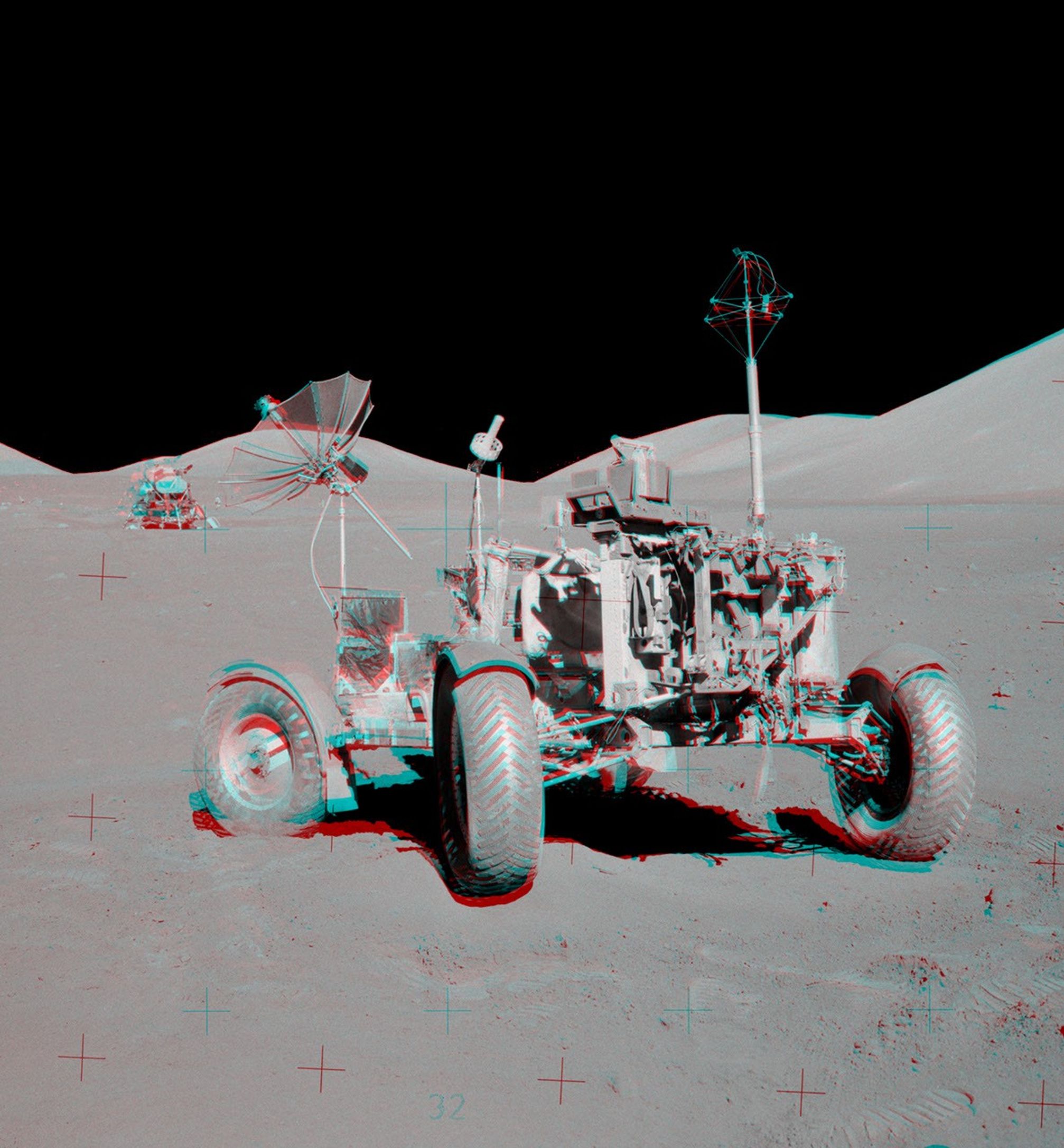
NASA's Astronomy Picture of the Day has featured a 3D stereo anaglyph of Apollo 17's VIP Site, showcasing humanity's final lunar landing site in immersive detail.
In this piece
A newly featured 3D stereo anaglyph on NASA's Astronomy Picture of the Day captures the Apollo 17 landing site in the Taurus-Littrow valley. The restored scene…
NASA's Astronomy Picture of the Day has spotlighted a vivid 3D stereo anaglyph of the Apollo 17 landing site, offering an immersive view of humanity's final crewed lunar expedition. The daily science feature revisits historic archival imagery from December 1972, presenting the Moon's desolate surface through modern digital stereoscopic processing.
Designed for viewing with standard red and blue 3D glasses, the composite photograph depicts the Apollo 17 Lunar Roving Vehicle parked in the rugged Taurus-Littrow valley. In the background behind the electric rover, the Lunar Module Challenger stands ready on the dusty plains, framed against steep lunar hills in the distance.
Astronauts Eugene Cernan and Harrison Schmitt deliberately parked the vehicle at this specific vantage point, dubbing it the VIP Site. The location was carefully selected so the rover's remote-controlled television camera could document and broadcast Challenger's ascent stage launching from the Moon back to Earth. That televised departure marked the conclusion of humanity's final lunar surface excursion of the twentieth century.
Apollo 17 was the sixth and final mission of NASA's historic Apollo lunar landing program. Over the course of three days on the surface, Cernan and Schmitt logged roughly 75 hours on the Moon, including more than 22 hours of field work that yielded essential rock and soil samples.
The original stereo pair used to assemble the image was photographed on high-resolution film by mission commander Cernan during an extravehicular excursion across the valley floor. Imaging specialist Erik van Meijgaarden later aligned and processed the dual frames into a cohesive color anaglyph, preserving subtle topographic variations across the lunar soil.
The Lunar Roving Vehicle drastically expanded the exploration capabilities of late Apollo missions, allowing astronauts to travel several kilometers away from their landing craft. Operated remotely from mission control in Houston, the rover's camera system provided ground controllers and the worldwide public with direct visual coverage of critical operations.
More than five decades after the mission concluded, such imagery serves as a poignant reminder of the engineering triumphs achieved during the original space race. Restoring archival Apollo photographs in stereoscopic 3D gives contemporary audiences an authentic spatial sense of the challenging alien terrain navigated by the astronauts.
Scientific analysis of the geological samples and documentation gathered at Taurus-Littrow continues to inform modern planetary science and theories of lunar volcanism. Researchers regularly cross-reference Apollo's photographic records with current high-resolution orbital maps captured by spacecraft like the Lunar Reconnaissance Orbiter.
As space agencies advance the Artemis program with goals of establishing a sustainable human presence on the lunar surface, Apollo's archival legacy remains highly relevant. Features like the Astronomy Picture of the Day ensure that the pioneering achievements of early lunar exploration continue to inspire future missions beyond Earth.
Primary source: NASA Breaking News. Newzly rewrites and structures source reporting for clarity; verify critical details at the original.