NEAR Protocol Governance Votes to Cut Token Issuance by 36%
NEAR Protocol's House of Stake has approved a 36% cut to annual token issuance over two years, aiming to curb supply dilution while lowering staking yields for network validators.
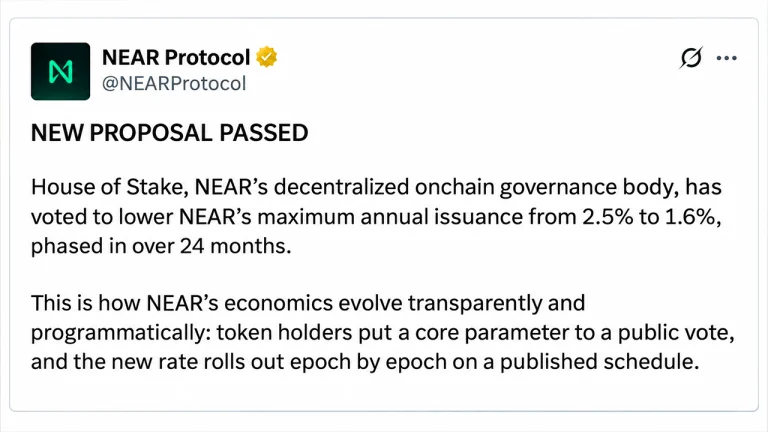
NEAR Protocol governance participants have voted overwhelmingly to reduce the blockchain network's annual token issuance ceiling by 36 percent. The decision, approved by the network's House of Stake governance body, establishes a structured two-year schedule designed to curb circulating supply expansion while gradually adjusting reward structures across the ecosystem.
The measure, designated as proposal HSP-029 and authored by SVRN chief executive Sal Ternullo, received near-unanimous endorsement from participating token holders. Community members committing vote-escrowed NEAR backed the initiative with more than 99.9 percent support, signaling broad consensus around tightening the protocol's macroeconomic parameters.
Under the approved framework, NEAR's maximum annual issuance rate will decline from 2.5 percent to 1.6 percent over a 24-month implementation period. The reduction will occur progressively rather than through a single abrupt change, scaling down by approximately 0.0375 percentage points each month to allow market participants and infrastructure providers adequate time to adapt.
Ecosystem projections indicate that the policy adjustment will prevent roughly 11.8 million NEAR tokens from entering circulation during the initial two-year ramp. Over a six-year horizon, modeled supply reductions reach an estimated 66.1 million tokens, markedly reducing programmatic dilution for long-term asset holders.
Despite the substantial reduction in newly minted tokens, the proposal preserves the network's established internal distribution split. Ninety percent of all newly issued NEAR will continue flowing directly to validators and stakers who maintain network security, while the remaining 10 percent remains earmarked for the protocol treasury to fund ecosystem development.
Because aggregate issuance will contract, validator yields will adjust downward in tandem with the slower minting schedule. Modeled estimates suggest that gross annual staking yields on NEAR could decline from around 5.27 percent to approximately 3.37 percent once the reduction reaches full maturity, compressing revenue margins for some node operators.
The governance move highlights an ongoing strategic debate across layer-one blockchain ecosystems between aggressive token issuance to incentivize node infrastructure and supply restraint to protect token value. Proponents argue that sustained high emissions act as an implicit inflation tax on passive holders, while critics frequently caution that diminished yields could weaken network decentralization if smaller validators find operating costs unsustainable.
Supporters of the reduction maintain that NEAR's mature infrastructure and growing transactional utility justify shifting away from subsidizing validator yields through heavy supply dilution. They argue that as on-chain adoption and transaction volumes mature, fee-driven revenue can increasingly offset reductions in base protocol subsidies for efficient node operators.
The vote does not trigger an immediate alteration of the protocol's operational code on mainnet. Formal activation requires ratification from the House of Stake Security Council, followed by an estimated 90-day grace period designed to give stakers and node runners sufficient warning before any parameter changes take effect.
Following the grace window, network validators must formally adopt and deploy a client upgrade to incorporate the new emission schedule into the consensus layer. Observers expect the implementation process to serve as a benchmark for how decentralized governance mechanisms can methodically recalibrate protocol-level monetary policy without disrupting live network stability.
Primary source: Bitcoin.com News. Newzly rewrites and structures source reporting for clarity; verify critical details at the original.