New weather warnings as third storm set to hit Scotland
Scotland faces a third named storm in as many days as tens of thousands of homes remain without power and communities continue to clear up after Storm Austen and Storm Boelo.
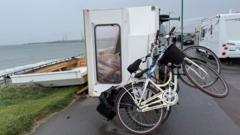
Scotland is on alert for a third named storm in as many days after Storm Austen and Storm Boelo brought severe disruption to transport networks, power supplies and coastal communities across the country. The Met Office issued a yellow weather warning for strong winds covering much of Scotland on Tuesday, effective from 3am until midnight, warning that damaging gusts could cause further travel chaos on ground already saturated by days of relentless rain.
At its peak on Sunday morning, more than 80,000 customers had lost electricity supply, with at least 30,000 of those in Scotland. Engineers were still working to restore connections as forecasters tracked the incoming Atlantic low-pressure system, which is understood to have been energised in part by the remnants of former Subtropical Storm Josephine.
Wind gusts reached 85mph at Machrihanish on the Mull of Kintyre during the weekend storms, among the strongest recorded at the site in recent years. Heavy rain accompanying the systems left 17 flood warnings and 11 flood alerts active across the country, with the Scottish Environment Protection Agency warning of an amber risk of flooding for the Northern and Western Isles, Caithness and Sutherland.
In Fort William, flood gates were closed along the mile-long Caol and Lochyside protection scheme as river levels rose. The Solway Firth, Firth of Clyde and Argyll coastline were also flagged for volatile conditions, with large waves adding to the hazard for low-lying properties.
Rail services were suspended on multiple Scottish routes after tracks became submerged, with flooding reported at Dalmarnock station in Glasgow. Nearly all CalMac ferry sailings serving the west coast islands were cancelled, cutting off communities that rely on the lifeline service for supplies and travel. A fishing boat was also reported stranded at Irvine Harbour amid the disruption.
Largs high street saw extensive surface flooding, with images circulating of vehicles navigating through deep standing water in the town centre. Fallen trees were reported across several regions, blocking roads and causing localised damage to properties.
Assistant Chief Constable Mark Sutherland said police were anticipating further disruption from fallen trees and other storm damage when the next system arrives on Tuesday, urging the public to avoid unnecessary journeys and heed official guidance.
Social Justice Secretary Shirley-Anne Somerville acknowledged the prolonged nature of the conditions, calling on households to become as resilient as possible in the face of successive weather events. She noted the challenges posed by multiple systems arriving in rapid succession, before communities had fully recovered from the previous one.
Forecasters said the third storm could bring severe gales to western Scotland and potentially Northern Ireland, with the warning period extending through much of Tuesday. The heavily waterlogged state of the ground means even moderate rainfall is likely to lead to rapid surface water flooding in areas that have already been badly affected.
Authorities are urging residents across exposed coastal and upland areas to monitor official flood alerts closely, secure outdoor items and charge devices in case of further power outages. The sequence of storms has renewed debate about infrastructure resilience and the capacity of emergency services to respond to overlapping extreme weather events.
Primary source: BBC Science. Newzly rewrites and structures source reporting for clarity; verify critical details at the original.