technology·New York·New York County
Off-Broadway Solo Show Uses Auracast to Broadcast Live Audio Directly to Audiences
A live Off-Broadway production at New York's SoHo Playhouse is using Bluetooth Auracast technology as its primary sound system, broadcasting dialogue directly to audience headphones and compatible hearing devices.
In this piece
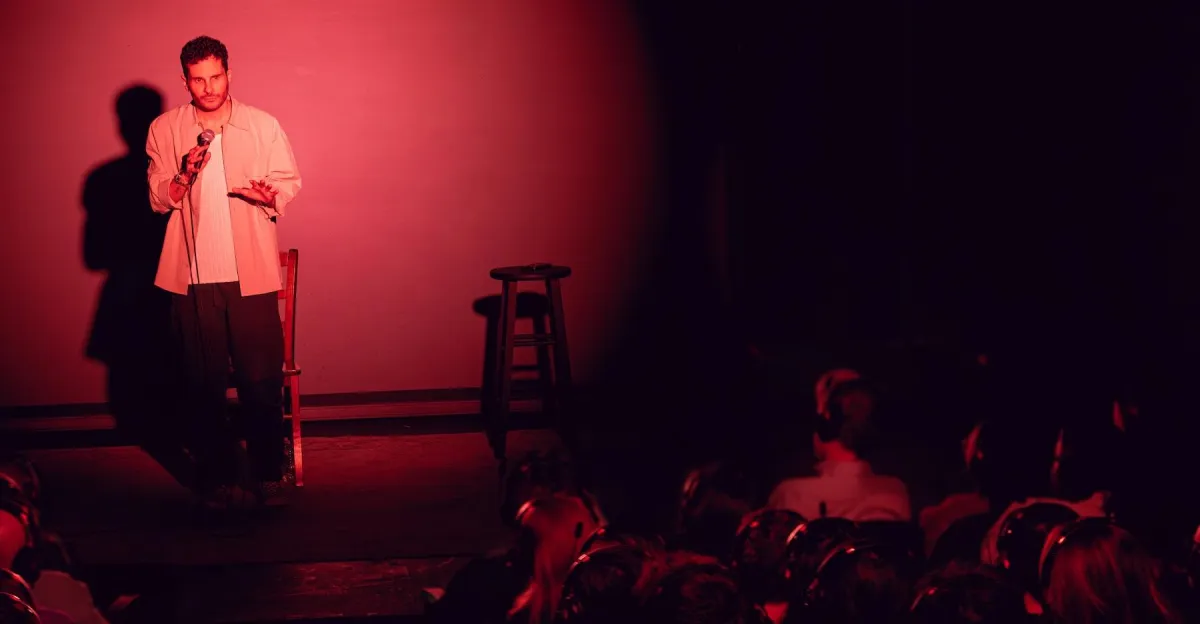
Comedian Drew Michael’s Off-Broadway show 'Love Me' at the SoHo Playhouse in New York has turned to Bluetooth Auracast broadcast technology to deliver dialogue…
Audience members stepping inside the historic SoHo Playhouse in New York City are experiencing live theater through a decidedly unconventional medium. Instead of relying on conventional overhead loudspeakers, the Off-Broadway production of comedian Drew Michael's solo show "Love Me" equips every attendee with an individual listening device. Ushers greet ticket holders at the door of the 178-seat venue with black drawstring bags containing wired headphones plugged into compact wireless receivers powered by Bluetooth Auracast technology.
The setup transforms the physical theater experience into an intimate personal broadcast. Written and performed by Michael, a former "Saturday Night Live" writer, "Love Me" centers on an introspective, stream-of-consciousness narrative charting personal relationships and personal reflection. By channeling the entire performance directly into listeners' ears, the production seeks to mirror internal monologues and nuanced audio cues that traditional venue acoustics might otherwise obscure or distort.
The installation is powered by commercial Auracast broadcast systems developed by assistive listening specialists Listen Technologies and Ampetronic under their joint "Auri" platform. Auracast is a feature of Bluetooth Low Energy Audio designed to broadcast one or more audio streams to an unlimited number of nearby receivers simultaneously. While traditional Bluetooth creates private, one-to-one connections that require manual pairing, Auracast functions more like an unencrypted public radio transmission that compatible devices can join at will.
For the live entertainment and accessibility sectors, this deployment represents a significant technical evolution over older assistive listening frameworks. Theaters and public venues have historically depended on frequency modulation systems, infrared transmitters, or induction hearing loops to serve hard-of-hearing patrons. While those systems have fulfilled legal accessibility mandates for decades, they often suffer from signal interference, high installation expenses, aesthetic constraints, or uneven sound fidelity across different seats.
A major advantage of Auracast lies in its direct compatibility with consumer hardware and modern health devices. Audience members who use Auracast-enabled hearing aids or cochlear implants can stream the stage audio directly into their personal prosthetics without borrowing venue-supplied hardware or neck loops. Patrons using standard audio gear can access the same high-resolution audio stream through the distributed portable receivers, standardizing audio quality across the entire auditorium.
During the performance, the personalized audio feed alters how patrons interact with the live stage. Listeners are granted discrete control over their individual volume levels, eliminating common complaints regarding harsh volume peaks or muffled stage whisperings. At the same time, because the theater remains largely silent from an acoustic perspective, the communal atmosphere of laughter and ambient reactions filters naturally through open-ear or adjusted headphones.
The New York production serves as a visible showcase for Bluetooth SIG, the standards body that has spent several years positioning Auracast as a transformative standard for public audio infrastructure. Beyond performing arts venues, industry advocates envision Auracast transmitters becoming ubiquitous across airport boarding gates, transit stations, fitness centers, sports bars, and cinema multiplexes. Widespread implementation has proceeded gradually, however, as manufacturers steadily incorporate LE Audio compatibility into mainstream smartphones, earbuds, and television soundbars.
Despite the promising deployment in SoHo, logistical hurdles continue to accompany full-venue silent audio setups. Venues must manage extensive inventories of battery-powered transceivers, coordinate pre-show distribution, sanitize headsets between performances, and assist attendees who are unfamiliar with personal audio hardware. Additionally, consumer awareness remains limited, meaning venues cannot yet rely entirely on patrons arriving with their own compatible personal receivers.
As "Love Me" demonstrates the artistic and accessibility viability of the standard, audio engineers and theater producers are evaluating whether similar broadcast frameworks could support multi-language translations and audio-described performances. Observers note that while traditional public address speakers are unlikely to vanish from Broadway houses anytime soon, targeted Auracast deployments offer a practical glimpse into how wireless connectivity can reshape live performance spaces. If hardware compatibility reaches critical mass over the coming years, personal audio channels may transition from an Off-Broadway novelty into a standard feature of modern public venues.
Primary source: The Verge. Newzly rewrites and structures source reporting for clarity; verify critical details at the original.