Open-Source Developer Details Fully Local Voice Assistant Pipeline for Smart Homes
Software engineer Fabio Manganiello has detailed a complete overhaul of his smart home voice assistant architecture, transitioning from fragile commercial cloud integrations to an entirely local, privacy-focused open-source pipeline.
In this piece
A comprehensive technical overhaul detailed by Platypush developer Fabio Manganiello demonstrates how modern open-source software can replace cloud-tethered…
Software engineer and Platypush creator Fabio Manganiello has published an in-depth breakdown of his latest voice assistant architecture, outlining how home automation enthusiasts can build an entirely local, self-hosted alternative to proprietary smart speakers. The project details a modular pipeline that processes audio commands, parses intent, and synthesizes replies directly on low-power consumer hardware without relying on third-party cloud infrastructure.
The new architecture marks the culmination of nearly two decades of experimentation with voice interfaces. Manganiello traced his efforts back to early speech recognition tools tested in the late 2000s, followed by stints integrating developer tools from Google Assistant and Amazon Alexa, as well as discontinued open-source projects such as Snowboy, Mozilla DeepSpeech, and Mycroft Mimic.
Over time, shifts in corporate priorities and discontinued APIs repeatedly broke custom voice automations, highlighting the fragility of building on external ecosystems. When commercial providers sunset developer libraries or abandon specialized hardware, hobbyists and independent developers are often left with nonfunctional hardware and unsupported software stacks.
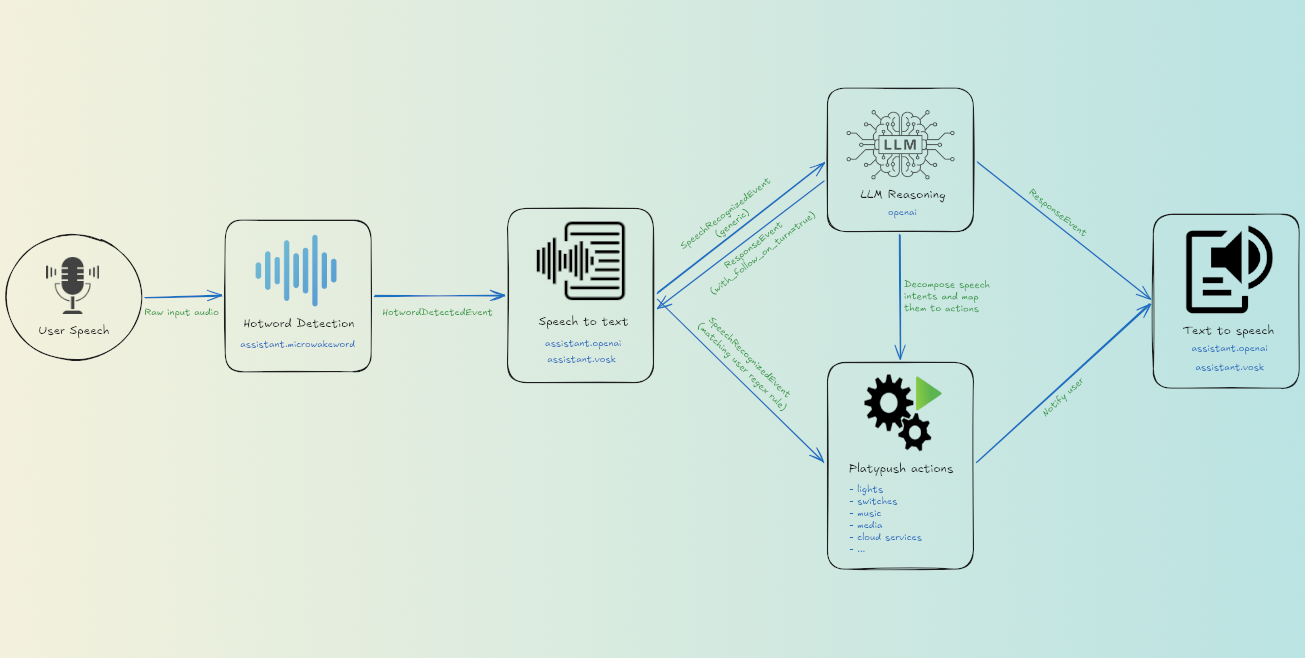
To eliminate those external dependencies, the re-engineered pipeline divides voice interaction into discrete, swappable components powered by modern open-source machine learning models. The process begins with hotword detection handled by openWakeWord, an efficient engine that runs continuously in the background to detect trigger phrases locally with minimal CPU utilization.
Once activated, the system captures spoken input and routes it through local speech-to-text engines like Vosk or quantized Whisper implementations for on-device transcription. The resulting text is then interpreted either through direct pattern matching or via local language model backends, allowing users to map casual speech into structured automation commands.
Command execution is handled directly through Platypush, an extensible open-source automation platform designed to interface with connected devices across local networks. Because the software interacts natively with smart lighting, media players, and environmental sensors, commands execute with low latency and without transmitting telemetry to commercial servers.
For voice feedback, the updated stack integrates Piper, a fast, lightweight neural text-to-speech engine capable of generating natural-sounding audio on single-board computers like the Raspberry Pi. This ensures that the assistant delivers immediate spoken confirmations without depending on remote synthesis APIs that introduce lag or recurring subscription costs.
The architectural rewrite arrives at a time of growing user fatigue with commercial smart assistants, where major platforms have scaled back voice divisions, introduced intrusive advertising, or sunset connected hardware. Privacy-conscious consumers and self-hosting advocates increasingly seek resilient hardware setups that continue functioning even when internet connectivity drops entirely.
Manganiello noted that while maintaining a custom voice stack requires ongoing tuning and technical familiarity, advances in compact machine learning models have finally made local processing viable for everyday household use. As open-source voice models and low-cost neural processors continue to mature, decentralized voice computing is positioned to become an increasingly accessible alternative to centralized big-tech ecosystems.
Primary source: Hacker News. Newzly rewrites and structures source reporting for clarity; verify critical details at the original.