OranjeBTC proposes dividend preferred shares as its stock falls 37% in 2026
The Brazilian bitcoin treasury firm said on Nov. 16, 2026, that it plans two classes of preferred shares paying monthly dividends, a financing idea aimed at bitcoin purchases and local income investors.
In this piece
OranjeBTC, which trades as OBTC3, outlined plans for two preferred-share classes with monthly dividends. Bitcoin.com News reported the move could fund further…
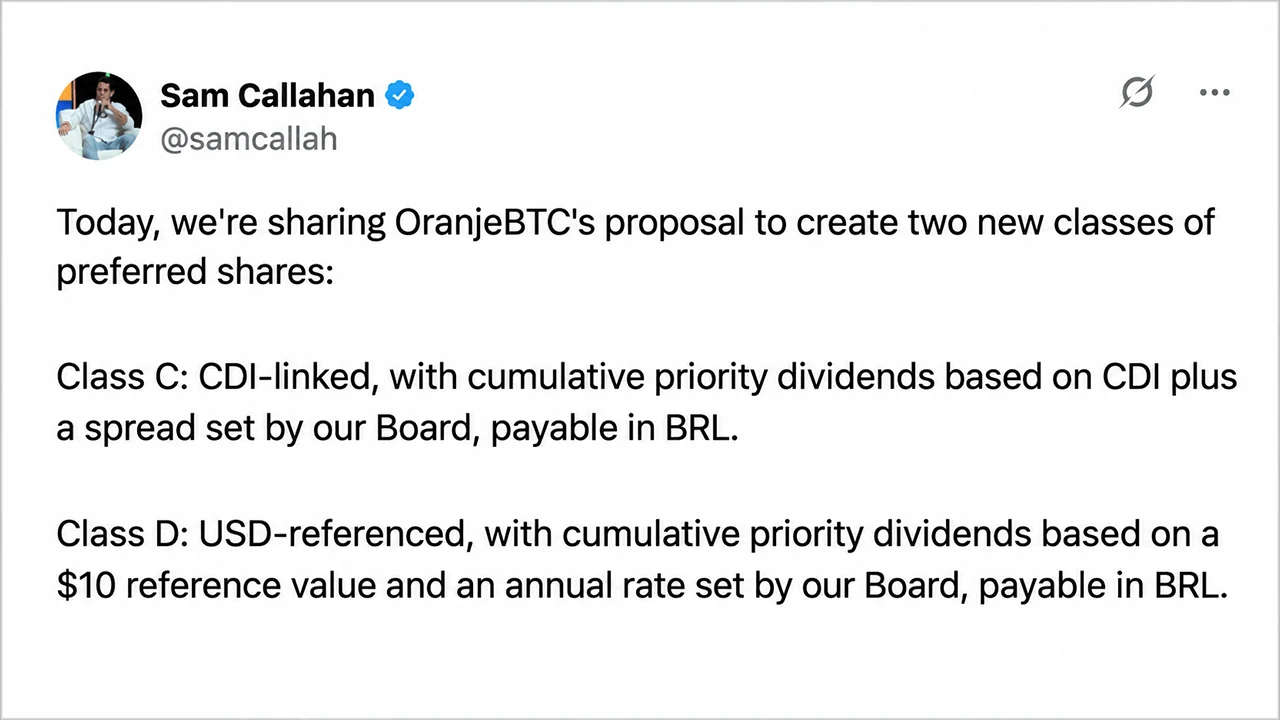
Brazilian bitcoin treasury company OranjeBTC unveiled plans on Monday, Nov. 16, 2026, to introduce two classes of preferred shares that would pay monthly dividends. Bitcoin.com News reported the proposal as a possible new way to raise money for bitcoin purchases and as an income-oriented product for investors in Brazil’s domestic capital markets.
The company trades under the ticker OBTC3. The same report’s headline said the stock has sunk 37% in 2026. The available account did not spell out the causes of that decline, the size of any proposed offering, or the terms investors would receive.
Preferred shares generally sit ahead of common equity for dividends and, in many structures, for claims if a company is wound up. They often appeal to buyers who want regular income rather than only a claim on asset-price gains. Bitcoin.com News framed OranjeBTC’s idea as Strategy-style preferred shares adapted for Brazilian investors, referring to a model in which a bitcoin-holding public company uses preferred equity as a financing channel.
What the company actually filed, or whether Brazilian regulators and the exchange must still approve the classes, was not detailed in the source summary. The report described the step as plans unveiled, not as shares already issued or dividends already declared. Until fuller documents are public, the dividend rate, conversion rights, voting limits, and any link between new capital and bitcoin purchases remain unspecified.
OranjeBTC is described as a bitcoin treasury company, meaning its corporate identity is tied to holding bitcoin rather than to a conventional operating business alone. For firms in that category, the cost and availability of capital matter because new purchases of bitcoin typically require cash or securities that can be sold for cash. Preferred shares, if investors buy them, can be one such channel. They can also add a fixed or formula-based payout obligation that common shareholders do not face in the same way.
The report said the products could bring income-oriented investments into Brazil’s home market. That framing matters because many bitcoin-linked listings give holders exposure to price swings without a stated monthly cash distribution. A preferred share with a monthly dividend would, if completed on those terms, sit closer to income products already familiar in local equity markets, while still being issued by a company whose strategy centers on bitcoin.
The 37% decline in the stock during 2026, as stated in the headline, is the main performance figure in the source. A weaker common share can make new financing harder, because investors may demand richer terms, or it can push a company to look beyond selling more common stock. The report did not say which of those pressures, if either, drove the preferred-share proposal, and it did not give OBTC3’s price level, trading volume, or bitcoin holdings.
Comparison with Strategy-style preferred equity is contextual, not a claim that OranjeBTC is copying a specific series, coupon, or prospectus. Public bitcoin-treasury firms elsewhere have used preferred and other capital-markets tools to fund coin purchases and to offer yield-like exposure. Whether OranjeBTC’s two classes would resemble those instruments in seniority, duration, or bitcoin linkage cannot be judged from the summary alone.
For common shareholders, the proposal raises ordinary capital-structure questions: how much new capital might rank ahead of OBTC3, whether dividends would be cumulative, and how much of any proceeds would go to bitcoin rather than to other uses. None of those points were quantified in the material available here. For prospective preferred buyers, the open questions are credit-like: the issuer’s ability to keep paying a monthly dividend through bitcoin price cycles, and what happens if it does not.
Brazil’s market would be the venue Bitcoin.com News highlighted. Local listing, local-currency dividends, and domestic investor rules can differ from U.S. preferred-share practice even when the strategic label is similar. The source did not describe tax treatment, currency of the dividend, or which Brazilian market segment would list the shares.
Next steps depend on corporate and regulatory process that the report did not lay out. Investors will be looking for a full term sheet or filing that names the two classes, states the dividend formula, and explains how proceeds relate to bitcoin acquisitions. Until then, the news is a proposal for monthly-dividend preferred equity at a bitcoin treasury company whose common stock, according to the report, is down 37% in 2026.
Primary source: Bitcoin.com News. Newzly rewrites and structures source reporting for clarity; verify critical details at the original.