Polymarket Puts Eisenkot at 55% to Become Israel’s Next Premier
Bitcoin.com News reports that Polymarket traders gave former Israeli military chief Gadi Eisenkot a 55% chance of becoming prime minister, a market assessment rather than a voter poll.
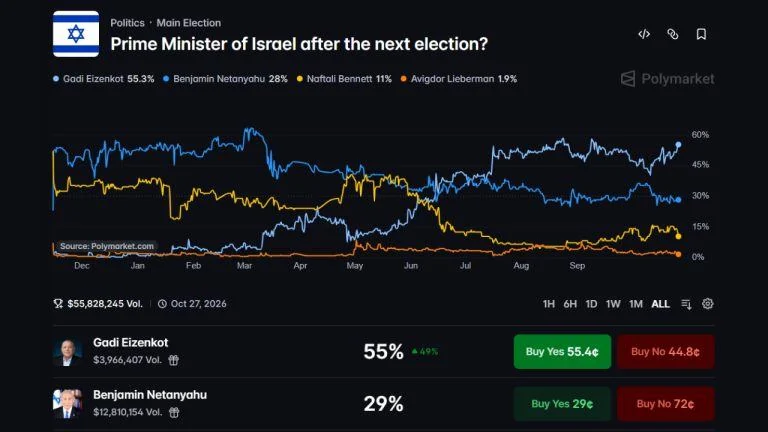
Polymarket traders gave Gadi Eisenkot a 55% chance of becoming Israel’s next prime minister, according to Bitcoin.com News, placing the former military chief ahead of Benjamin Netanyahu and other contenders in the reported market snapshot. The figure represents a trading-based assessment of the leadership outcome following the next parliamentary election, not a confirmed political result.
Eisenkot previously served as chief of staff of the Israel Defense Forces. His reported position at the top of the market puts a former senior military leader at the center of traders’ expectations about who could lead the next government. However, the supplied report excerpt does not establish when the 55% reading was recorded.
That timing matters because prediction-market prices change as participants buy and sell. Polymarket’s documentation explains that its odds emerge from users’ trading activity rather than being assigned by the platform. The reported figure should therefore be understood as a snapshot, not a fixed forecast that necessarily remains available to traders.
On Polymarket, prices are presented as implied probabilities of particular outcomes. Its documentation gives the example that a share trading at 18 cents indicates an 18% market-implied chance of the event occurring. This framework translates trading prices into an accessible probability, but it does not turn those prices into a measurement of voter support.
The distinction is particularly important in Israel, where parliamentary elections and the selection of a prime minister are connected but separate stages. Voters elect the Knesset rather than directly choosing the head of government. A market about the next prime minister consequently addresses a different question from which party receives the most votes or parliamentary seats.
According to the Knesset’s explanation of government formation, the president consults parliamentary groups before assigning a member the task of forming a government. The proposed government must subsequently secure an expression of confidence from the Knesset before taking office. These steps mean the leadership outcome depends on the government-formation process, not simply an individual candidate’s standing before election day.
The 55% reading suggests that traders at the reported moment considered Eisenkot’s accession more likely than not, while still leaving substantial uncertainty. It does not establish that he will defeat Netanyahu, secure the necessary parliamentary backing or take office. Nor does the supplied excerpt provide enough information to assess the market’s trading depth or the breadth of participation behind that price.
The next meaningful tests will be the parliamentary result and the ensuing effort to establish a government. The Knesset notes that the outgoing government continues to perform its functions until a new one is formed. Until that process produces an outcome, the reported Polymarket odds remain an indication of expectations rather than evidence that a transfer of power is assured.
Primary source: Bitcoin.com News. Newzly rewrites and structures source reporting for clarity; verify critical details at the original.