President Droupadi Murmu Begins Two-Day Visit to Kerala With Cultural and Academic Stops
President Droupadi Murmu arrived in Kerala on Wednesday for a two-day official tour featuring stops at historical pilgrimage sites, an address at an Ayurvedic institution in Thrissur, and a military review at the Indian Naval Academy.
In this piece
President Droupadi Murmu has commenced a two-day official tour of Kerala following her arrival at Cochin International Airport. Her itinerary encompasses…
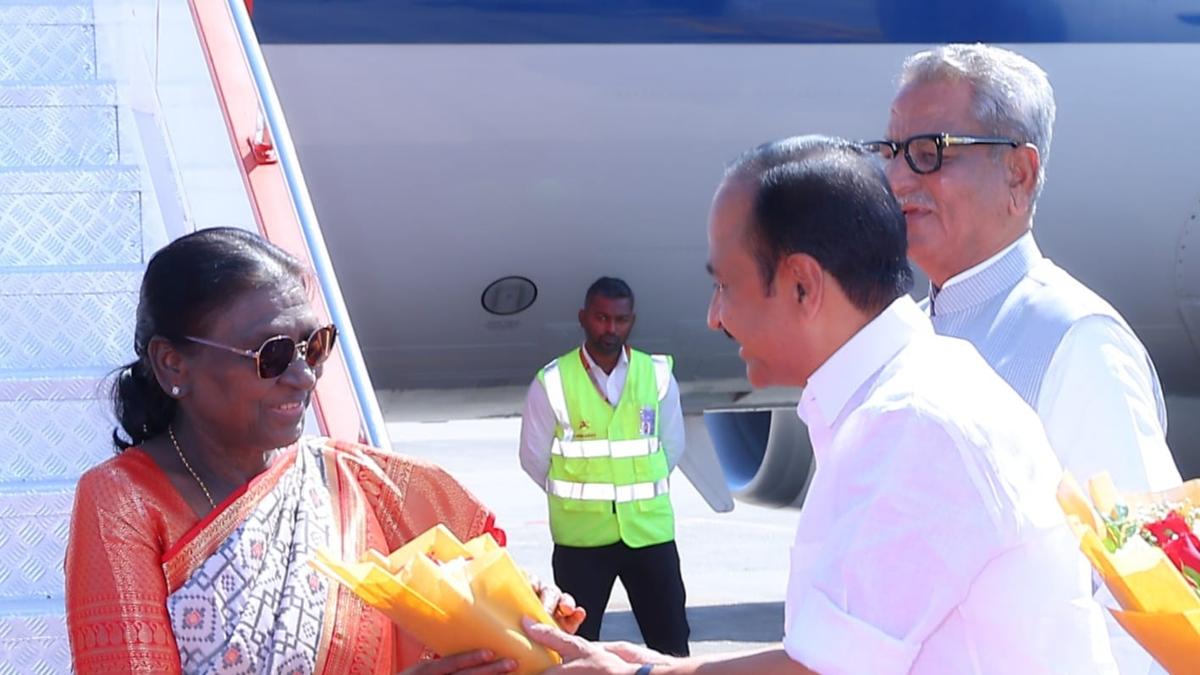
President Droupadi Murmu arrived in Kerala on Wednesday for a comprehensive two-day official visit spanning cultural, educational, and defense engagements across the southern state. Touching down at the Cochin International Airport at Nedumbassery aboard an Indian Air Force aircraft, the President was received with a ceremonial guard of honor and formal state greetings by senior government dignitaries. The visit marks her latest high-profile tour of the region, drawing significant public attention and elaborate administrative preparations across multiple districts.
Following the reception at the airport, President Murmu traveled directly to Kalady, the revered birthplace of eighth-century philosopher and theologian Adi Shankaracharya. At the Sri Sankaracharya Janmabhoomi temple complex, she offered prayers and was welcomed by temple custodians with traditional customary honors. The spiritual stop formed the opening chapter of an itinerary designed to blend historical heritage with contemporary institutional milestones.
From Kalady, the President proceeded to Thrissur district to take part in the valedictory ceremony marking the golden jubilee of the Vaidyaratnam Ayurveda College. Addressing faculty members, students, and practitioners of traditional medicine, she commended Kerala for safeguarding centuries-old healing systems through unbroken lineage and rigorous scholarship. She noted that the state's traditional physicians, historically known as Ashtavaidyas, played a pivotal role in preserving classical Ayurvedic knowledge.
President Murmu highlighted that Kerala’s contribution to Ayurveda uniquely transcended Sanskrit texts, pointing to seminal vernacular treatises composed in Malayalam and Manipravalam such as Chikitsa-Manjari and Sahasra-Yogam. She urged institutions to build on this distinctive literary and clinical legacy by conducting rigorous, evidence-based research into therapies such as Panchakarma. Collaboration between public health bodies and private research centers, she noted, would establish the state as a recognized global authority on standardized holistic care.
The President framed the expansion of traditional medical science within the broader national goal of achieving a developed India by 2047. She noted that high standards of training and research at institutions like Vaidyaratnam are essential to addressing modern preventive and curative healthcare challenges. By integrating ancient wisdom with contemporary scientific evaluation, educational centers can prepare a new generation of healthcare practitioners capable of serving diverse communities worldwide.
Her schedule in Thrissur district also includes offering prayers at the renowned Guruvayur Sree Krishna Temple, one of the country's most frequented pilgrimage destinations. District authorities and temple management committees instituted comprehensive security cordons and crowd management protocols to accommodate the presidential convoy without disrupting regular pilgrim movements. The temple visit reflects a standard protocol of paying respects at prominent socio-cultural institutions during presidential state tours.
On the second day of the itinerary, the President will travel northward to Kannur district to visit the Indian Naval Academy at Ezhimala. Serving as the supreme commander of the armed forces, President Murmu is scheduled to review the prestigious passing-out parade of the graduating midshipmen and cadets. The academy ceremony is one of the military's hallmark events, symbolizing the commissioning of newly trained naval officers into active service.
State and district administrations in Ernakulam, Thrissur, and Kannur coordinated extensively to enforce multi-layered security measures and traffic regulations along all presidential routes. Police contingents conducted rehearsals across transit corridors, while healthcare and emergency services were placed on high alert near every scheduled venue. Local officials reported that logistical plans were executed smoothly to minimize public inconvenience while ensuring maximum safety for the head of state.
The two-day visit concludes following the review of the naval parade in Ezhimala, after which President Murmu will depart Kerala for New Delhi. Observers and community leaders noted that the presidential visit underscores the central government's ongoing engagement with southern states across cultural preservation, educational development, and defense preparedness. Her remarks on standardizing traditional medical practices are expected to inspire new academic initiatives and clinical research collaborations across Kerala’s healthcare sector.
Primary source: Google News Kerala. Newzly rewrites and structures source reporting for clarity; verify critical details at the original.