Punjab Launches Smart Ration Card Scheme for 10 Lakh Beneficiaries
Punjab Chief Minister Bhagwant Mann has launched the Smart Ration Card Scheme in Moga, extending monthly food grains and kitchen grocery kits to 10 lakh newly verified beneficiaries across the state.
In this piece
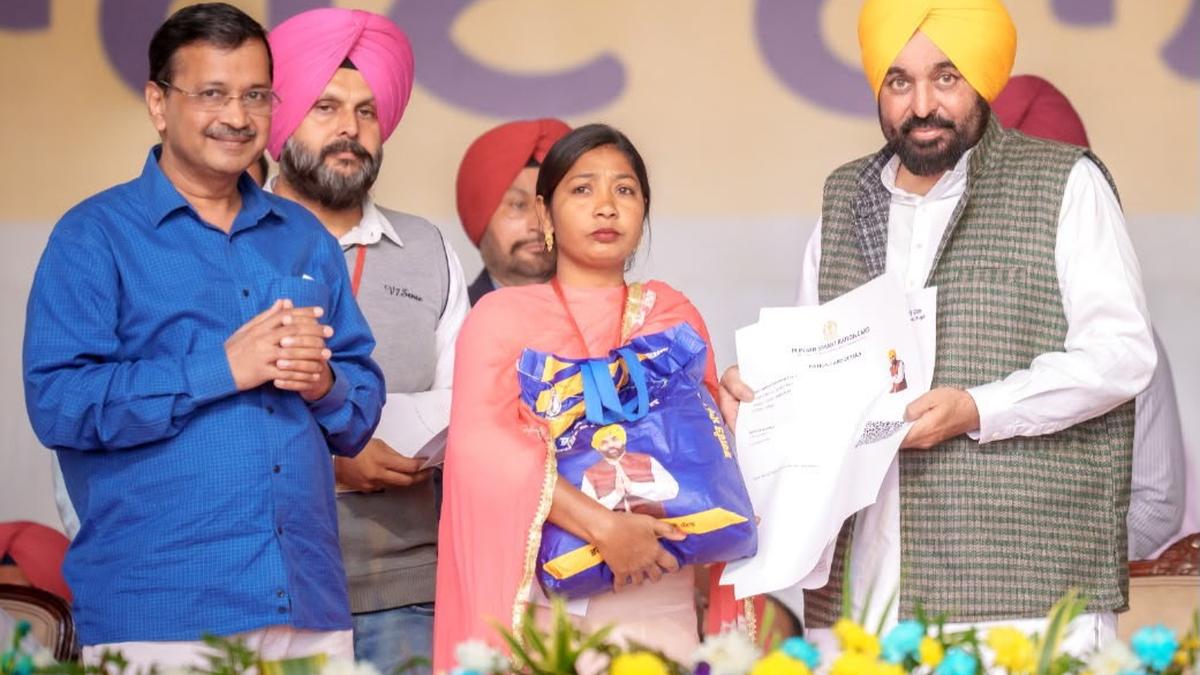
Punjab Chief Minister Bhagwant Mann and AAP convenor Arvind Kejriwal have launched the Smart Ration Card Scheme in Moga to benefit 10 lakh families. The program…
Punjab Chief Minister Bhagwant Mann has officially rolled out the state's Smart Ration Card Scheme during a public ceremony in Moga, extending subsidised and free food-security provisions to 10 lakh additional beneficiaries. Addressing the gathering alongside Aam Aadmi Party national convenor Arvind Kejriwal, the Chief Minister formally handed over the first batch of digitised cards to eligible families. The initiative is aimed at broadening the social safety net across Punjab while transitioning welfare entitlements to an automated digital platform.
Under the newly expanded framework, cardholders are entitled to receive five kilograms of free wheat per family member each month under the National Food Security Act, contingent on the completion of electronic Know Your Customer verification. To mark the inauguration, the administration also distributed supplementary grocery packages designated as Meri Rasoi kits. These specialised household hampers include two kilograms of pulses, two kilograms of sugar, one kilogram of salt, 200 grams of turmeric powder, and one litre of mustard oil.
The government initiated the welfare expansion following an extensive statewide outreach campaign that registered more than 19 lakh online applications from prospective households. To filter the large pool of applicants and identify those most in need, district administrations carried out door-to-door physical verifications. State officials noted that field teams reviewed household income levels and living standards across urban and rural pockets before approving the final list of 10 lakh recipients.
During his address in Moga, Chief Minister Mann emphasised that the recipient roster was determined through an impartial, objective process insulated from external interference. The administration framed the selection under a strict "No Cash, No Farmaish" mandate, signalling that cards were allocated without monetary bribes or political recommendations. Mann underscored that previous welfare distributions had faced criticism over patronage, promising that genuine socioeconomic vulnerability served as the sole qualifying metric.
Public distribution systems represent a critical pillar of social welfare in Punjab, where thousands of low-income families rely on government-backed rations to cushion the impact of retail food inflation. The introduction of smart cards modernises the distribution apparatus by integrating biometric authentication and digitised inventory tracking at fair price shops. Authorities indicated that moving away from manual paper booklets will significantly curtail leakage, phantom beneficiaries, and unauthorized grain diversions.
Aam Aadmi Party convenor Arvind Kejriwal, speaking at the event, highlighted the rollout as part of the ruling dispensation's broader governance agenda focused on accessible public services. Kejriwal stated that public welfare funds are being directly reinvested into basic household necessities rather than lost to administrative intermediaries. Party leadership positioned the targeted food security initiative alongside recent governance interventions in public education and grassroots healthcare clinics across the state.
For eligible families, the combination of essential cooking staples and monthly grain allocations offers immediate financial relief amid fluctuating market prices. The inclusion of edible oil, pulses, and basic condiments through the Meri Rasoi parcels directly addresses recurring kitchen expenses that often disproportionately strain modest household budgets. Community advocates have long argued that diversifying rations beyond staple grains is essential for improving nutritional outcomes among vulnerable populations.
Local food and civil supplies departments are now tasking fair price outlets and administrative blocks with expediting biometric authentication for all newly enrolled cardholders. Officials reiterated that prompt completion of the e-KYC process remains mandatory to ensure seamless monthly grain disbursals and maintain up-to-date registry records. Beneficiaries who face technical discrepancies or authentication hurdles will be assisted by local administrative facilitation camps set up across districts.
State authorities plan to monitor distribution logistics closely over the coming months to assess whether delivery mechanisms function smoothly across both rural villages and urban centres. As the 10 lakh smart ration cards become fully operational, the state government has indicated that feedback from local distribution points will guide potential future expansions of the consumer basket. The administration maintains that transparent public distribution remains central to its commitment to equitable social development in Punjab.
Primary source: Google News Punjab. Newzly rewrites and structures source reporting for clarity; verify critical details at the original.