Quickex Introduces Private Swap to Minimize Direct On-Chain Wallet Linkage
Quickex has launched Private Swap, a feature engineered to break direct on-chain links between sending and receiving wallets while maintaining the platform's standard token conversion workflow.
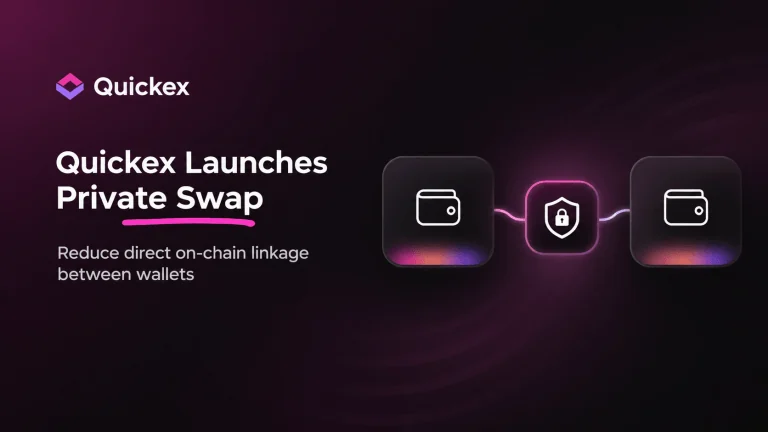
Cryptocurrency swap platform Quickex has introduced Private Swap, a specialized feature designed to limit the direct, publicly visible on-chain connections between sending and receiving digital wallets. Announced from Panama City, the update is aimed at users seeking greater privacy when reallocating digital assets across supported networks.
According to the company, the new feature preserves the foundational user experience of standard Quickex transactions. Participants select their chosen asset pairs and specify swap amounts, allowing the platform to process trades through its established conversion framework while mitigating conspicuous wallet-to-wallet trails.
Founded in 2018, Quickex has provided instant token swapping services for several years, focusing on fast conversions without requiring traditional order-book navigation. The platform has built its presence around streamlined swaps across multiple blockchain ecosystems, catering to traders who prioritize convenience and rapid execution.
The motivation behind the feature stems from the transparent architecture inherent to public blockchain ledgers. Standard transactions record sender and receiver addresses permanently, enabling outside observers, data scrapers, and analytics providers to map out user portfolios and observe payment trajectories in real time.
Such transparency has increasingly created friction for individuals concerned about data privacy and targeted surveillance. When addresses become clustered or tied to off-chain identifiers, holders risk exposing total account values, recurring trading behaviors, and counterparty relationships to the public domain.
While specialized privacy coins and decentralized mixing protocols exist to address these vulnerabilities, they frequently involve steep technical learning curves or liquidity fragmentation. By integrating direct linkage reduction into an ordinary swap interface, Quickex aims to lower the barrier to basic transaction discretion for regular crypto holders.
Initial communications from Quickex did not disclose the precise cryptographic or routing techniques utilized behind Private Swap. Industry analysts typically point out that the resilience of privacy-preserving conversion tools depends on whether transfers are batched, delayed, routed through shared liquidity reserves, or handled off-chain.
The launch also arrives during an era of rigorous regulatory scrutiny surrounding privacy-enhancing financial technologies across international jurisdictions. Platform operators must balance consumer interest in lawful financial confidentiality against evolving compliance demands and anti-money-laundering frameworks that monitor transaction obfuscation.
Market watchers view initiatives like Private Swap as part of an ongoing effort among crypto services to refine digital sovereignty features without alienating everyday users. As blockchain intelligence software becomes more ubiquitous, routine consumer demand for defensive privacy tools is expected to expand across consumer-facing platforms.
Moving forward, adoption of the Private Swap mechanism will likely hinge on transaction costs, liquidity depth, and execution speeds compared to standard swaps. Users and security researchers will also monitor the feature closely to verify how effectively it breaks transactional links across various blockchain explorers.
Primary source: Bitcoin.com News. Newzly rewrites and structures source reporting for clarity; verify critical details at the original.