Russell fastest in wet Las Vegas Grand Prix practice
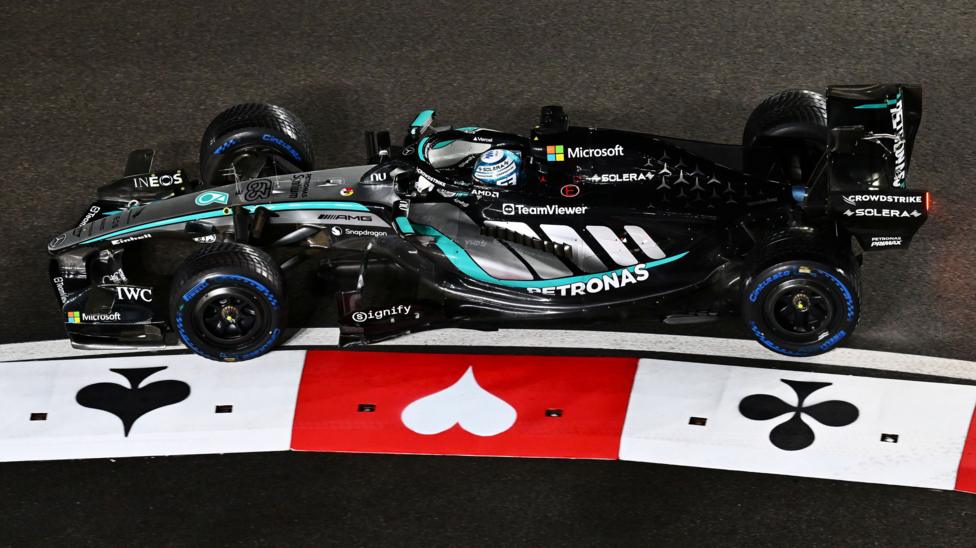
George Russell put Mercedes fastest in second practice at the Las Vegas Grand Prix, BBC Sport reported. The session was held on a wet track that was slowly drying, so the order reflects changing grip.
In this piece
Mercedes driver George Russell topped second practice at the Las Vegas Grand Prix on a wet but slowly drying track, BBC Sport reported. The account does not…
Mercedes driver George Russell was fastest in a second practice session at the Las Vegas Grand Prix, BBC Sport reported. The session ran on a wet track that was slowly drying. The conditions, rather than a published set of lap times, are the main detail attached to his place at the top.
The account names Russell and his Mercedes team and identifies the running as the weekend's second practice. It does not give his lap time, the gap to the next car, or a full classification. Those figures are not available in the material used for this report, so the result is stated only as a session lead.
Practice is the part of a Formula 1 weekend when teams gather information before qualifying and the race. Drivers complete installation laps, single-lap runs, and longer stints while engineers watch balance, tire behavior, and cooling. A time at the top of the sheet is a reference point, not a grid position.
Rain changes that work. On a wet but drying surface, grip is uneven from one corner to the next and can improve within a few minutes. A driver who finds a clearer line late in a run may set a time that earlier laps on a wetter track cannot match. Teams usually treat that order as provisional until the circuit offers more consistent conditions.
Las Vegas stages a round of the Formula 1 world championship on a temporary street circuit. Public roads used for racing tend to hold less rubber than permanent tracks, and rain can make them slower and less predictable. BBC Sport's report frames this session around that wet, slowly drying surface.
For Mercedes, Russell's fastest time is an early signal that the car could be put on the pace in mixed weather. It does not, on its own, show how the team will compare once every car has a dry track and a similar tire choice. Practice leaders have often been reshuffled later in a weekend when the surface changes.
The source is silent on which tire compounds were used, how many laps drivers completed, and whether any stoppages broke up the session. It also does not say whether the rain eased enough for a dry line to appear before the session ended. Any description beyond a wet, slowly drying track would go past what has been reported.
That limit matters for readers comparing form. A narrow or a large advantage would tell different stories about Mercedes' single-lap speed, but neither margin is stated. Other drivers may have been close, or they may have sat well behind; this account does not say which. The confirmed fact is Russell's position at the head of the times.
Formula 1 cars lose grip quickly when water sits on the surface, and they regain it unevenly as the racing line dries. Drivers manage that change by choosing when to push and when to abandon a lap. Engineers then decide whether a setup that felt stable in the wet will still work when the track is dry. Russell's session gives Mercedes one data point from the wetter end of that range.
The Las Vegas event draws attention because the circuit runs through a dense urban setting and because small changes in track condition can swing confidence before qualifying. A second practice topped in the wet tells the paddock who was quickest in that window. It leaves open how the order will look when the asphalt is drier and the running is more comparable.
Further sessions will test whether the picture holds. If the track continues to dry, teams will look for cleaner single-lap comparisons and for signs of race pace over longer runs. Until that running is complete, Russell's lead in a wet, slowly drying second practice is the firm result on offer, with the rest of the competitive order still to be established.
Primary source: BBC Sport. Newzly rewrites and structures source reporting for clarity; verify critical details at the original.