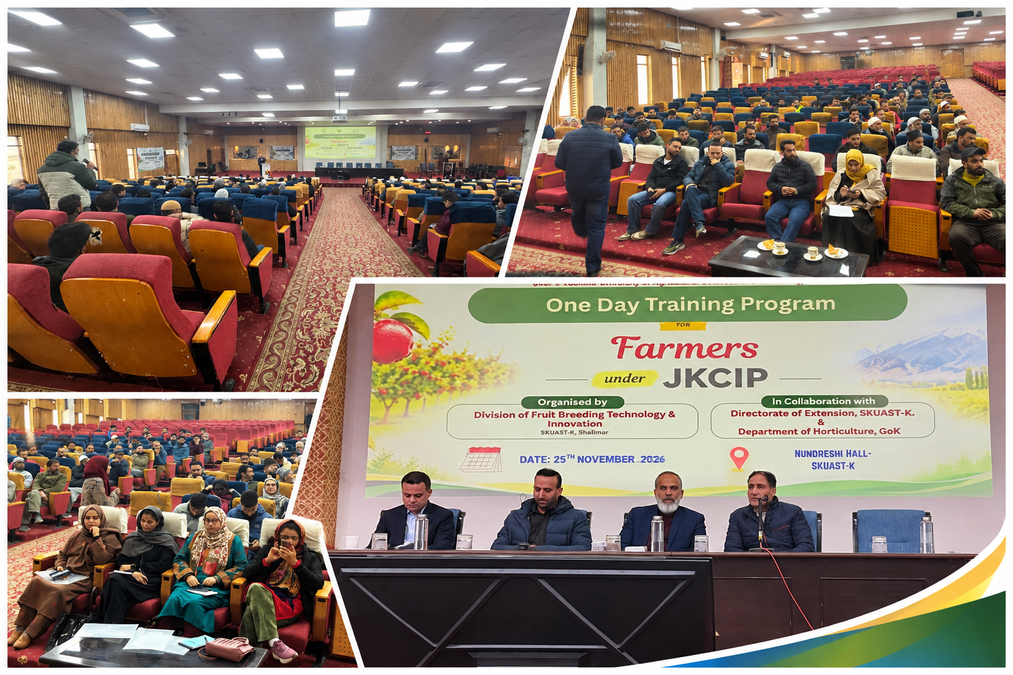
SKUAST-K trains 300 farmers from 10 districts under JKCIP
SKUAST-K has trained 300 farmers from 10 districts under JKCIP, Rising Kashmir reported. The available report summary gives the participation figures but does not detail the training subjects, schedule or outcomes.
In this piece
SKUAST-K trained 300 farmers drawn from 10 districts under JKCIP, according to Rising Kashmir. The available source material establishes the programme’s…
SKUAST-K has trained 300 farmers from 10 districts under JKCIP, according to a report by Rising Kashmir. The reported participation brings together farmers from multiple districts, although the available source material does not identify those districts or describe how participants were selected.
The training is the central development identified in the report’s headline. The supplied news listing repeats that headline without providing the underlying article text, leaving the timing, venue and duration of the programme unspecified. It also does not establish whether the farmers attended together or in separate groups.
The reported figures describe participation rather than the results of the instruction. They establish that 300 farmers received training, according to the publication, but do not show whether participants subsequently adopted particular practices. No assessment of learning, follow-up survey or farm-level outcome is included in the available material.
Farmer training can provide a setting for explaining agricultural methods and discussing practical questions about their use. Its relevance to individual participants, however, depends on the subjects covered and the conditions in which they farm. The supplied summary does not identify the crops, activities or production challenges addressed during this programme.
The involvement of farmers from 10 districts gives the initiative a multi-district scope, rather than indicating participation from a single locality. That distinction is important when describing its reach, but the total alone does not establish how widely places were distributed. No district-by-district breakdown accompanies the reported figure of 300 participants.
JKCIP is identified as the programme under which the training took place. The available source does not expand the acronym or set out the project’s objectives, funding arrangements or implementation timetable. It therefore does not support more specific conclusions about how this training fits into a broader programme of agricultural support.
For farmers, the practical significance of such instruction would depend on whether it addresses their needs and can be applied with the resources available to them. Those considerations are distinct from attendance numbers and cannot be assessed from the headline alone. The report summary provides no participant accounts or details of any continuing advisory support.
Further information from SKUAST-K or the full Rising Kashmir report would be needed to establish the curriculum, participating districts and arrangements after the training. For now, the source-supported development is that 300 farmers from 10 districts were trained under JKCIP. Whether additional sessions or an evaluation will follow is not specified in the supplied material.
Primary source: Google News Jammu and Kashmir. Newzly rewrites and structures source reporting for clarity; verify critical details at the original.