Spacecraft Closes In on Mercury After Epic Eight-Year Voyage
After an eight-year journey through the inner solar system, a joint European-Japanese spacecraft is preparing to enter orbit around Mercury to deliver humanity's closest look yet at the sun-scorched planet.
In this piece
A joint European and Japanese spacecraft is nearing Mercury after an arduous eight-year journey across the inner solar system. The BepiColombo mission aims to…
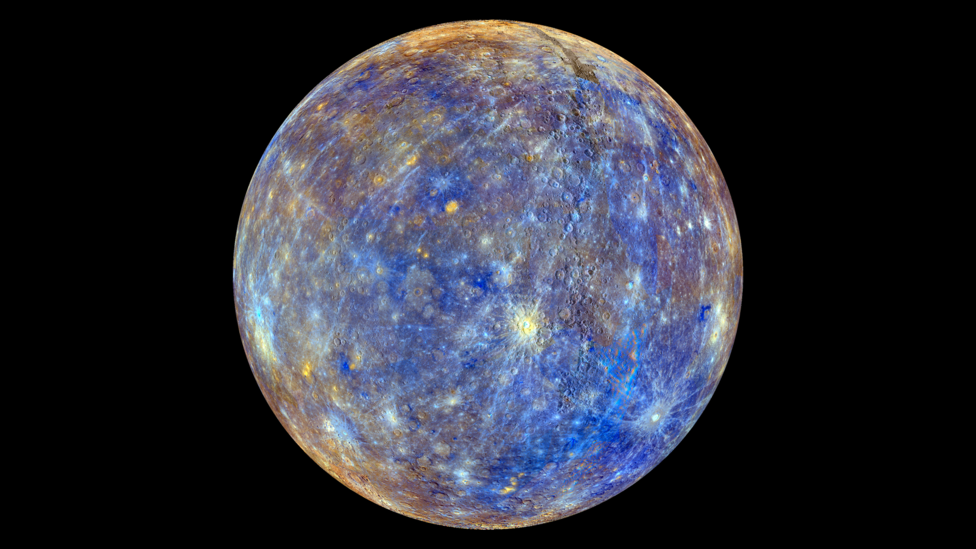
An international space mission is closing in on Mercury following an arduous eight-year voyage across the inner solar system, positioning scientists to capture their clearest view yet of the planet closest to the Sun. The joint European and Japanese endeavor, known as BepiColombo, is approaching the culmination of a cruise designed to deliver two advanced scientific orbiters to the scorched celestial body.
The ambitious project, managed collaboratively by the European Space Agency and the Japan Aerospace Exploration Agency, consists of two distinct orbiters traveling together aboard a carrier module. Europe's Mercury Planetary Orbiter will focus on mapping the planet's rugged surface and internal composition, while Japan's Mercury Magnetospheric Orbiter, nicknamed Mio, is dedicated to analyzing the surrounding magnetic field and fragile exosphere.
Reaching Mercury represents one of the most formidable navigational challenges in deep-space exploration because of the Sun's immense gravitational pull. Any spacecraft venturing toward the center of the solar system gains enormous speed, requiring delicate maneuvers and vast amounts of energy to decelerate enough to avoid plunging toward the star.
To manage that gravitational descent without exhausting its propellant, BepiColombo embarked on a convoluted trajectory following its launch in late 2018. Over the course of nearly eight years, the probe executed a sequence of planetary gravity assists, swinging past Earth, Venus, and Mercury multiple times to gradually brake and shape its trajectory.
Despite being relatively close to Earth compared to the outer planets, Mercury remains one of the least explored rocky worlds in the solar system. Previous visits by NASA's Mariner 10 in the 1970s and the MESSENGER orbital mission in the 2010s solved some foundational puzzles, but they also uncovered unexpected mysteries that have baffled planetary scientists for decades.
Among the most perplexing aspects of Mercury is its oversized metallic core, which accounts for an unusually high proportion of the planet's total volume. Researchers also seek to understand how such a small, slowly rotating world manages to sustain an active global magnetic field, a rare trait among the terrestrial planets that defies conventional dynamo models.
Mercury also endures some of the most violent temperature swings in the solar system, with daytime surface temperatures soaring high enough to melt lead while nighttime temperatures plunge into deep freeze. Scientists are particularly eager to investigate permanently shadowed craters near the poles, where previous observations detected tantalizing evidence of preserved water ice deposits.
Unraveling Mercury's complex composition and thermal history is critical for broader models of how terrestrial planets formed during the chaotic infancy of the solar system. By examining the planet's extreme density and volatile elements, astronomers hope to gain insights that apply not only to our neighboring worlds, but also to rocky exoplanets discovered orbiting close to distant stars.
As the spacecraft approaches its final orbital insertion phase, flight controllers will separate the component modules and maneuver the two science craft into their respective operational orbits. Once deployed, the tandem probes will initiate coordinated observation campaigns, providing complementary data streams that researchers anticipate will transform our understanding of the solar system's innermost world.
Primary source: BBC Science. Newzly rewrites and structures source reporting for clarity; verify critical details at the original.