Supreme Court Collegium recommends Justice Vivek Singh Thakur as Tripura High Court chief justice
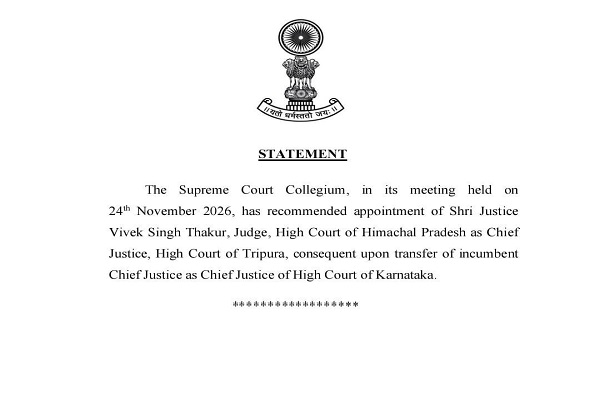
The Supreme Court Collegium has recommended Justice Vivek Singh Thakur as the next chief justice of the Tripura High Court, Tripuratimes reports. The feed item does not include a resolution or an appointment date.
In this piece
Tripuratimes reports that the Supreme Court Collegium has recommended Justice Vivek Singh Thakur to head the Tripura High Court. The circulated item gives the…
The Supreme Court Collegium has recommended Justice Vivek Singh Thakur to be the next Chief Justice of the Tripura High Court, according to a report published by Tripuratimes and circulated through Google News.
The news item, headlined as a collegium recommendation for the Tripura High Court, identifies Justice Thakur by name and describes the proposed post as chief justice. The feed summary does not reproduce a collegium resolution, a government order, or any comment from the judge, the court, or the Union law ministry.
In India’s higher judiciary, the Supreme Court Collegium recommends appointments of high court chief justices. The collegium is led by the Chief Justice of India and includes senior judges of the Supreme Court. A recommendation records the collegium’s choice; the formal appointment follows a separate constitutional step.
That later step ordinarily involves consideration by the executive and a warrant of appointment issued in the name of the President. Until such a notification is published, a collegium recommendation remains a proposal rather than a completed change in the leadership of the court. The Tripuratimes item, as it appears in the news feed, does not say whether that later stage has begun.
The Tripura High Court is the high court for the state of Tripura. Its chief justice presides over the court and is responsible, with colleague judges, for judicial work and court administration in the state. A change in that office is therefore an institutional event for litigants, lawyers, and the state government that appears before the court.
The publicly circulated report does not state Justice Thakur’s present high court, the date of the recommendation, or whether the proposal is a transfer from another court or an elevation from the Tripura bench. It also does not name the judge he would succeed or give a date for assuming charge. Those particulars are absent from the source material available here and should not be inferred.
Recommendations of this kind sit within the memorandum of procedure that governs appointments to the higher judiciary after the Supreme Court affirmed the collegium system. The process is meant to separate the judiciary’s assessment of suitability from the formal act of appointment. Public debate in India has long focused on how much of a collegium’s reasoning is placed on record; this news item does not describe whether any resolution text has been released in Justice Thakur’s case.
For the Tripura High Court, the identity of the chief justice can shape listing priorities, the composition of benches, and the pace of administrative decisions, even though individual cases continue to be decided by the judges who hear them. The report does not attribute any policy agenda or pending matter to the recommendation.
What happens next depends on the ordinary appointment sequence. If the recommendation is processed, an official notification would be required before Justice Thakur could take office as chief justice. The Tripuratimes account, as summarized in the feed, does not report acceptance by the government, a swearing-in date, or any objection to the name.
Until a notification or a fuller court communication appears, the development is best understood as a reported recommendation by the Supreme Court Collegium. Further confirmation would be expected from the Supreme Court, the Union government, or the Tripura High Court rather than from the headline alone.
Primary source: Google News Tripura. Newzly rewrites and structures source reporting for clarity; verify critical details at the original.