Treasury Bitcoin Buy Quote Hits 21% on Kalshi, With Thin Backing
A reported 21% asking price on a Kalshi bitcoin contract drew attention, but limited money behind the quote weakens its value as a signal of expectations for Treasury purchases.
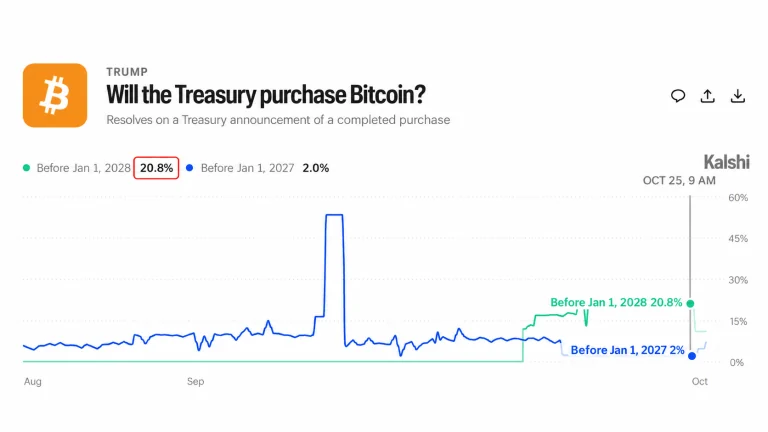
An asking price on a Kalshi contract tied to a U.S. Treasury bitcoin purchase before 2028 reached 21%, according to Bitcoin.com News. The report said only a small amount of money backed the figure, limiting how confidently it could be read as a broader market forecast.
The distinction between an asking price and an executed trade is central to the story. An ask indicates the price at which a seller is offering a contract, not necessarily a price buyers have accepted or one supported by substantial trading.
Prediction-market prices are often presented as implied probabilities, but that shorthand needs qualification when participation is thin. A lightly backed offer provides less evidence of collective expectations than a price repeatedly tested by buyers and sellers committing meaningful amounts of money.
The supplied report excerpt did not disclose an exact trading volume, the amount available at the quoted price or a complete set of settlement rules. It also described the deadline as both before 2028 and next year, making the absolute deadline the clearer reference without a verified publication date.
Those missing details matter because a contract concerns a defined event rather than the general direction of government cryptocurrency policy. Its precise wording determines what action would qualify, which institution must take it and what evidence would establish the outcome. The excerpt itself cautioned that the fine print was narrower than the headline description.
The policy background provides another important distinction: retaining bitcoin the government already owns is different from buying additional coins. President Donald Trump’s March 6, 2025, executive order established a Strategic Bitcoin Reserve initially capitalized with qualifying bitcoin already held by the Treasury through forfeiture proceedings.
The order also directed the Treasury and Commerce secretaries to develop strategies for acquiring additional bitcoin, provided those strategies were budget neutral and imposed no incremental costs on taxpayers. That directive established a framework for exploring acquisitions; it was not itself an announcement that a purchase had been completed.
Consequently, news about reserve administration or the movement of existing government holdings should not automatically be treated as evidence of fresh buying. Whether any particular development would settle the reported contract would depend on its full rules, which could not be independently verified from the supplied excerpt.
Kalshi’s own explanation of market participants adds context to interpreting quoted prices. The exchange says market makers provide liquidity and can earn the difference between buying and selling prices without necessarily holding a directional view. An available quote therefore need not represent a strong conviction about the underlying policy outcome.
The next meaningful evidence would be clearer contract documentation, sustained trading behind the quoted level and an official Treasury announcement of any qualifying purchase. Until then, the reported 21% ask is best understood as a lightly supported market offer, not confirmation of government buying or a firmly established consensus forecast.
Primary source: Bitcoin.com News. Newzly rewrites and structures source reporting for clarity; verify critical details at the original.