UMass Faculty and Staff Unions Rally at Massachusetts State House Demanding 'Fair Wages Now!'
Hundreds of UMass faculty and staff rallied at the Massachusetts State House under the 'Fair Wages Now!' banner, demanding a 30 percent pay increase over three years to combat regional living costs.
In this piece
Faculty and staff unions from the University of Massachusetts gathered at the State House in Boston to demand a 30 percent wage increase over three years…
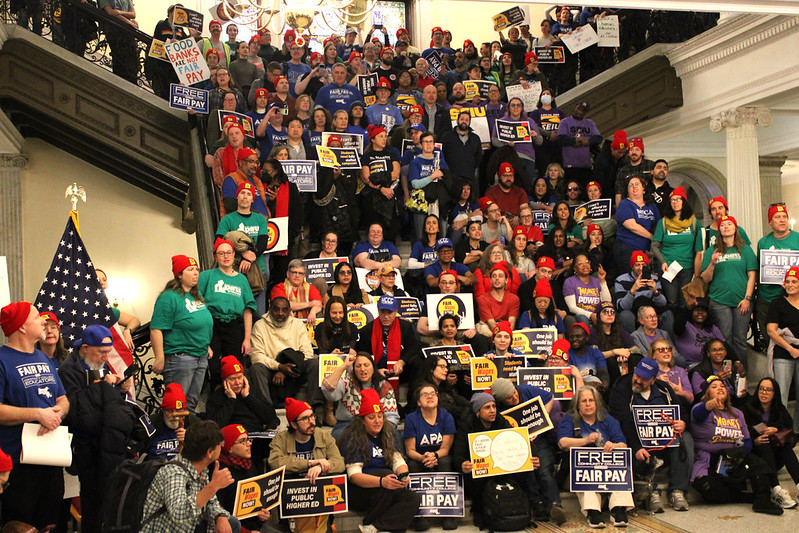
Hundreds of University of Massachusetts faculty and staff members converged on the Massachusetts State House in Boston to demand substantial pay increases under the banner of the 'Fair Wages Now!' campaign. The demonstration brought higher education workers face-to-face with state lawmakers, urging legislative leadership to confront an escalating affordability crisis across public campuses.
Organized in partnership with the Massachusetts Teachers Association, the coalition brought together members from major campus bargaining units, including the Massachusetts Society of Professors, the UMass Professional Staff Union, and the University Staff Association. Approximately 200 workers boarded chartered buses from the UMass Amherst campus alone to join colleagues from across the state on Beacon Hill. Demonstrators filled the State House corridors and gathered on the grand staircase to make their voices heard.
At the core of the union campaign is a demand for a 30 percent wage increase distributed over three years. Under the coalition's proposal, workers would receive cost-of-living adjustments structured as 5 percent increases every six months. Union representatives argue that this adjustment is necessary to restore lost purchasing power and bring compensation in line with peer public institutions.
Union members cited severe economic strain caused by Massachusetts' steep cost of living, with housing, food, and childcare expenses outpacing wage growth. Speakers noted that low compensation has forced many staff members to take on secondary employment or seek community assistance simply to afford living in the communities they serve. Organizers stressed that financial instability directly impacts worker retention and the overall quality of campus life.
The demonstration extended beyond the interior of the State House, where mobile billboard trucks circled nearby streets carrying messages such as 'One job should be enough' and 'I can't afford to live where I work.' Inside, chants and testimonies echoed through legislative hallways as employees shared personal accounts of enduring long commutes and mounting household debt. The visual and vocal presence was intended to ensure lawmakers could not overlook campus labor concerns during ongoing budget discussions.
Advocates argued that the Commonwealth has the financial capacity to invest more deeply in its public higher education workforce. Union officials highlighted recent revenue gains, including funds generated by the state's Fair Share Amendment, alongside existing state reserves, as justifiable funding sources for salary enhancements. They contended that public universities should not balance operational budgets by allowing employee compensation to erode against inflation.
The economic pressure on staff also reflects broader operational challenges across the University of Massachusetts system. Departmental vacancies and high employee turnover have placed an increasing burden on remaining staff, straining essential student support services and academic programs. Campus union leaders warned that failing to offer competitive pay will deepen recruitment challenges and weaken the public university system's standing.
Campus administrators and state officials face a challenging fiscal landscape, with contract negotiations taking place alongside statewide debates over education funding priorities. While university leadership has acknowledged the rising cost of living facing personnel, balancing compensation demands with tuition predictability and state appropriations remains a contentious legislative debate.
Union organizers stated that the State House rally marks an intensification of their collective bargaining efforts rather than an isolated action. Coalition leaders plan to hold additional campus demonstrations and coordinate with student groups as contract talks advance. Workers signaled they intend to keep pressure on both university leadership and Beacon Hill lawmakers until substantial wage commitments are secured in final contract agreements.
Primary source: Google News Massachusetts. Newzly rewrites and structures source reporting for clarity; verify critical details at the original.