Unkernel Compiles Real Linux Kernel to WebAssembly for Browser-Based Computing
An open-source systems project called Unkernel has compiled a full Linux kernel directly into WebAssembly, enabling unmodified ARM binaries to boot within browser environments in under a second.
In this piece
The open-source project Unkernel has introduced a new architecture that compiles the Linux kernel directly into a WebAssembly module. By embedding an internal…
A new open-source systems initiative dubbed Unkernel has introduced a novel method for running Linux inside web browsers by compiling the core operating system kernel directly into WebAssembly. Rather than emulating an entire PC hardware architecture from scratch, the project translates core kernel subsystems into a standalone WebAssembly module. The resulting architecture allows unmodified software packages to execute in browser tabs with near-native performance.
Traditional efforts to bring Linux to web environments have typically relied on heavy hardware emulators such as QEMU running inside a browser sandbox. While these implementations successfully simulate full CPU architectures, peripherals, and memory management units, they often suffer from sluggish boot sequences and high memory overhead. Unkernel addresses these historical bottlenecks by splitting kernel execution from user-space execution.
At the foundation of the project is a modern Linux kernel compiled into WebAssembly, keeping essential subsystems like system call handling, scheduling, the ext4 file system, and TCP/IP networking running at native WebAssembly execution speeds. Instead of running these kernel operations through an emulated instruction layer, the WebAssembly module manages them directly. This design dramatically minimizes the translation tax that usually slows down virtualized environments on the web.
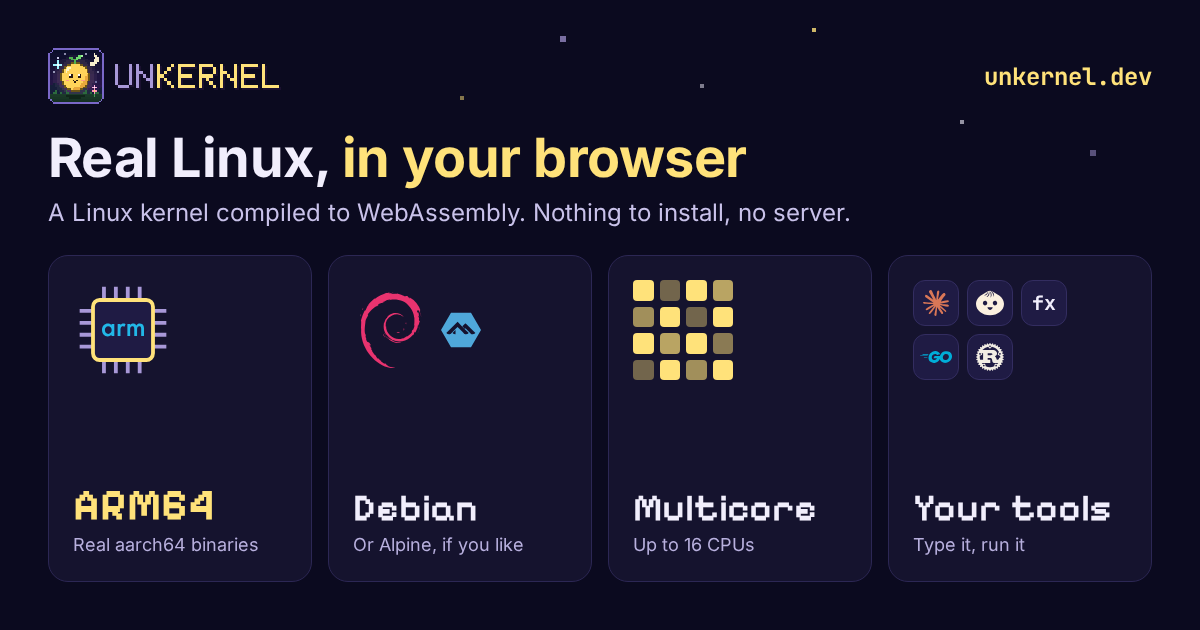
To run regular Linux software without requiring developers to recompile every utility into WebAssembly, Unkernel embeds an internal 64-bit ARM CPU emulator known as kwemu. Written in the Zig programming language, kwemu sits directly inside the kernel structure. This setup allows standard, precompiled Debian and Alpine packages built for aarch64 architectures to run without modification.
A central technical achievement of the project is its implementation of a functional memory management unit. Unkernel provides real page tables, making fundamental Unix facilities such as fork, mmap, copy-on-write, multi-threading, and POSIX signals function as expected. Consequently, complex developer toolchains and multi-process server applications can execute inside the environment without custom architectural patches.
Early benchmarks and community demonstrations highlight substantial performance advantages over conventional web-based virtual machines. Operating system instances powered by Unkernel can boot to an interactive shell in less than a second. Because process creation, page fault handling, and syscall routing run through compiled WebAssembly code, everyday command-line tasks execute with noticeable responsiveness.
The underlying runtime has already fueled several practical demonstrations within the open-source ecosystem. A companion demo named Trynix leverages the engine to run Nix packages and graphical Linux desktop environments, complete with Wayland compositing, WebGL2-backed graphics, and browser-routed audio. Another related utility, tabc, serves as an OCI-compliant container runtime that runs Docker containers directly in browser sessions or across host operating systems without requiring hypervisor setups.
To facilitate integration into existing web stacks, Unkernel also includes a dedicated JavaScript software development kit. Web developers can programmatically mount storage volumes, spawn and supervise running processes, and redirect network traffic directly through browser APIs. This tooling enables browser-based code editors, testing suites, and interactive educational environments to supply authentic Linux environments on demand.
Despite its early momentum, operating systems compiled to WebAssembly continue to face inherent sandboxing limitations and evolving web platform standards. Browser memory ceilings, threading constraints, and browser-enforced security boundaries present ongoing engineering challenges for high-throughput enterprise workloads. System architects also continue to evaluate the balance between emulation overhead and binary compatibility for specialized architectures.
As developer interest in edge computing and browser-based virtualization grows, Unkernel points toward a future where client-side operating systems require neither heavy cloud virtual machines nor complex local hypervisors. Community contributors and systems engineers are monitoring the repository to see how the architecture scales toward broader hardware support and richer container ecosystems.
Primary source: Hacker News. Newzly rewrites and structures source reporting for clarity; verify critical details at the original.