US Commits $5 Million to Pacific Crypto Crime Investigations
The PACIFIC initiative will train financial intelligence and cybercrime units in cryptocurrency tracing, digital forensics and ownership investigations as part of a broader US effort against transnational criminal networks.
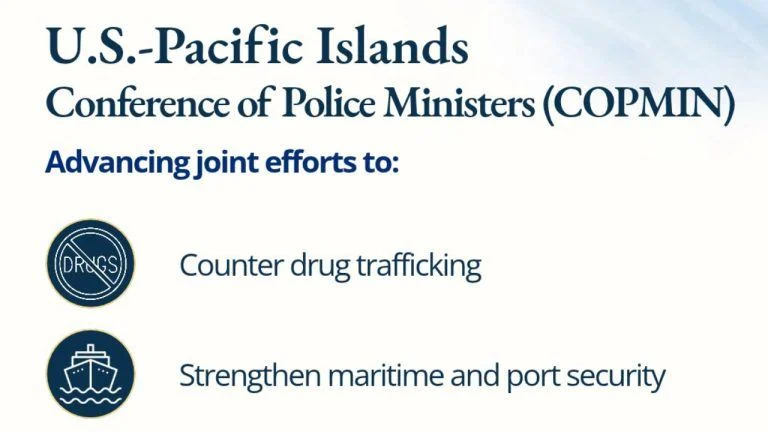
The Trump administration has announced $5 million to strengthen financial intelligence and cybercrime units in the Pacific Islands, including training in cryptocurrency investigations. The initiative, known as PACIFIC, targets illicit financial activity as part of a broader regional campaign against transnational criminal networks.
The funding was outlined in an October 22 State Department fact sheet following the inaugural U.S.-Pacific Islands Conference of Police Ministers in Los Angeles. The October 21–22 meeting brought together Pacific officials and international partners to coordinate responses to trafficking, money laundering and other cross-border crimes.
PACIFIC stands for the Pacific Alliance for Combating Illicit Finance and Cybercrime. Under the program, US federal agencies will train officers in cryptocurrency tracing, beneficial-ownership investigations and digital forensics, according to the department’s announcement.
The initiative also includes assistance to update anti-money laundering and cybercrime laws. The department said that work would follow Financial Action Task Force and Budapest Convention standards, pairing investigative training with support for the legal frameworks governing financial crime and electronic evidence.
The $5 million allocation is one component of more than $44 million in new programming announced at the conference. The wider package combines financial investigations with maritime enforcement, border security, police training and information sharing, rather than treating cryptocurrency crime as a separate security problem.
The State Department framed the package around its assessment that criminal networks operating across the Pacific rely on interconnected trafficking and money-laundering operations. Its stated approach is to disrupt multiple parts of those networks, including the movement of goods and the financial activity supporting them.
For PACIFIC, the significance lies in combining different investigative disciplines. Cryptocurrency tracing examines digital transactions, while beneficial-ownership investigations focus on who ultimately controls relevant entities or assets; digital forensics can support the examination of electronic evidence. The announcement places all three within the same capacity-building effort.
The department also presented the program as a way to protect the legitimate digital economy supported by US cloud and telecommunications initiatives in the region. That framing distinguishes the effort from a general restriction on digital assets: its stated focus is criminal misuse and the ability of local authorities to investigate it.
The announcement describes funding and planned assistance, not completed enforcement results. It does not identify a specific PACIFIC cryptocurrency case, report assets recovered through the initiative or provide a country-by-country training schedule. Those omissions leave the timing and practical reach of the program to be clarified during implementation.
Conference participants committed to strengthen their ability to investigate scam operations, cryptocurrency laundering and corruption alongside maritime and border threats. The State Department said the United States would support Pacific partners into 2027 and beyond, with delivery of the announced training and legal assistance the next steps for PACIFIC.
Primary source: Bitcoin.com News. Newzly rewrites and structures source reporting for clarity; verify critical details at the original.